Showing posts sorted by date for query bryson. Sort by relevance Show all posts

Thursday, June 30, 2022

Summer Books: The List

Designed for kids,
including several read - alouds,
but also fun for grown ups!

"The summer grew prettier and prettier,
a long series of calm blue summer days
."

from The Summer Book
by Tove Jansson (1914 - 2001)
Before reading all of the other books on your challenge list, I recommend starting with this summer story of a small family on a small island in Finland. Every page is filled with images of immersive midsummer light, capturing "the allure of summer itself for these people who spend so much of the year in the dark."

READ [present tense verb]:

1. by flashlight
[or nightlight]
The Anthropocene Reviewed by John Green

Somehow instead of the "Signed Edition" I ended up with the "Large Print Edition." But that's okay. That nice big font actually comes in handy when reading by nightlight -- a lifesaver when your hotel room is without a reading alcove and your traveling companion falls asleep before you.

So, as it turns out, I have already fulfilled my flashlight requirement by staying up super - late reading the first few chapters of this book by the glow of a tiny nightlight! [I'm all for tweaking the stipulations a little bit if need be!]

p 142: "Do I believe in God? I believe around God. But I can only believe in what I am in -- sunlight and shadow, oxygen and carbon dioxide, solar systems and galaxies." Hey -- that's what I said: The Miracle of Oxygen & The Precession of the Equinoxes!

p 248: "Tradition is a way of being with people, not just the people you're observing the traditions with now, but also all those who've ever observed them."

2. in a funny accent [audio ~ Cornish]
The Birds by Daphne du Maurier

3. a comic book ~ [Click for more]
Tom's Midnight Garden:
A Graphic Adaptation of the Philippa Pearce Classic

4. as a family
Family favorite author Bill Bryson's uber - informative The Body: A Guide for Occupants. We read it sequentially (first Gerry, then me). I think that counts for "as a family." Book after book, year after year, Bryson never fails!

The Body:
p 4 - 6: “That is unquestionably the most astounding thing about us – that we are just a collection of inert components, the same stuff you would find in a pile of dirt. I’ve said it before in another book, but I believe it’s worth repeating: the only thing special about the elements that make you is that they make you. That is the miracle of life. . . . Altogether it takes 7 billion billion billion (that’s 7,000,000,000,000,000,000,000,000,000, or 7 octillion) atoms to make you. No one can say why those 7 billion billion billion have such an urgent desire to be you. They are mindless particles, after all, without a single thought or notion between them. Yet somehow for the length of your existence, they will build and maintain all the countless systems and structures necessary to keep you humming, to make you you, to give you form and shape and let you enjoy the rare and supremely agreeable condition known as life. . . . But your atoms are just building blocks, and are not themselves alive. Where life begins, precisely is not easy to say. The basic unit of life is a cell -- everyone is agreed on that. The cell is full of busy things --ribosomes and proteins, DNA, RNA, mitochondria and much other cellular arcana, but none of those are themselves alive. The cell itself is just a compartment – a kind of little room: a cell -- to contain them, and of itself is as nonliving as any other room. Yet somehow when all of these things are brought together, you have life. That is the part that eludes science. I kind of hope it always will.”

The Brain:
p 48 - 49: “The great paradox of the brain is that everything you know about the world is provided to you by an organ that has itself never seen that world. The brain exists in silence and darkness, like a dungeoned prisoner. It has no pain receptors, literally no feelings. It has never felt warm sunshine or a soft breeze. To your brain, the world is just a stream of electrical pulses, like taps of Morse code. And out of this bare and neutral information it creates for you—quite literally creates—a vibrant, three-dimensional, sensually engaging universe. Your brain is you. Everything else is just plumbing and scaffolding.”

p 50: " . . . to quote the neuroscientist David Eagleman . . . [there are] as many connections ‘in a single cubic centimetre of brain tissue as there are stars in the Milky Way.’"

For more on these neural connections & pathways,
see my previous post: Twister!

Thus the persistent & perpetual
importance of CONNECTION!

5. about your country

6. under a tree

7. about friendship

8. about space

9. in a blanket fort

10. to a pet

11. a book with a color in the title

12. a book with chapters

13. at breakfast

14. about a city far away


15. a book of poems
The Poetry of Impermanence, Mindfulness, and Joy
Edited by John Brehm

Days
What are days for?
Days are where we live.
They come, they wake us
Time and time over.
They are to be happy in:
Where can we live but days?

Ah, solving that question
Brings the priest and the doctor
In their long coats
Running over the fields.


by Philip Larkin (1922 - 1985)

Nothing Gold Can Stay
Nature's first green is gold,
Her hardest hue to hold.
Her early leaf's a flower;
But only so an hour.
Then leaf subsides to leaf.
So Eden sank to grief,
So dawn goes down to day.
Nothing gold can stay.


by Robert Frost (1874 - 1963)

16. about your favorite [or other] animal
The Little Gentleman by Philippa Pearce

[For more on 16 & 17, see
"Summer Books: The Beach"]

17. a mystery
The Nine Tailors by Dorothy L. Sayers
some background reading & a mini-series

18. a funny book
~ [Click for more]
The entire Strange Planet series by Nathan Pyle!

19. to a sibling:
Take a look at Ellie Reading to Aidan: "Such Goings- On"!
Ready, set, go! I will be back to fill
in each line as the summer progresses!
I hope to incorporate into the challenge
a number of books that I have been meaning
to read for months. Now is my chance!

P.S.
I am NOT a fast reader.

P.P.S.
Thanks to my friend
Cathy McKinnis for this delightful idea!

Friday, July 31, 2020

CATCHING UP ON ATKINSON

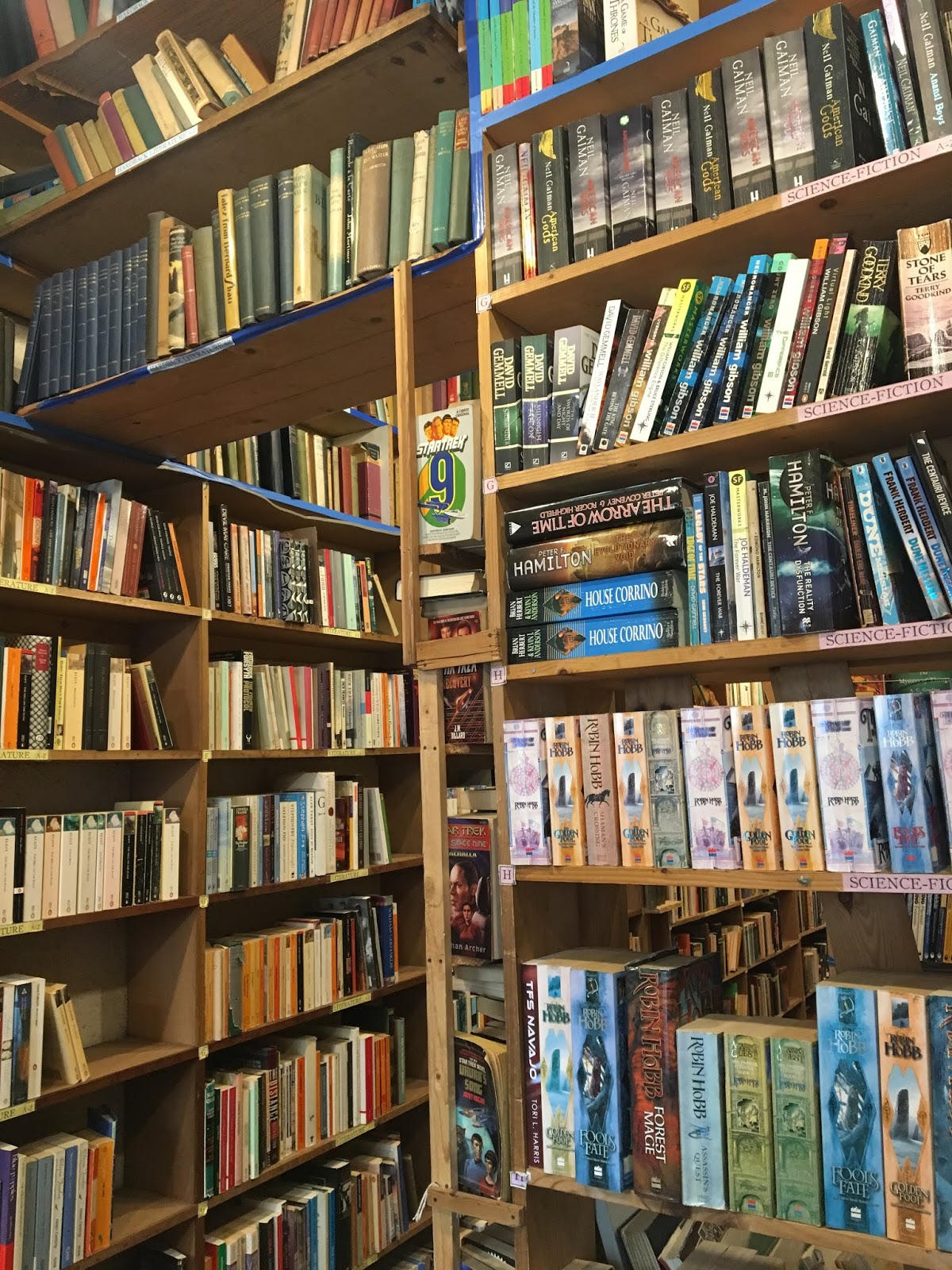
Charming, mysterious, irregular bookstore,
along the tourist path in Edinburgh; perfect for
browsing at leisure through the Kate Atkinson titles!
Armchair Books right next door to the
Afrin Barber, where Gerry got a shave

Scholarly, spell - binding, prize - winning,
can you ask for more than that?
The family sagas are filled with mystery,
the mysteries are filled with family drama.
Atkinson novels read to date:

~ 1995 ~ & ~ 1997 ~

In One Volume

Behind the Scenes at the Museum is a multi - generational novel, ranging from pre - WW I to the present, about all the women in a typical British family, containing lots of coincidences (in manner of Charles Dickens), centering around Bunty, who lost 2 of her 4 daughters in tragic accidents, narrated by one of her twin girls, starting in-utero.

Human Croquet is similar in scope and style, but a different family, with its own secrets, kept through the decades and slowly revealed to the reader, amidst the mysterious imagery of autumnal reverie, sleeping cats, and delicious babies.

[And: "How's my treasure? . . . He's edible, don't you think?" (p 78)
from the novel When Will There Be Good News?]

Next come the Scottish mysteries. If you don't already admire Kate Atkinson (b 1951) as one of the most literary authors on the shelf, then you've got to love her for creating Jackson Brodie (humble, lovable, cantankerous, heroic, damaged, striving) and Louise Monroe (independent, introspective, despondent, determined).

1. Case Histories
"She felt like someone who'd lost her way and ended up in the wrong generation. . . . She had read too much James and Wharton. No one in Edith Wharton's world really wanted to be there but Amelia would have got along fine inside an Edith Wharton novel. In fact, she could have happily lived inside any nineteenth - century novel. . . . she, in turn, wanted no one -- apart from men in nineteenth - century novels, which put a whole new spin on the idea of 'unattainable'" (130, 185).
2. One Good Turn
"Everything was connected.
Everything in the whole world
" (463).
(see this & more)

Near the end of One Good Turn,
Jackson recalls some lyrics from Cowboy Junkies:
"good news always sleeps till noon."
Bringing us to the next mystery in the series . . .

3. When Will There Be Good News?: All the major characters -- Jackson, Louise, Reggie, Joanna -- are readers themselves, carrying their own extensive frames of reference from which Atkinson allows them to make connections and share quotations. [Carnival ~ Carnage]

Numerous overlapping and leap - frogging memories tie the novels one to another: "'A coincidence is just an explanation waiting to happen,' Jackson Brodie had said to her once." When Louise makes this recollection in Good News (163, 319), I was delighted to flip back through Good Turn and reread the very conversation (343 - 44) to which Louise refers. Summarized here for you!

4. Started Early, Took My Dog
"Jackson's new pastime. Trains, coins, stamps, Cistercian abbeys . . . all part of the semi-autistic male impulse to collect -- a need for order or a desire to possess, or both. . . . the ruins had touched his soul in some inarticulate and melancholy place, the nearest thing to holiness for an atheistic Jackson. He missed God. But then who didn't? As far as Jackson was concerned, God slipped out of the building a long time ago and he wasn't coming back, but like any good architect, he had left his work behind as his legacy. North Yorkshire had been designed when God was in his pomp and each time that Jackson came here he was struck anew by the power that landscape and beauty had over him these days" (51).
More on photographs & lost youth
See poem by Emily Dickinson ~ in comments below
5. Big Sky

~ 2013 ~ & ~ 2015 ~

After the mysteries, Atkinson returns to her previous strength, another British family saga, spanning the world wars. These two novels are very good but sometimes almost too intriguing; and you can't expect the same sweetness as Behind the Scenes. Perhaps the nostalgic charm has been displaced by a graver, keener loss of innocence.

Both novels follow the impact of war upon each member of the Todd family, particularly Ursula in Life After Life and Teddy in A God in Ruins. Each novel is a companion to the other, though not necessarily a prequel or a sequel -- which would be unnecessary in any case, considering the ease with which these characters move through time. Not quite so easy for the reader, however, who must adjust to the timeless reality that past, present, alternative present, future -- all are one.

Also about WW2, but different characters: Transcription
Thanks to my sister - in - law Tina for highly and repeatedly recommending these books and to my friend Jonnie for jumping right in and reading everything by Atkinson at lightning speed; to my cousin - in - law Jonny for sharing his extra copy of One Good Turn and to Auntie Jan for the permanent loan of Started Early, Took My Dog.
P.S. Previous Catch - Ups

Bryson ~ Lamott ~ Sedaris

Thursday, October 31, 2019

Literature Only!

Some Excellent Advice from the Airline

An Excellent Book to Read While Traveling!

Bryson is always so knowledgeable that it's hard to pick the most informative anecdote and so hilarious that it's impossible to pick the funniest. The Road to Little Dribbling is no exception.

That being said, this passage is a favorite, not necessarily for wisdom or humor, but more for it's poetic loveliness. If there's one thing Bryson can do, it is to wax lyrical in praise of Britain, land that he loves:
"This is the most extraordinary thing about Britain. It wants to be a garden. Flowers bloom in the unlikeliest places -- on railway sidings and waste grounds where there is nothing beneath them but rubble and grit. You even see clumps of flowery life growing on the sides of abandoned warehouses and old viaducts. If all the humans in the UK vanished tomorrow, Britain would still be in flower. This is in complete contrast to American, where nature is wild and raw. You need flamethrowers to keep the weeds in check where I come from [Iowa]. Here is is just miles of accidental loveliness. It is really quite splendid." (72)
from
The Road to Little Dribbling:
Adventures of an American in Britain

Wednesday, July 17, 2019

To Assume My Humanity

Enfant écrivant (1870) ~ Henriette Browne (1829 - 1901)
Alternately entitled: A Girl Writing; The Pet Goldfinch

**************************

From youth to age we turn to books
in search of our true selves . . .


"When you were young
And your heart was an open book

You used to say live and let live
You know you did
You know you did
You know you did
But if this ever changin' world
In which we live in
Makes you give in and cry
Say live and let die
. . ."
~ Paul & Linda McCartney ~


"When you are old and grey and full of sleep,
And nodding by the fire, take down this book,
And slowly read, and dream of the soft look
Your eyes had once, and of their shadows deep
. . ."
~ William Butler Yeats ~


**************************

Steve Almond: "Literature exists to help people know themselves. . . . What I want to argue in this peculiar pint-sized ode is that our favorite novels aren't just books. They are manuals for living. We surrender ourselves to them for the pleasures they provide, and for the lessons they impart" (9, 15, emphasis added).

From his essay:
William Stoner and the Battle for the Inner Life
[Recommended by Ned; see also Stoner; and Victoria]


Madeleine L'Engle: "Journal entries for those days were earnest. I was reading as many letters of the great wrtiers as I could get hold of, and copying out the things that touched me closely. . . . Chekhov . . . Thoreau . . . Plato . . . Slowly I was learning who I was and who I wanted to be with the help of the great ones who had gone before me" (39 - 41, emphasis added).

From her autobiography:
Two - Part Invention: The Story of a Marriage


Marilynne Robinson: "Why do we need to read poetry? . . . Read it and you'll know why. If you still don't know, read it again. And again. Some of them took the things she said to heart, as she had done once when they were said to her. She was helping them to assume their humanity" (21, emphasis added).

From her novel
Home
**************************

So I asked myself: Who were the poets who helped me "assume my humanity"? Which "great ones" had paved the way? When did this process begin and with what authors?

For teen - age booksworms, particularly girls, a typical and time - honored answer might be Jane Austen, or the Bronte sisters. For me, however, it was Taylor Caldwell and Lloyd C. Douglas. Literary or not, these were the authors who inspired a summertime (1970 or so) quest to read if not their complete works, at least all that I could see on the library shelf.

Around the same time, my appreciation of poetry was kindled not by any one matchless poet but by the editor Ted Malone who introduced the selections in his anthology so tenderly that my heart was ready to honor each poem before I even read it. Next (1974 - 1980) came the early soul - searching and consciousness - raising poems of Naomi Shihab Nye; and eventually I gathered "who I was and who I wanted to be" from Edna St. Vincent Millay, Mary Oliver, Marge Piercy, Walt Whitman, Ernest ~ Sandeen (please see comment below).

When I asked Gerry about the idea of assuming one's humanity through literature, he named Charles Dickens and George Orwell. Unlike Gerry, who answered with no hesitation whatsoever, I confess to a few moments of consternation before settling on Franz Kafka and Virginia Woolf as the classic reading - list authors who most significantly provide pleasure, impart wisdom, and profoundly impact my way of understanding the world around me and the world inside my head.

A couple of summer's ago, my friend Don Lynam suggested that we all share our "list of books that have survived multiple purges." So many people posted so many intriguing titles, ranging from classics tried and true to others lesser known, with a generous sprinkling of curious, eccentric, and unique choices! Each item, thoughtfully chosen, had undoubtedly aided the various contributors in the assumption of their humanity.

The titles on my personal list overlapped with many already included in Don's survey, so I added only two: my all - time favorite The Master & Margarita by Mikhail Bulgakov; and, on Gerry's behalf, Diary of a Man in Despair by Friedrich Reck-Malleczewen.

**************************

In closing, here are a few life - changing, mostly non-fiction "manuals for living" that would survive any purge of mine. If you are in search of life coach advice, try delving into -- or even just skimming -- nearly anything written by . . .

Brian Andreas - poetic cartoonist
Bill Bryson
Paul Collins - Not Even Wrong
Joan Didion - "On Keeping a Notebook" ~ "On Self - Respect" ~
"In Bed: On Migraines"
Andrea Dworkin
Marilyn French - The Women's Room
Stephen Jay Gould

Anne Lamott ~ Turning 60 / 61 / 68 / 70 / Commence
"Age Makes the Miracles . . ." [in comments below}

Alan Parsons - lyricist
Leonard Shlain - The Alphabet Versus the Goddess
Sarah Vowell
Barbara G. Walker - The Skeptical Feminist: Discovering the Virgin, Mother, and Crone

And three plays:
The Fantasticks
Our Town ~ "The Least Important Day"
Stop the World -- I Want to Get Off

Sunday, December 30, 2012

Another Year Over

Time to winterize your croquet set!

Memorable Passages from Books Read in 2012

A Couple of Novels by Kate Atkinson

1. Human Croquet

109: "Eliza picked Isobel up from the counter and started nibbling her ear. Why, Vinny wondered, was Eliza always trying to eat bits of her children? What a tasty little morsel, Eliza murmured in Isobel's ear while Vinny patted butter aggressively, imagining it was Eliza's head. If Eliza wasn't careful, Vinny thought, she'd look around one day and discover that she'd eaten them all up."

131: "The sadness of autumn is in the air, the smell of woodsmoke and earth and things long-forgotten. Over our heads the first skein of geese (the souls of the dead) scissor through the air, heading for their winter home, north of Boscrambe Woods, the creaking noise they make engenders a fit of melancholy in both of us. The Dog lifts its head, watching them make their black wingprints across the sky and gives a sad little whine. 'Here comes winter,' Audrey says."

135: "Why do cats sleep so much? Perhaps they've been trusted with some major cosmic task, an essential law of physics -- such as: if there are less than five million cats sleeping at any one time the world will stop spinning. So that when you look at them and think, what a lazy, good - for - nothing animal, they are, in fact, working very, very hard."

2. Behind the Scenes at the Museum: I actually read this one back in 2002 and again in 2006, and have been meaning to read Human Croquet ever since. Finally, mission accomplished!


A Couple of Titles by Ann - Marie MacDonald

1. Fall on Your Knees

86: " . . . the mysterious population of that far - off place called the Old Country. A place better than any on earth, but a place you are nonetheless lucky to have escaped."

106: "On Christmas Day 1914, the British and the Germans had laid down their arms, climbed out of their trenches, and walked into No Man's Land. They met halfway between the lines, and exchanged gifts. Not so strange, considering that never before had so many nice men with families and decent job volunteered to face each other under arms across distances as brief and static as twenty yards. Such chocolate. Such bully beef. The truce was completely spontaneous and not repeated in anything like those numbers again -- somehow people can still get into the Christmas spirit when they've only been mowing each other down with ordinary bullets, but the festivity goes right out of the season once they've gassed each other."

174: "She still has all her dolls from when she was little. . . . there is Maurice, the organ - grinder's monkey; there is Scarlet Fever, the girl baby with the porcelain head; there is Diphtheria Rose . . . there are the twin sailors, Typhoid and TB Ahoy, and the little boy doll, Small Pox. There used to be a lovely lady doll in a ball gown, Cholera La France, but she got lost somewhere. In the pride of place is the flamenco dancer with her crimson dress and castanets. Spanish Influenza."

216: "When you're about to die and the priest comes and gives you extreme unction, he takes a set of clean underwear out of your drawer and blesses them. Then he puts them on you. Or if it's an emergency and there's no priest, anyone can bless the clean underwear. That's where Fruit of the Loom underwear comes from, it comes from the Hail Mary when you say, 'Blessed is the fruit of thy loom, Jesus.'"

239: "It's simple really: just don't move, and you won't do anything you'll regret later."

481: Actually, you smell like the sea. . . . it smell[s] . . . Like rocks. Like an empty house with all the windows blowing open. Like thinking, like tears. Like November."

2. Goodnight Desdemona (Good Morning Juliet)

7: "In neither play do the supposedly fate - ordained deaths of the flawed heroes and heroines, seem quite inevitable. . . . In both plays, the tragic characters, particularly Romeo and Othello, have abundant opportunity to save themselves. The fact that they do not save themselves, tends to characterize them as the unwitting victims of a disastrous practical joke. Insofar as these plays may be said to be fatalistic at all, any grains of authentic tragedy must be seen to reside in the heroines, Desdemona and Juliet."

The main character, Constance, is a sad Shakespearean academic whose theory is that Othello & Romeo Juliet would be comedies instead of tragedies except that both plays lack the character of the Wise Fool, whose role is to provide the characters with the information they need to avert tragic consequences. Constance then magically falls into the action of each of the plays and becomes the Wise Fool. She meets Desdemona and Juliet, introduces them to each other, and saves them from death. Voila - comedy! Very clever!

Years ago, I wrote something similar (though certainly not as clever) about the tragic heroine Anne Frankford in "A Woman Killed With Kindness" by Thomas Heywood (contemporary to Shakespeare). My complaint was that Anne is merely a character -- not a woman -- killed with kindness because Heywood leaves her woefully undeveloped and motive-less, using her only to serve the contrary and misogynistic point of his play. Who am I to criticize the master? Well, I am heartened to see that MacDonald also feels less than satisfied with the time - honored heroines. I applaud and recommend her most delightful re-write!

Similarly, in Reading Lolita in Tehran, Azar Nafisi writes of the tyrannical novelist "who shapes his characters according to his own ideology or desires and never allows them the space to become themselves" (249).

Similar also in Stoner by John Williams: Edith is cast as a bad wife and mother because the author feels that the story calls for such a damaged character. Stoner is a martyr to Edith's unkindness, but what motivates Edith? If she is "enigmatic," it is not as a character trait but as a lack of character devolpment.


A Couple of Heartfelt Memoirs

1. So Briefly An Eagle
by Don Carriker

A sad and beautiful tribute written by my Uncle Don (my dad's youngest brother) about their older brother Uncle Rudy who died in France in WW II.

2. Mourning and Dancing: A Memoir of Grief and Recovery
by Sally Downham Miller

Very sad. A local hero, gone too soon. This book was recommended to me in 2010 by a local friend who died unexpectedly in 2011. Strange. As if she knew.


A Couple of Funny Family Tales

1. Bossypants
by Tina Fey

The early coming - of - age chapters were the most fun, all about growing up right outside of Philadelphia in neighborhoods that I recognized from my West Philly years. The show - biz chapters, less fun. Maybe you had to be there. By the end, I wasn't calling my friends to say "buy and read!" the way I had been at the beginning!

2. Happy Birthday or Whatever:
Track Suits, Kim Chee, and Other Family Disasters

by Annie Choi

I enjoyed the adventures -- food, fashion, travel, education -- of this odd but smart, lovable family and am looking forward to reading her upcoming Shut Up, You're Welcome: Thoughts on Life, Death, and Other Inconveniences


A Couple of History Books

1. Unfamiliar Fishes
by Sarah Vowell

Before starting in on Hawaii, Vowell reminisces about majoring in French: "Affection for the French Enlightenment kind of comes with the diploma, along with a map of the Paris subway and a foolproof recipe for Proust's madeleines. One of my first homework assignments at college was to read Voltaire's Candide. I loved the book, but I especially loved discussing the book in class. I had spent my high school years trying to hide just how pretentious I was. So imagine my teenage glee at sitting in a fluorescent - lit room arguing about what Voltaire meant by 'we must cultivate our garden.' It occurs to me now that the novel is actually about an optimistic young person's disillusionment, but that irony was lost on me."

After reading Unfamiliar Fishes . . .

. . . you might want to take an hour to reread Candide, just for old time's sake, and as a reminder to count our blessings and cultivate our gardens and contemplate the best of all possible worlds. In the following storypeople story, Brian Andreas captures perfectly Candide's Dilemma:

Partial Enlightenment
The problem with knowing everything's
going exactly as it needs to is that
when you're not having that much fun
it doesn't even do any good to complain.

. . . and you'll wish that all of your history classes had been taught by Sarah Vowell . . . or Bill Bryson . . .

2. At Home: A Short History of Private Life
by Bill Bryson


A Couple of Conspiracy Theories -- or Not

1. Diana: Death of a Goddess
by David Cohen

Well, what can I say. Every now and then, I just have to read a Diana book. Talk about gone too soon. I passed this one on to my British father - in - law.

2. Killing Kennedy: The End of Camelot
by Bill O'Reilly

Very level - headed. No in - your - face agenda. One of my Christmas presents from Sam, which I read in conjunction with our visit to Dallas and New Year's Eve tour of the Book Depository and the Grassy Knoll. Next, I'll have to read O'Reilly's Killing Lincoln . . . but will it be better than Sarah Vowell's Assassination Vacation?

Saturday, June 30, 2012

Our Island Home

The Book of Common Prayer:
"At your command all things came to be:
the vast expanse of interstellar space,
galaxies, suns, the planets in their courses,
and this fragile earth, our island home"
(370).

As in Home . . .

by British author / critic Julie Myerson

And Island . . .

by British / Jamaican author Andrea Levy

American author Bill Bryson also has a book entitled [Notes From a] Small Island, which opens with his typical drollery:

"There are certain idiosyncratic
notions that you quietly come to accept
when you live for a long time in Britain.
One is . . . the idea that Britain is a big place."
(see my previous post)

It's all a matter of perspective! Andrea Levy's novel of World War II (also a movie) moves back and forth between small Britain and even smaller Jamaica. Jamaican character, Gilbert Joseph has volunteered for the RAF, traveled to England, and discovered it to be rife with racism and geographical ignorance. Ironically, even when he meets two kind African American soldiers stationed in Yorkshire, they have no idea of Jamaica's location or connection to England or how it is that Gilbert wears a British uniform:

"I hope I don't cause offense
if I tell you that to my eye you don't look British."

"I am from Jamaica."

"Jamaica, England?"

Had no one outside the Caribbean ever heard of Jamaica?
I did not yell or cry out in pain, although I should have.
"No, Jamaica is in the Caribbean," I told them.
But this made no impression on their look of puzzlement.
"The West Indies?" I tried.

"Well, you could have landed from a twinkling star . . . ."

Gilbert continues with his explanation until the Black Americans, themselves from Florida, finally come to the conclusion that "This island, Jamaica, is in the Caribbean Sea" and "the British have all their black folks living on an island. You a long way from home just like us" (155 - 57).

British character Queenie Bligh offers this perspective of life on the sceptered isle: "But overseas? Where overseas? How far! We live on an island, for God's sake, everywhere is blinking overseas" (288). Queenie makes her living during the war by running a boarding house in London, where her lodgers include Gilbert and a number of other Jamaicans. Queenie's shabby yet stately Victorian property at 21 Nevern Street may be fictional, but it sure sounds real!

Shortly after my friend Katy gave me a copy of Small Island to read, my sister - in - law Tina gave me a copy of Julie Myerson's intriguing book Home: The Story of Everyone Who Ever Lived in Our House. What perfect timing! These two books, one fiction, one non-fiction paired up perfectly. Katy & Tina, thanks for loaning me these books!

I was fascinated to realize that Myerson's Victorian terrace house at 34 Lillieshall Road was rented by a number of Jamaican families between 1959 and 1975 -- slightly later than the events in Levy's novel, but still close enough in time and place that I couldn't resist mapquesting to see what I could learn. These books didn't come with maps (I love books that do!) but they should have!

A = 21 Nevern Street / B = 34 Lillieshall Road
~~ just under five miles apart ~~
[click here & on map to enlarge for reading]

Throughout the course of tracking down every occupant, owner or tenant, going back to 1873, Myerson encounters at least as much despair as joy. She writes of being "highly conscious that I'm wading through the tragic, personal lives of total strangers" (230). And what of the first owners, when the house had no sad past to contend with? Myerson imagines even the earliest mistress of the house wondering, "Could this house be haunted? . . . oppressed with a weight she can't justify or fathom. It's a new house . . . there can be no ghosts. It can only be the future that she senses, then, the grief and sadness that's stored up to come, the events that will unfurl and happen. It's the weight of the future she feels pressing down on her" (380).

For Myerson it became a painstaking, all - consuming, pre - google quest for information and images. She confesses that "a part of me became convinced that if I researched these stories hard enough, I could somehow summon these people back to life, however briefly -- and that they'd somehow be here again in this house" (377).

But no, these non - fictional characters are of the past, not subject to manipulation, and much of their sorrow remains unfathomed: "The house won't tell, can't tell . . . does the house even want to tell?" Myserson concludes that "real people aren't like authors -- they're not in it to spin tales or fake it. They already believe in the story -- because it's true" (377, 439).

Inspired by Myerson's book, I want to continuing pursuing the historical generations of my own houses. I already know a number of scattered facts and legends about each one -- 814, 309, 443 -- but there's undoubtedly much much more to be revealed! (Also, see below / scroll down for a view of my grandparents' painted house.)


Related Song by Janis Ian:
"Memories Within the Walls & Tapestries"


Favorite Quotations (& additional blog post) from
Home: The Story of Everyone Who Ever Lived in Our House


In search of lost time: "Maybe it was just the sense of the strong, clean lines of the present bending for a moment, going shaky and blurred. Whatever it was, for a few uneasy seconds I felt surrounded -- not by people perhaps, so much as by moments, lost moments. Forgotten days and nights, lost hours, old minutes that had ticked away and would not come again. . . . We inhabit spaces and we know we aren't the first to do so . . . Their clutter, their smells, their noises, and their way of doing things is long gone. . . . If it wasn't, the sense of claustrophobia would overwhelm us. We'd be stifled by years of emotional history every time we passed through a doorway of climbed the stairs" (5, 15, 23).

Remembrance of things past: "Our moments have blotted out theirs. Maybe this is a necessary element of domestic living -- maybe it's the only way we can co - exist comfortably with each other's past lives, each other's ghosts. . . . it's not really our house at all is it . . . It's like we're just the top layer. And one day there'll be another layer right on top of us, squashing us down. . . . There are whole pieces of the past that lie just around the last corner, closer perhaps then we'd like to think. We may choose to forget this, but the house doesn't. The house has seen it, done it, felt it all before." (23, 16, 46). [See also my post above: "The Top Layer"]

One vast story: "These letters and phone messages are peculiarly and unexpectedly touching. I realize that actually they're a part of what I'm trying to explore: the fact that all of us badly want to be part of a story, to be the Right Person, the One someone's looking for. Don't we all, at the end of the day, just want to connect our lives with the lives of others and experience that satisfying symmetry of time and place that comes from being notified, written to, called to account" (78 - 79; for more on the significance of story, see "Everyone Loves Stories" on The Fortnightly Kitti Carriker).

Those who've gone before: "Maybe buildings can draw people back to them. Maybe all the buildings we ever go in, our ancestors have been in before us and we just don't know it because we never find out those things" (98.)

Lillieshall Road Today

********************

Favorite Quotations from Small Island

About books: "My favourite task was to hand out the books at the beginning of term. Those children all had new books, whose turning pages wafted a fragrance of sun on sweet wood; a scent of knowledge" (44).

Vacationing in Yorkshire: "We were billeted four to a chalet at the training camp in Filey in the county of Yorkshire. Pure imagination was needed to see how in peacetime English families could actually enjoy a holiday at this woebegone place. . . . I huddled round the hot pipes . . . . We blocked up the door of this little holiday home with spare clothes, sealed up the gaps in the windows with old newspaper. . . . Could this misery be a portrait of an English holiday?" (135).

Twilight: "In twilight you can trust nothing your eyes see because your mind believes this half-light to be a dream. . . . Is that a tall man in a black cloak or a tumbling wall? See that phantom, could that be a tree? Did a rabbit run or did I blink my eye?" (156).

The bombing of London: "For a good few seconds all three of us stared at each other. We'd heard it [the air - raid siren] before, taken no notice of it. But that was before the war, which was only a few minutes ago. Now it was the war, so there was every chance that we were going to die. . . . But surely I'd been walking among houses? A woman had called out from a window, 'Herman, get in here,' and I'd thought How common. The boy running past me had made a face as he went by. And a tabby cat was stretched on a step. Too everyday to remember but surely there people walking, looking at watches to see if they were late for a train, arm in arm, carrying bags? There was an old man reading a paper and a pub on the corner with a sign that swayed. Where had they gone? Now it was all jagged hills of wreckage, crumbling, twisting, creaking, smoking under far too much sky. There was only this bleak landscape left" (264, 305, emphasis added).

Demolished houses: "A house had its front sliced off as sure as if it had been opened on a hinge. A doll's house with all the rooms on show. The little staircase zigzagging in the cramped hall. The bedroom with a bed sliding, the sheet dangling. flapping a white flag. A wardrobe open with the clothes tripping out from the inside to flutter away. Empty armchairs siting cosy by the fire. The kettle on in the kitchen with two wellington boots by the stove . . . " (304 - 05).

Alzheimer's / Shell Shock: " . . . my teacher at Bolsbrooke Elementary School, taught us all in English grammar that an apostrophe is a mark to show where something is missing. And that was how I'd always seen Bernard's father, Arthur: a human apostrophe. He was there only to show us that something precious had gone astray." (288)

Prejudice: "In five, no, in six places, the job I had gone for vanish with one look upon my face. Another, I wait, letter in my hand, while everyone in this office go about their business as if I am not there. I can feel them watching me close . . . but cannot catch even a peeping twinkle of an eye. Until a man come in agitated. "What're you doing here?' he say to me. 'We don't want you. There's no job for you here. I'm going to get in touch with that labour exchange, tell them not to send any more of you people. We can't use your sort. Go on, get out.'

"The girl at another office look on me with such horror -- man . . . Was I to look upon that expression every day? Come, soon I would believe that there was indeed something wrong with me" (313).

Nevern Street Today

Monday, October 25, 2010

Eclectic Course of Must Reads

The Little Prince, Most Dashing in his Traveling Scarf!

A few years back, several people all at once, each unbeknownst to the other, asked me what titles I would recommend to a reader who was starting at "Go." I mulled it over some, thinking about syllabi and reading lists. More importantly, however, I went with my heart and in an hour or so of brainstorming came up with the following list of "Must Reads."

Undoubtedly, you have only to glance down the page before a thousand omissions become apparent. No Shakespeare, for example...but maybe I wouldn't recommend Shakespeare at the starting line; better to run a couple of laps first. Not necessarily thematic or consistent or even rational, this list represents the titles that came to mind that day when I asked myself "What books are you really glad that you have read?"

I hope you will enjoy at least some of these suggestions:

VERY OLD FAVORITES FROM WAY BACK

These were the soul - searchers:

The Fantasticks
by Tom Jones & Harvey Schmidt

Our Town

by Thornton Wilder

The Little Prince

by Antoine de Saint Exupery

I Heard the Owl Call My Name

by Margaret Craven

Doctor Zhivago

by Boris Pasternak

The Good Earth

by Pearl S. Buck

The Heart is a Lonely Hunter
by Carson McCullers

To Kill a Mockingbird

by Harper Lee

Stranger in a Strange Land
by Robert Heinlein

The Water is Wide

by Pat Conroy


MYSTERIES

If you’re in the mood for a thriller,
I think these are all above average:

The Daughter of Time

by Josephine Tey

Summer’s Lease

by John Mortimer

The 7th of July

by Jill McCorkle

Fatal Inversion

by Ruth Rendell

The Secret History

by Donna Tartt

Turtle Moon

and
Second Nature

both by Alice Hoffman

The Erasers

by Alain Robbe-Grillet


TRAVEL

As mentioned awhile back,
you should read everything by Bill Bryson;
also these American travelogues:

Blue Highways

and PrairyErth
both by William Least Heat Moon

Mama Makes Up Her Mind

and Sleeping At the Starlite Motel
both by Bailey White


WORLD WAR II

Loss, sadness, and European history:

Badenheim 1939

by Aron Appelfeld

The Tin Drum

by Gunter Grass

War Time Memories

by Louis Begley

The Remains of the Day

by Kazuo Ishiguro

How German Is It

by Walter Abish

Hiroshima

by John Hersey

Slaughterhouse Five

by Kurt Vonnegut

The White Hotel

by D. M. Thomas


MISC. WORLD LIT

Nearly all from my classes with
Professor Leonard Orr:

The Metamorphosis

and The Trial
by Franz Kafka

The Wanderer

by Henri Alain-Fournier

Death in Venice

by Thomas Mann

The Master and Margarita

by Mikhail Bulgakov

Out of Africa

and "Babette's Feast"
both by Isak Dinesen

Kitchen

by Banana Yoshimoto

If On A Winter’s Night a Traveler

by Italo Calvino


AMERICAN STANDARDS

Don't worry, I'm leaving out Moby Dick:

Bartleby, the Scrivener
by Herman Melville

My Antonia

by Willa Cather

The Great Gatsby

by F. Scott Fitzgerald

Winesburg, Ohio

by Sherwood Anderson

The Sound and the Fury

by William Faulkner

In Our Time

by Ernest Hemingway

"Appointment in Samara"
by John O’Hara

Cat On A Hot Tin Roof

by Tennessee Williams

Catcher in the Rye
by J. D. Salinger


MORE RECENT AMERICAN NOVELS

Modern and post-modern despair:

Dangling Man

by Saul Bellow

Miss Lonelyhearts
by Nathanael West

The Universal Baseball Association
by Robert Coover

Edwin Mullhouse

by Steven Millhauser

84 Charing Cross Road

by Helene Hanff

Still Life With Woodpecker

and Another Roadside Attraction
both by Tom Robbins

Breakfast of Champions
Cat's Cradle
Slapstick

and Jailbird
all by Kurt Vonnegut, Jr.

Ragtime
by E. L. Doctorow

Bright Lights, Big City
and Brightness Falls
both by Jay McInerney

Moo

by Jane Smiley


A FEW PICKS FROM MY GRAD SCHOOL READING LIST

Modern British and Irish fiction:

Far From the Madding Crowd

by Thomas Hardy

Sons and Lovers
The Man Who Died
The Captain’s Doll

all by D. H. Lawrence

Brideshead Revisited
by Evelyn Waugh

Anglo-Saxon Attitudes
by Angus Wilson

Lucky Jim

by Kingsley Amis

Hurry On Down

by James Wain

My Strange Quest for Mensonge
by Malcolm Bradbury

Brave New World

by Aldous Huxley

Keep the Aspidistra Flying

by George Orwell

The Ice Age
by Margaret Drabble

Dubliners

and Portrait of the Artist As a Young Man
by James Joyce

The Third Policeman
by Flann O’Brien

My Left Foot

by Christy Brown

Murder in the Cathedral

by T. S. Eliot

A Man for All Seasons

by Robert Bolt

The Importance of Being Ernest
by Oscar Wilde


SOME SLIGHTLY EARLIER BRITISH LIT

You can substitute other Dickens' titles if you want,
but I preferred these to David Copperfield or Oliver Twist:

A Tale of Two Cities

and Great Expectations
both by Charles Dickens

Frankenstein

by Mary Shelley

Wednesday, April 14, 2010

CATCHING UP ON LAMOTT

See also my Fortnightly Post:
"Play With This!"
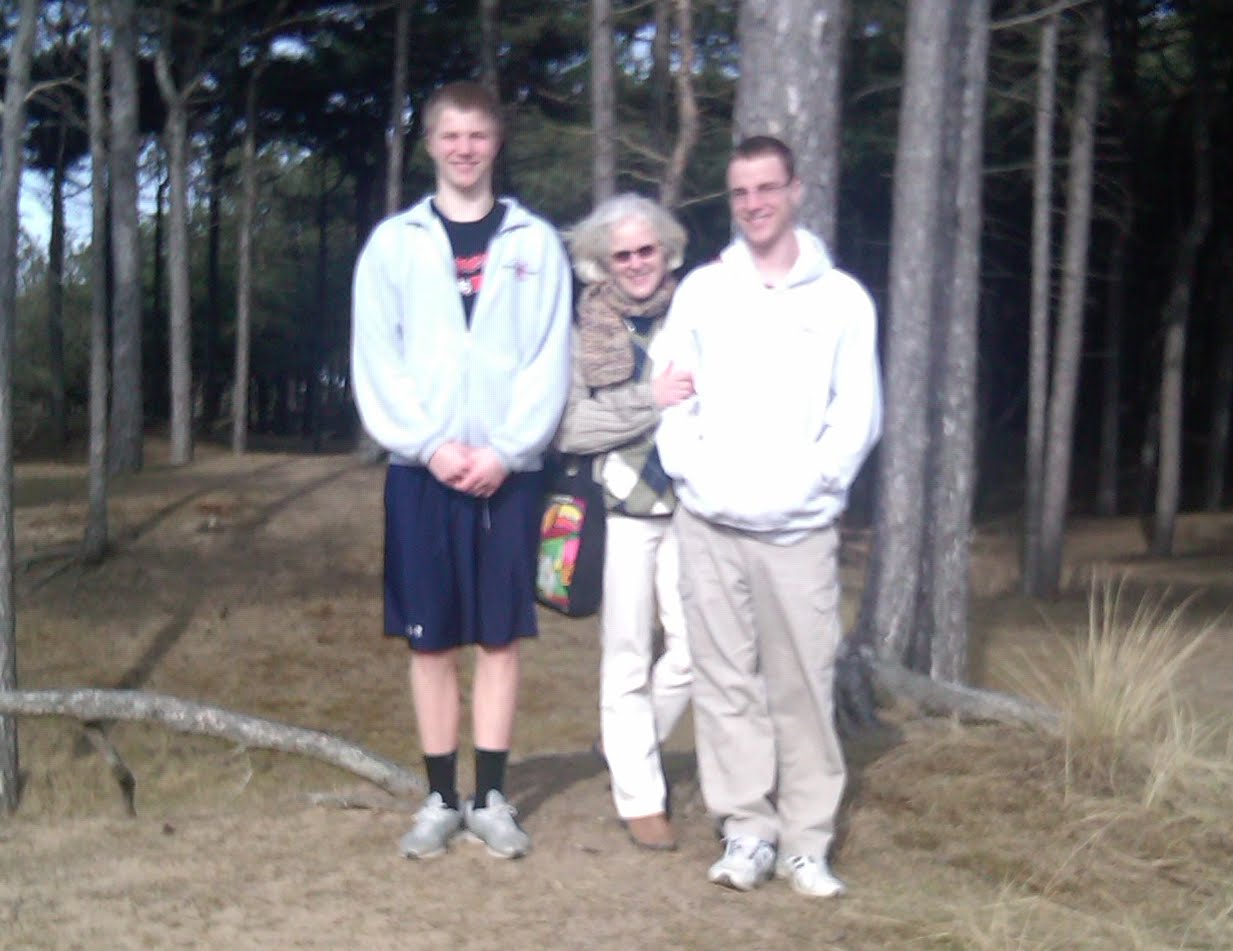
I can appreciate Lamott's anecdote about the evening when her son Sam hugged her good-night and they both suddenly realized how much taller than her he had grown: "Wow," he said, stepping back, "When did this happen? You're like a little gnome to me now."
(PLAN B, 150)
Speaking of which, in above photo:
My Older Son Ben, Me [Little Gnome], My Younger Son Sam
March 2010, Formby Pine Woods, Merseyside, England

OPERATING INSTRUCTIONS:
A JOURNAL OF MY SON'S FIRST YEAR (1993)

TRAVELING MERCIES: SOME THOUGHTS ON FAITH (1999)

I read these two Anne Lamott books about ten years ago, when my friend Etta gave them to me as a birthday present. Rather than one book about child-rearing and one book about faith, really both books are about both subjects. As I told Etta at the time, the religious parts are on the wacky side but Lamott's parenting insights are excellent, all about coping with the fragility of life and childhood passages (illness, growing pains, coming of age, etc.).

A couple of years later, I read BIRD BY BIRD: SOME INSTRUCTIONS ON WRITING AND LIFE (1994), and wrote to tell Etta what a delightful book it was, about writing and life, full of wit and creativity, positive energy and good advice:

"Don't be afraid of your material or your past. Be afraid of wasting any more time obsessing about how you look and how people see you. Be afraid of not getting your writing done. . . . Don't worry about appearing sentimental. Worry about being unavailable; worry about being absent or fraudulent. Risk being unliked. Tell the truth as you understand it" (226).

Etta wrote back all worried that I hadn't liked the first two Lamott books she had sent (Operating and Traveling). I had to remind her that my original assessment had been at least 50% positive. I wrote to her (thank goodness for saved mail): "Etta, go back in your mind to what I said when you sent them. I loved Lamott's wit from the very beginning. She seems like a wonderful parent, and her generous observations have allowed me to forgive myself for not being the perfect mother -- that 's saying a lot! Not many books have been able to do that! My one & only criticism was her religious mumbo jumbo, and you know that has always made me uneasy, since I was about age 9 or so! Still, everything else she says is so meaningful that I can work around the stumbling blocks. Now, do you believe me at last that the books were a wonderful present that have had a profound impact on my way of thinking and being in the world? I hope so!"

In fact, when I pulled out Operating Instructions that day (to re-read favorite passages after finishing Bird by Bird) guess what fell out -- the birthday card that Etta had enclosed back in 1999, telling me that Lamott's writing reminded her of my "funny voice." She had written on the card: "If you ever feel compelled to write, I hope you use your funny voice like this book does." What a wonderful compliment! I blushed at such high praise, and felt honored that she could see any resemblance between Lamott's tone & mine.


PLAN B: FURTHER THOUGHTS ON FAITH (2005)

GRACE (EVENTUALLY): THOUGHTS ON FAITH (2007)

In Plan B you'll find Lamott at her best! Last year, in my Fortnightly post, "Rocky Road" I told the story of how this book, like the first two, entered my life as a birthday present -- this time from my friend Cate. To this day, Cate's favorite is the essay about the rock in Mary's hand. I like the one called "Diamond Heart," which contains the "Little Gnome" incident and an opening ode to puttering: "I was puttering around the house, which is my main spiritual practice" (Plan B, 149). Hey, mine too! The exaltation of puttering! You've gotta love that!

Most recently is Grace Eventually, like the others a mixed bag but mostly terrific. Existential moment: "Why are we here? . . . "To live, love, help -- to decorate. To sweep our huts and find some food" (135). Another favorite line: "The lesson was on Letting Go: so I gritted my teeth winsomely" (31). Only Anne Lamott (and Roz Chast -- I can see it now) could grit her teeth winsomely. In fact, I can always count on these two for a laugh (also on my list: Bryson, Colbert, Sedaris, Vowell).

From my cynical perspective, these two books, same as with those above, contain some crazy portions that raised my skepticism. Lamott's narrative voice combines a progressive political stance with a near-fundamentalist religious outlook -- two views which, in my experience, rarely co-exist within one individual. Yet, she doesn't judge; and all of her books make me laugh and cry and feel compelled to read aloud to Gerry and think a lot about belief, faith, and forgiveness. I definitely admire her vision of what life on Earth is supposed to look like.

One thing you can say about Anne Lamott, she has the guts to expose her craziness to the world, and in a very reassuring way. More than any other writer I've ever encountered, she shows me how to forgive myself for being human, for being mean, for being wrong, for making bad choices and stupid mistakes. I need a writer like that in my life!

P.S. I tried Plan B as a book on tape, read by Anne herself. But strangely enough, I didn't feel the love, didn't hear the wryness, didn't laugh the way I do when hearing her voice in my head. The same thing happened when I saw her on The Colbert Report. She was earnest, but where was that "nice sick sense of humor" that she writes about in Bird by Bird (50)? Back home inside those books I guess. So, with these titles, even if they're available to download or as CDs, I have to recommend sticking with the written word.

P.P.S. Question / Suggestion for Anne: Why the same subtitle three times in a row? Time to branch out!

Tuesday, November 17, 2009

CATCHING UP ON SEDARIS


David Sedaris is another author (like Bill Bryson) that I look forward to reading, book after book. The first one I read was Me Talk Pretty One Day, back in the summer of 2001. You know how some movies or books have such great and funny and apt lines that they just don't go away and you keep incorporating them into your life and conversation and laughing over and over? Well, that's Me Talk Pretty One Day! When I had this book open, I could not stop laughing - even while sitting all by myself on a public park bench. I may have looked a bit on the crazy side, but I couldn't help myself. He is that hilarious!

A couple of summers later, I was reading his book Naked while traveling, and the same thing happened again, yet another bout of suppressed (as best I could) snickers and snorts. Coincidentally, this is exactly the kind of thing that Sedaris loves to write about, i.e., what to do when you find yourself seated beside a nutcase on an airplane.

Holidays on Ice kept me entertained (more audible, embarrassing chuckling) while sitting in a huge holding pen in Philadelphia, waiting to see if I would be chosen for jury duty. Some of these Christmas essays don't strike me as Sedaris at his best, but "Dinah, the Christmas Whore" (also included in Naked) really captures his mother's compassionate nature. And in "SantaLand Diaries" (also included in Barrel Fever) Sedaris recounts his laughable stint as a department store elf named Crumpet. Laughable, but also grim. It is certainly not all HoHoHo in Elf Land. Sedaris reveals the dark side of seasonal employment and the less than charitable side of some parents who bring their kids to sit on Santa's lap.

If you're a fan of that silly movie Elf, then you know what "SantaLand Diaries" is all about. In fact, you'd swear that Sedaris had a hand in that film script. Watch Elf closely, and you'll notice that Amy Sedaris, beloved sister of David, has a part in the movie as an office secretary. (Speaking of Christmas movies, you may also recall that the two little brothers in A Christmas Story have a similarly bad experience when they visit the humorless department store Santa to ask about the BB gun.)

It is sad that David & Amy's mother didn't live to a ripe old age to see the success of her talented children. As portrayed in her son's essays, she seems an amazing woman. I admire the way she blows off all the teachers and school counselors who try to tell her there's something wrong with David when he is little and just starting school: "The kid's wound too tight, but he'll come out of it," she says, in "A Plague of Tics" (14, Naked). She trusted that everything would come out okay for him, and it did! The essays in which he describes the end of her life are heartbreaking, especially, "Ashes" (234 - 250, Naked).

Neither of his parents are anything like either of mine, nor are his five siblings much like my five; yet the family life he describes -- the discipline, the holidays, the values, the squabbling -- feels so familiar to me! Maybe it's his gift (one of many) to make everyone feel that way. In Dress Your Family in Corduroy and Denim, he takes a tender-hearted look at his various siblings, now adults. In When You Are Engulfed in Flames, he shares many funny moments of traveling with his partner Hugh, as well as many humorous examples of his attempt to learn Japanese, while living in Japan and giving up cigarettes.

His Japanese language lessons are reminiscent of his earlier French lessons, as described in the essay "Jesus Shaves" (177 - 180, Me Talk Pretty One Day). In a vocabulary exercise featuring French holidays, Sedaris learns that in France it is not the Easter Bunny who brings the chocolate eggs; it is the Easter Bell! This hilarious essay contains everything that I like most about Sedaris. He is so earnest yet so whimsical and unbelievably funny. So cynical yet so hopeful. Nothing slips past him. As he says of his French class:

"Why bother struggling with the grammar lessons of a six-year-old if each of us didn't believe that, against all reason, we might eventually improve? If I could hope to one day carry on a fluent conversation, it was a relatively short leap to believing that a rabbit might visit my home in the middle of the night, leaving behind a handful of chocolate kisses and a carton of menthol cigarettes. So why stop there? If I could believe in myself, why not give other improbabilities the benefit of the doubt? I told myself that despite her past behavior, my teacher was a kind and loving person who had only my best interests at heart. I accepted the idea that an omniscient God had cast me in his own image and that he watched over me and guided me from one place to the next. The Virgin Birth, the Resurrection, and countless miracles -- my heart expanded to encompass all the wonders and possibilities of the universe.

A bell, though . . . ." (180)


[You'll have to read the book yourself to see his final observation concerning this cultural oddity!]If you're into books on tape (CD, IPOD, whatever) it is especially fun to listen to Sedaris read his own works. He is very funny, of course, and so sincerely modest and unassuming; there's a touching sweetness in his tone that I wasn't really expecting.

For additional listening fun, try Stephen Colbert's I Am America (And So Can You!). Colbert, like Sedaris, has a built-in shit detector (see The Quotidian Kit, right hand column.) and he's not afraid to use it! You can plug these books in, do a few miles on the treadmill, and let everyone else at the gym wonder what the heck it is that you're chortling about!