Sunday, January 31, 2021

Some Old Things for the New Year

Plus a new little avid reader!
Sometimes a baby just needs to catch up
on her favorite magazines!
So far, Little Ellie has only new favorites,
but I have a lot of recurring favorites.
Here is a random list of things that have re-
crossed my mind lately or come up in conversation:
"Although speakers and listeners, writers and readers, are in one sense engaged in a cooperative effort to understand one another, they are also in conflict over the amount of effort that each will expend on the other.  That is, the speaker or writer wants to say what he has to say with as little energy as possible and the reader or listener wants to understand with as little energy as possible. . . . Thus anything that facilitates the transfer of  meaning is important in this tight economy of energy."
Mina P. Shaughnessy (1924 - 1978)
from Errors and Expectations, pp 11 - 12

1. More about writing:
"On Keeping a Notebook" by Joan Didion

2. About spirituality:
Nearly anything by Richard Rohr

3. About reminiscing:
Flowers for Algernon by Daniel Keyes

4. About the meaning of life:
The Thing About Life is That One Day You'll Be Dead
by David Shields

5. About de-cluttering:
The Gentle Art of Swedish Death Cleaning:
How to Free Yourself and Your Family from a Lifetime of Clutter

by Margareta Magnusson

6. About reincarnation:
The Search for a Soul: Taylor Caldwell's Psychic Lives
by Jess Stearn

7. About visions:
Lying Awake by Mark Salzman

"She knew that it was better to have a dream, and pay a price for it, than to be lukewarm. Sometimes the price of following a dream includes confusion. . . . Sister John thought: I can't bear the thought of going back to who I was before. I prayed and scrubbed and went through the motions with no feeling of love, only a will to keep busy. If the surgery were to take my dream away, everything I've goone through up to now would seem meaningless. I wouldn't even be able to draw inspiration from the memeory of it; I couldn't face that desert again, not this late in my life." (137 - 38)

8. While we're on the topic, a great poem that goes
along with the theme of the novel Lying Awake:

Monet Refuses The Operation

Doctor, you say there are no halos
around the streetlights of Paris
and what I see is an aberration
caused by old age, an affliction.
I tell you it has taken me all my life
to arrive at the vision of gas lamps as angels,
to soften and blur and finally banish
the edges you regret I don’t see,
to learn that the line I called the horizon
does not exist and sky and water,
so long apart, are the same state of being.

Fifty-four years before I could see
Rouen cathedral is built
of parallel shafts of sun,
and now you want to restore
my youthful errors: fixed
notions of top and bottom,
the illusion of three-dimensional space,
wisteria separate
from the bridge it covers.
What can I say to convince you
the Houses of Parliament dissolve
night after night to become
the fluid dream of the Thames?

I will not return to a universe
of objects that don’t know each other,
as if islands were not the lost children
of one great continent. The world
is flux, and light becomes what it touches,
becomes water, lilies on water,
above and below water,
becomes lilac and mauve and yellow
and white and cerulean lamps,
small fists passing sunlight
so quickly to one another
that it would take long, streaming hair
inside my brush to catch it.
To paint the speed of light!
Our weighted shapes, these verticals,
burn to mix with air
and change our bones, skin, clothes
to gases. Doctor,
if only you could see
how heaven pulls earth into its arms
and how infinitely the heart expands
to claim this world, blue vapor without end.


Lisel Mueller (b. 1924)
German born American poet
Pultizer Prize for Poetry, 1997

*************
Ironically, a year ago we joked that 2020
was going to the year of clearer vision,
as in 20 / 20. Haha!
But, alas, it was not to be.

Here's to better luck in 2021!

Re-read some old favorites and
may our minds be stronger tomorrow!

Thursday, December 31, 2020

Power of Reading

Suggested reading for
end - of - the - year perception checking:

The Coronavirus Is Rewriting Our Imaginations
By Kim Stanley Robinson

Why do I find this to be one of the most interesting lines
in the article --

"Still, if you read science fiction, you may be
a little less surprised by whatever does happen"
?

Because if you read just about ANYTHING AT ALL -- not just science fiction, but also Louisa May Alcott, Isaac Asimov, Margaret Atwood, George Orwell, Virginia Woolf, you name it -- you'll be a little less surprised by life and death!

And now for some fun visuals
on the joy and power of reading,
with many thanks to imaginative readerly
friends, Curtis, Barbara and Igor:
Keep Out! Haha!

***************
Come On In!
2021, here we come!

***************


See also Uniquely Magic

Sunday, November 15, 2020

Location, Location, Location

From
"What They Did Yesterday Afternoon"
By British Poet Warsan Shire

~~~~~~~~~~~~~~~~

In each of the following stories, location is practically a character, with time and place dominating each narrative. The small - town despair of Olive Kitteridge reminded me of Kent Haruf's fictional Holt Colorado - the setting of all of his novels - but with perhaps less hope. Ordinary Grace falls into the same category - but with somewhat more hope.

Check out the place names and locales, each so unique, plus a favorite passage from each:

1.
"In any quiet town you can find
a street, a field, a stand of trees,
which breaks into the dreams of its citizens
years after the dreamers have left home for good."
(93)

from
Things Invisible To See (1985)
by Nancy Willard
setting: Ann Arbor, Michigan (1940s)


2.
"Safe house
. Saying the words to myself in secret.
For safe house made me smile.
Safe house made me feel warm.
Safe house was something small you could hide in, I thought.
Like a dollhouse where if you were small enough to fit inside
you would be so small nobody would come looking for you
." (61)

from
Black Girl / White Girl (2006)
Joyce Carol Oates
setting: Schuylersville, Pennsylvania
Chadds Ford, Pennsylvania (1974 - 1975)

3.
"It was early September and the maples were red at their tops; a few bright red leaves had fallen onto the dirt road, perfect things, star-shaped. Years earlier when his sons were small, Harmon might have pointed to them, and they'd have picked them up with eagerness...

"The leaves were half-gone now. The Norway maples still hung on to their yellow, but most of the orangey-red of the sugar maples had found their way to the ground, leaving behind the stark branches that seemed to hang like stuck-out arms and tiny fingers, skeletal and bleak.

"By November, the leaves were gone, the trees along Main Street were bare, and the sky was often overcast. The shortening days made Harmon recall a soberness of heart that he had felt off and on for a long time
..." (77-78, 89, 91)

from
Olive Kitteridge (2008)
by Elizabeth Strout
setting: Crosby, Maine (1970s - present day)

4.
"There's a math problem everyone is familiar with. It involves two trains. One leaves from one location, New York, for example, and theother from another location, say San Francisco. The trains are traveling toward each other at different speeds. The idea is to calculate how far each train will have traveled by the time they meet. I was never any good at math and didn't waste time trying to solve this problem but I did spend a lot of time thinking about it. Not about how many miles the trains would have covered but about the travelers on them. Who were these people and why were they leaving New York and San Francisco and what were they seeking at the other end of the line? Most especially I wondered if they had any idea what awaited them when the two trains met. Because I thought of them as traveling on the same set of tracks, I imagined their meeting as a catastrophic collision. So it always struck me not as a math problem but rather a philosophic consideration of life, death, and unhappy circumstance.

"In my own life, the two trains of this problem are the summer of 1961 and the present. And they collide every year on Memorial Day in the cemetery in New Bremen.
" (301)

from
Ordinary Grace (2013)
William Kent Krueger
setting: New Bremen, Minnesota (1961)

5.
"It was quiet out in the suburbs; the views were open, with no tenements or high-rise blocks to obscure the distant hills. The light was soft and gentle—summer was drifting ever onward and the evening seemed delicate, fragile. We walked in silence, the kind that you didn't feel the need to fill.

"I was almost sad when we arrived at the squat, white clubhouse. It was halfway to dark by then, with both a moon and a sun sitting high in a sky that was sugar almond pink and shot with gold. The birds were singing valiantly against the coming night, swooping over the greens in long, drunken loops. The air was grassy, with a hint of flowers and earth, and the warm, sweet outbreath of the day sighed gently into our hair and over our skin. I felt like asking Raymond whether we should keep walking, walk over the rolling greens, keep walking till the birds fell silent in their bowers and we could see only by starlight. It almost felt like he might suggest it himself
." (162)

from
Eleanor Oliphant Is Completely Fine (2017)
by Gail Honeyman
setting: Glasgow, Scotland (present day)

6.
" . . . he could spin the web
between what he had read
and what had happened in the supermarket,
or what he had heard on the radio."


from
The Guest Book (2019)
by Sarah Blake
setting: New York City
Crockett's Island, Maine (1930s - present day)

~~~~~~~~~~~~~~~~

Not forgetting the option of a more exotic locale . . .

Where'd You Go Bernadette, 2012)
by Maria Semple
setting: Seattle & Antarctica (present day)

~ or ~

A Gentleman in Moscow (2016)
by Amor Towles
setting: The Metropole Hotel, Moscow (1922 - 1952)
“For all the varied concerns attendant to the raising of a child — over schoolwork, dress, and manners — in the end, a parent's responsibility could not be more simple: To bring a child safely into adulthood so that she could have a chance to experience a life of purpose and, God willing, contentment.” (p 309)

“For pomp is a tenacious force. And a wily one too. How humbly it bows its head as the emperor is dragged down the steps and tossed in the street. But then, having quietly bided its time, while helping the newly appointed leader on with his jacket, it compliments his appearance and suggests the wearing of a medal or two. Or, having served him at a formal dinner, it wonders aloud if a taller chair might not have been more fitting for a man with such responsibilities. The soldiers of the common man may toss the banners of the old regime on the victory pyre, but soon enough trumpets will blare and pomp will take its place at the side of the throne, having once again secured its dominion over history and kings.”

P.S. Click for more on
Gentleman in Moscow & Ordinary Grace

Saturday, October 31, 2020

"The Jeweled Books in the Shelves"

"Mystic literature -- take me away!" ~ Sir Igor
Our Mystical Library
The books, for example, with which my study walls were lined. Like the flowers, they glowed, when I looked at them, with brighter colors, a profounder significance. Red books, like rubies; emerald books; books bound in white jade; books of agate; of aquamarine, of yellow topaz; lapis lazuli books whose color was so intense, so intrinsically meaningful, that they seemed to be on the point of leaving the shelves to thrust themselves more insistently on my attention. . . .

I saw the books, but was not at all concerned with their positions in space. What I noticed, what impressed itself upon my mind was the fact that all of them glowed with living light and that in some the glory was more manifest than in others. In this context, position and the three dimensions were beside the point. Not, of course, that the category of space had been abolished.
Aldous Huxley
from The Doors of Perception (19 - 20, 34)

~~~~~~~~~~~~~~~~~~~

Wishing all readers a long introspective weekend!
Use that extra hour for reading!
Library Pumpkin
Missoula Montana Public Library

All Hallows ~ All Saints ~ All Souls
A Good Ending!

Wednesday, September 30, 2020

At the Library: It's Different in There!

I like the way this "Autumn Library"
resembles the Supreme Court!
Here are a couple of poems to read at the library . . .


Eating Poetry

Ink runs from the corners of my mouth.
There is no happiness like mine.
I have been eating poetry.

The librarian does not believe what she sees.
Her eyes are sad
and she walks with her hands in her dress.
The poems are gone.
The light is dim.
The dogs are on the basement stairs and coming up.

Their eyeballs roll,
their blond legs burn like brush.
The poor librarian begins to stamp her feet and weep.

She does not understand.
When I get on my knees and lick her hand,
she screams.

I am a new man.
I snarl at her and bark.
I romp with joy in the bookish dark.


by Mark Strand (1934 - 2014)

************************

Don’t Go Into the Library

The library is dangerous—
Don’t go in. If you do

You know what will happen.
It’s like a pet store or a bakery—

Every single time you’ll come out of there
Holding something in your arms.

Those novels with their big eyes.
And those no-nonsense, all muscle

Greyhounds and Dobermans,
All non-fiction and business,

Cuddly when they’re young,
But then the first page is turned.

The doughnut scent of it all, knowledge,
The aroma of coffee being made

In all those books, something for everyone,
The deli offerings of civilization itself.

The library is the book of books,
Its concrete and wood and glass covers

Keeping within them the very big,
Very long story of everything.

The library is dangerous, full
Of answers. If you go inside,

You may not come out
The same person who went in.


by Alberto Rios (b. 1952)

Thanks to Sheri Reda for sharing!

Happy Autumn Reading!
Wishing you some juicy poetry & some juicy peaches . . .

Monday, August 31, 2020

The Wind Flips the Pages

The Water Flips the Pages
~ click to see ~
Thanks to Sir Igor for sharing this
~ Water Feature for Readers ~
What was lost in winter
remains lost. But
once again the wind flips
the pages
of the book
like surf, delicately
backwards, and we start again
at the first chapter,
where just at the edge of sight
an ambiguous bee hangs
on the blossoms,
its ancient sting
almost forgotten.


by Linda Pastan
from the poem "At the Still Point"

Night after Night ~ Year after Year!
Especially this year!


P.S. Speaking of the wind . . .

The funny thing is,
I read reviews of these two books
saying that they would change my life:

1. When the Wind Blows

2. Shabanu: Daughter of the Wind
(6 years ago!)

. . . but they didn't.
Guess I'll just "whistle them down the wind."

I have loved this phrase,
ever since encountering it in a novel years ago,
but haven't had much occasion to use it:

"So, as for Jem Wilson, she could whistle him down the road."
from Mary Barton: A Tale of Manchester Life (1848)
the first novel by English author Elizabeth Gaskell (1810 - 1865)

Now seems the perfect time!


P.S.
Some nice quotes though . . .
Quotidian & Fortnightly

Friday, July 31, 2020

CATCHING UP ON ATKINSON

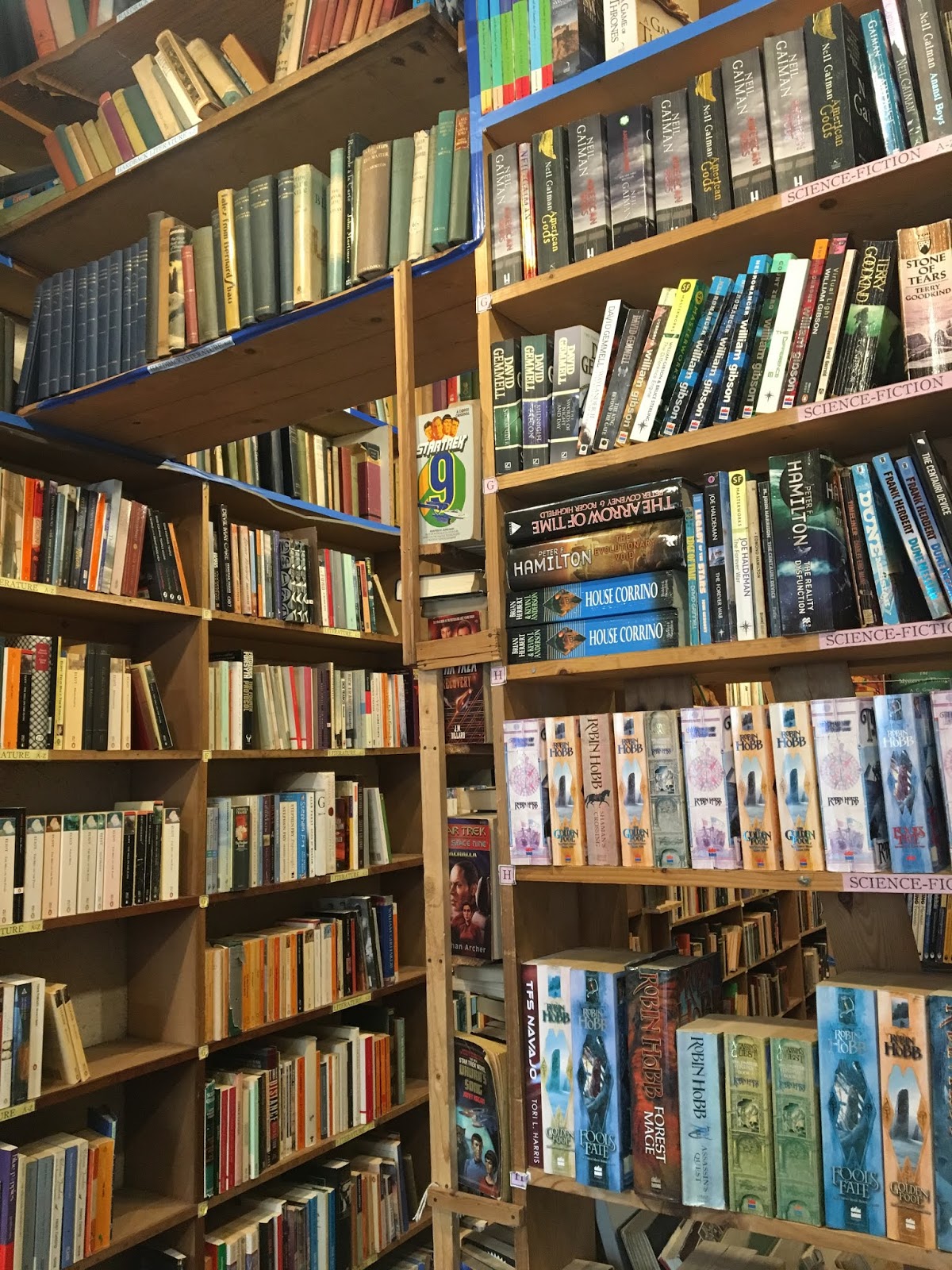
Charming, mysterious, irregular bookstore,
along the tourist path in Edinburgh; perfect for
browsing at leisure through the Kate Atkinson titles!
Armchair Books right next door to the
Afrin Barber, where Gerry got a shave

Scholarly, spell - binding, prize - winning,
can you ask for more than that?
The family sagas are filled with mystery,
the mysteries are filled with family drama.
Atkinson novels read to date:

~ 1995 ~ & ~ 1997 ~

In One Volume

Behind the Scenes at the Museum is a multi - generational novel, ranging from pre - WW I to the present, about all the women in a typical British family, containing lots of coincidences (in manner of Charles Dickens), centering around Bunty, who lost 2 of her 4 daughters in tragic accidents, narrated by one of her twin girls, starting in-utero.

Human Croquet is similar in scope and style, but a different family, with its own secrets, kept through the decades and slowly revealed to the reader, amidst the mysterious imagery of autumnal reverie, sleeping cats, and delicious babies.

[And: "How's my treasure? . . . He's edible, don't you think?" (p 78)
from the novel When Will There Be Good News?]

Next come the Scottish mysteries. If you don't already admire Kate Atkinson (b 1951) as one of the most literary authors on the shelf, then you've got to love her for creating Jackson Brodie (humble, lovable, cantankerous, heroic, damaged, striving) and Louise Monroe (independent, introspective, despondent, determined).

1. Case Histories
"She felt like someone who'd lost her way and ended up in the wrong generation. . . . She had read too much James and Wharton. No one in Edith Wharton's world really wanted to be there but Amelia would have got along fine inside an Edith Wharton novel. In fact, she could have happily lived inside any nineteenth - century novel. . . . she, in turn, wanted no one -- apart from men in nineteenth - century novels, which put a whole new spin on the idea of 'unattainable'" (130, 185).
2. One Good Turn
"Everything was connected.
Everything in the whole world
" (463).
(see this & more)

Near the end of One Good Turn,
Jackson recalls some lyrics from Cowboy Junkies:
"good news always sleeps till noon."
Bringing us to the next mystery in the series . . .

3. When Will There Be Good News?: All the major characters -- Jackson, Louise, Reggie, Joanna -- are readers themselves, carrying their own extensive frames of reference from which Atkinson allows them to make connections and share quotations. [Carnival ~ Carnage]

Numerous overlapping and leap - frogging memories tie the novels one to another: "'A coincidence is just an explanation waiting to happen,' Jackson Brodie had said to her once." When Louise makes this recollection in Good News (163, 319), I was delighted to flip back through Good Turn and reread the very conversation (343 - 44) to which Louise refers. Summarized here for you!

4. Started Early, Took My Dog
"Jackson's new pastime. Trains, coins, stamps, Cistercian abbeys . . . all part of the semi-autistic male impulse to collect -- a need for order or a desire to possess, or both. . . . the ruins had touched his soul in some inarticulate and melancholy place, the nearest thing to holiness for an atheistic Jackson. He missed God. But then who didn't? As far as Jackson was concerned, God slipped out of the building a long time ago and he wasn't coming back, but like any good architect, he had left his work behind as his legacy. North Yorkshire had been designed when God was in his pomp and each time that Jackson came here he was struck anew by the power that landscape and beauty had over him these days" (51).
More on photographs & lost youth
See poem by Emily Dickinson ~ in comments below
5. Big Sky

~ 2013 ~ & ~ 2015 ~

After the mysteries, Atkinson returns to her previous strength, another British family saga, spanning the world wars. These two novels are very good but sometimes almost too intriguing; and you can't expect the same sweetness as Behind the Scenes. Perhaps the nostalgic charm has been displaced by a graver, keener loss of innocence.

Both novels follow the impact of war upon each member of the Todd family, particularly Ursula in Life After Life and Teddy in A God in Ruins. Each novel is a companion to the other, though not necessarily a prequel or a sequel -- which would be unnecessary in any case, considering the ease with which these characters move through time. Not quite so easy for the reader, however, who must adjust to the timeless reality that past, present, alternative present, future -- all are one.

Also about WW2, but different characters: Transcription
Thanks to my sister - in - law Tina for highly and repeatedly recommending these books and to my friend Jonnie for jumping right in and reading everything by Atkinson at lightning speed; to my cousin - in - law Jonny for sharing his extra copy of One Good Turn and to Auntie Jan for the permanent loan of Started Early, Took My Dog.
P.S. Previous Catch - Ups

Bryson ~ Lamott ~ Sedaris