Saturday, April 30, 2022

Bookmobile

~ 1956 ~
Who doesn't love a neighborhood
visit from the Bookmobile?

Even more exciting than the ice cream truck circling our block every summer afternoon was the Bookmobile arriving once every other week! I loved to enter the air - conditioned van, peruse all the choices, and check out Little Women. The illustrated version that was my favorite in 1968 is still a vived memory.

Searching google images, I was disappointed not to come across an exact match for the book jacket that I remember so well. This 1960 abridged paperback is not exactly right but the closest I could find. My Bookmobile version was a big fat hardback with a laminated chartreuse cover. However, it had this same floral oval cameo motif; so I'm guessing it might have been the hardback companion to this paperback:

1960


More on Louisa May Alcott

Junior High Favorites

Transcendentalists

Orchard House

Simone de Beauvoir

Jo March and More

******************

More happy memories from Bookmobile Days:
Author Cards!
So many authors to learn about!
More recent editions:

Thursday, March 31, 2022

A Year of Ellie Reading

“Oh, magic hour, when a child first knows
she can read printed words. . . . From that time on,
the world was hers for the reading.”


from A Tree Grows in Brooklyn
by Betty Smith

********************

December 11, 2020
Starting With One, Two, Three!

January 29, 2021
Seasonal Magazines from Katie!

March 4, 2021
Highlights from Doris & Denis!

April 14, 2021
A Greeting Card from Aunt Sue!

April 20,2021
More Highlights!

April 27, 2021
A Real Page - Turner!

Finger Puppet Books ~ Thanks Sandy!

April 29, 2021
Grandpa, Read Me the Dragon Book!

June 12, 2021
Soon She'll Be Reading Music!

July 17, 2021
Let's Have a Look at this Special Offer!

August 14, 2021
A Very Hungry Caterpillar Birthday Party!
Click for some darling videos: Caterpillar & Dada

August 24, 2021
“Currently reading about the price of Bitcoin.”

October 23, 2021
Reading Eloise Wilkin
In her little rocking chair

December 17, 2021
Christmas Classics

March 13, 2022
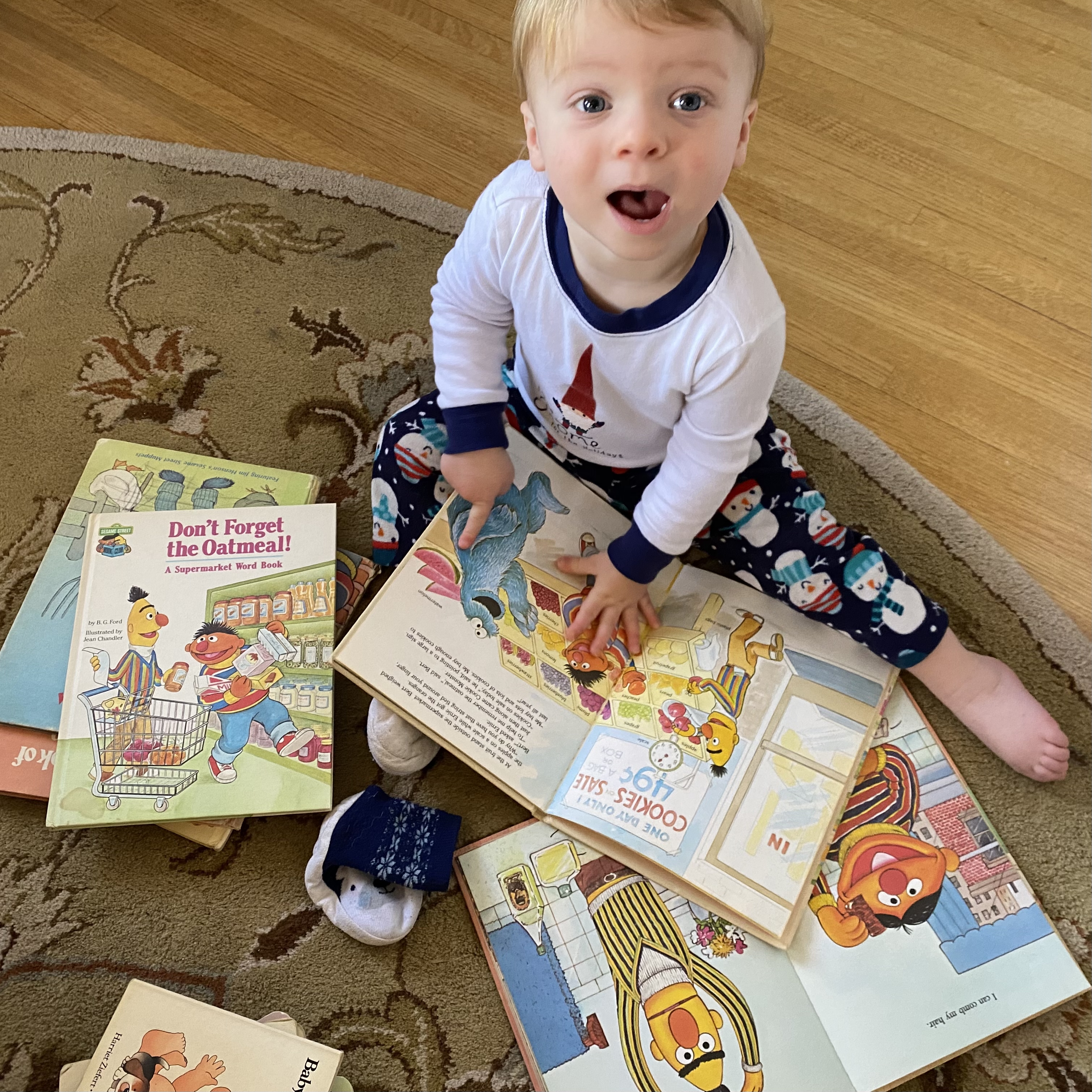
Sesame Street: Don't Forget the Oatmeal!

March 15, 2022
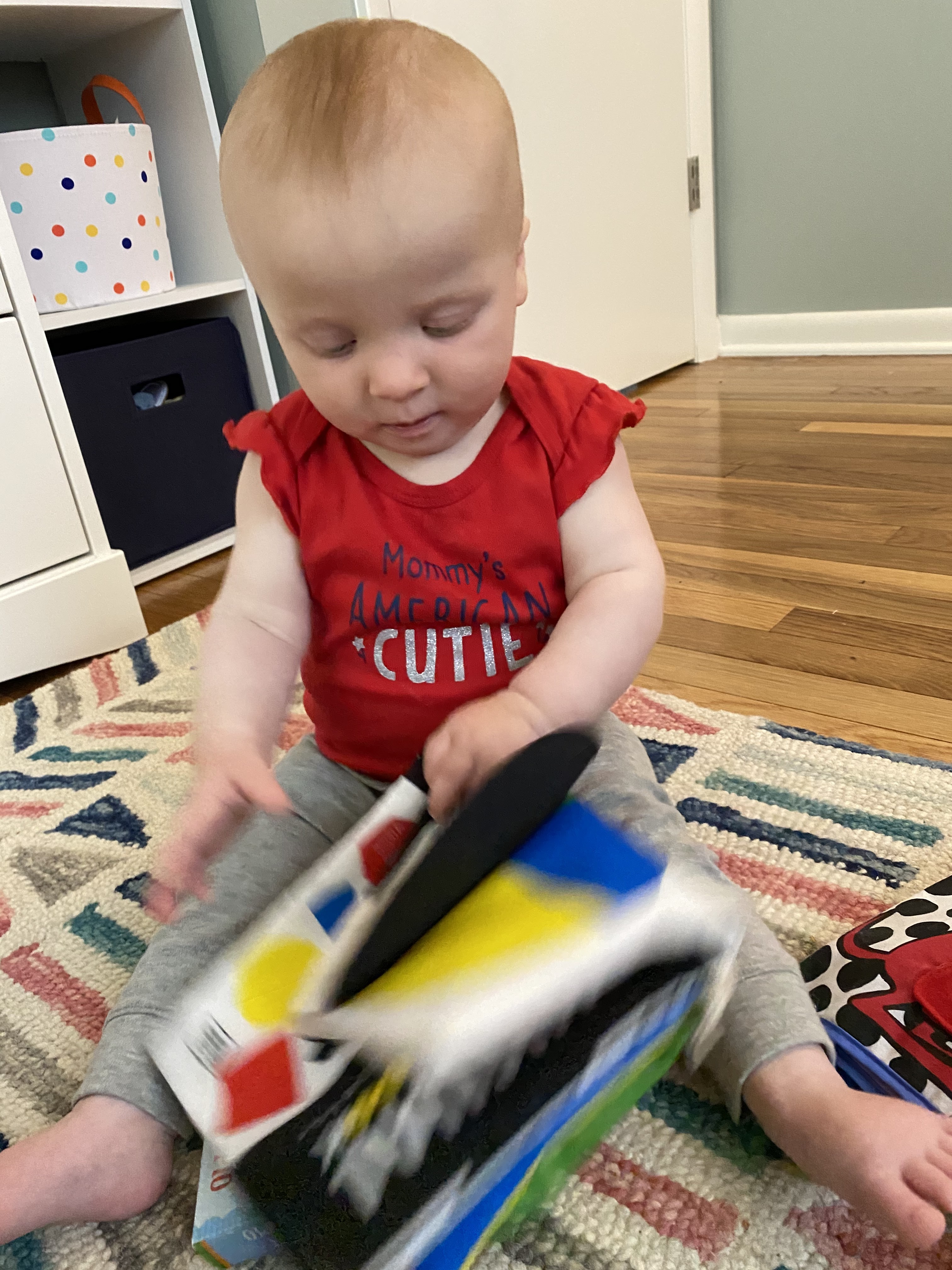
~ Ellie Reading and Rearranging ~

*****************

See more:
Summer 2022
Ellie Reading to Aidan

Monday, February 28, 2022

Reading Charm

My Favorite Earring
"What an astonishing thing a book is. It's a flat object made from a tree with flexible parts on which are imprinted lots of funny dark squiggles. But one glance at it and you're inside the mind of another person, maybe somebody dead for thousands of years. Across the millennia, an author is speaking clearly and silently inside your head, directly to you. Writing is perhaps the greatest of human inventions, binding together people who never knew each other, citizens of distant epochs. Books break the shackles of time. A book is proof that humans are capable of working magic. . . .

"Books permit us to voyage through time, to tap the wisdom of our ancestors. The library connects us with the insight and knowledge, painfully extracted from Nature, of the greatest minds that ever were, with the best teachers, drawn from the entire planet and from all our history, to instruct us without tiring, and to inspire us to make our own contribution to the collective knowledge of the human species. I think the health of our civilization, the depth of our awareness about the underpinnings of our culture and our concern for the future can all be tested by how well we support our libraries."


by Visionary American Scientist, Carl Sagan (1934 - 96)
from his book Cosmos
in Chapter 11: "The Persistence of Memory," pp 295, 297

**************

See also
Neil Gaiman & George Saunders

And of course,
Emily Dickinson
:

There is no frigate
like a book
To take us lands away,
Nor any coursers
like a page
Of prancing poetry.
This traverse may
the poorest take
Without oppress of toll;
How frugal is the chariot
That bears a human soul!

Emily Dickinson
American Poet
1830 - 1886

Monday, January 31, 2022

Mrs. Browning Rescue

Thanks to my brother Aaron and sister - in - law Pam
for passing on to me this antique copy of the poems of
Elizabeth Barrett Browning
(6 March 1806 - 29 June 1861, age 55).
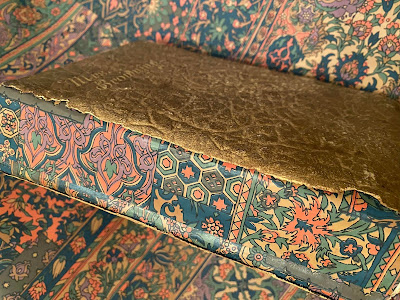
The book was in good repair but fragile due to a damaged spine. I had been brooding about the right approach to this project for awhile when all of a sudden I remembered the partial roll of patterned wallpaper up in the attic, used 25 years ago to cover the entry way of our first Philadelphia house (built in 1895). The wallpaper features a contemporary design but is meant to look vintage, from around the same time as the book publication (Hurst edition, 1879), so I thought it was a good fit.
My glue - work isn't perfect, but on the other hand, I didn't do any further damage, so a complete over-haul is still possible somewhere down the road. Best of all, the book is now fully intact for everyday use, sturdy enough to be handled with care and read -- not just sidelined as an artifact, even though well over 100 years old!
"Viola and Essie" -- who might they be?
Although we have no idea, this gift
from their mother has retained its currency.
Another perspective: propped up for the
holidays on my mother’s old Christmas light bulb box,
which may not be a century old, but is at least half that!
I added a couple of small leftover strips as bookmarks,
and as I was thumbing through the pages, look what I found:
these ribbons left behind by a previous reader!
Concluding words from Aaron & Pam:
"Awesome! I'm glad we rescued the book
and that you'll be able to enjoy it!
"

********************

Additional posts:

Robert Browning: "She was my wife."
I wonder if my Great-great Uncle Will had a similar edition?
As read at Ben & Cathleen's wedding!

Saturday, December 25, 2021

Christmas Gifts From The Sea

" . . . the small circle of home . . . the particular uniqueness
of each member of the family;
the spontaneity of now; the vividness of here.
This is the basic substance of life.
"
[And of Christmas!]
Shells for the Tree

For what is Christmas,
if not heaven on earth?

57 - 58: " . . . the neglect of our own inner springs. Why have we been seduced into abandoning this timeless inner strength of woman for the temporal outer strength of man? This outer strength of man is essential to the pattern, but even here the reign of purely outward solutions seems to be waning today. Men, too are being forced to look inward -- to find inner solutions as well as outer ones. Perhaps this change marks a new stage of maturity for modern extrovert, activist, materialistic man. Can it be that he is beginning to realize that that the kingdom of heaven is within?"

126: "If we stop to think about it, are not the real casualties of modern life just these centers I have been discussing: the here, the now, the individual and his relationships. The present is passed over in the race for the future, the here is neglected in favor of the there, and the individual is dwarfed by the enormity of the mass. America, which as the most glorious present still existing in the world today, hardly stops to enjoy it, in her insatiable appetite for the future."

127 - 128: "The here, the now, and the individual have always been the special concern of the saint, the artist, and -- from time immemorial -- the woman. . . . the small circle of home . . . the particular uniqueness of each member of the family; the spontaneity of now; the vividness of here. This is the basic substance of life. These are the individual elements that form the bigger entities like mass, future, world. We may neglect these elements, but we cannot dispense with them. They are the drops that make up the stream. They are the essence of life itself. It may be our special function to emphasize again these neglected realities, not as a retreat from greater responsibilities, but as a first real step toward a deeper understanding and solution of them. When we start at the center of ourselves, we discover something worthwhile extending toward the periphery of the circle. We find again some of the joy in the now, some of the peace in the here, some of the love in me and thee which go to make up the kingdom of heaven on earth.”

Anne Morrow Lindbergh
Gift from the Sea

Previous Related Posts:
Only Collect a Few (Imprints #3)
More Gifts from the Sea (& Sky)
More Gifts from the Seashore
Trees and Shells
Thanks to Antoinette for this one:

"I must write it all out, at any cost.
Writing is thinking. It is more than living,
for it is being conscious of living
."

~ Anne Morrow Lindbergh ~

Tuesday, November 23, 2021

More Gifts from the Seashore

Thanks to Vicky, Nikki, and Katie
for these thoughtful beach souvenirs!

Anne Morrow Lindbergh's Gifts from the Sea is full of so much wisdom, I can't put it down without compiling yet another blog post of favorite insights. It is only a short, small book and can be read so quickly, but the content is dense with empowering mantras.

All Anne Morrow Lindbergh passages below
are taken from Gift from the Sea (1955)
by Anne Morrow Lindbergh (1906 – 2001)

The Dilemma of Free Time
Lindbergh's vocabulary on the stressful fragmentation and multiplicity of modern (i.e., 1955) life seems to be taken straight from a 21st century podcast:
“This is not the life of simplicity but the life of multiplicity that the wise men warn us of. It leads not to unification but to fragmentation. It does not bring grace; it destroys the soul. And this is not only true of my life, I am forced to conclude; it is the life of millions of women in America. I stress America, because today, the American woman more than any other has the privilege of choosing such a life. Woman in large parts of the civilized world has been forced back by war, by poverty, by collapse, by the sheer struggle to survive, into a smaller circle of immediate time and space, immediate family life, immediate problems of existence. The American woman is still relatively free to choose the wider life. How long she will hold this enviable and precarious position no one knows. But her particular situation has a significance far above its apparent economic, national or even sex limitations. . . . not only . . . the American woman, but also the American man. . . . not merely . . . the American . . . but of our whole modern civilization, since life in American today is held up as the ideal of a large part of the world. (26 - 28)

"I remember again, ironically, that today more of us in America than anywhere else in the world have the luxury of choice between simplicity and complication of life. And for the most part, we, who could choose simplicity, choose complication. (33)

"The room of one's own, the hour alone are now more possible in a wider economic class than ever before."
(52)
The Value of Childcare, Housework, and Homemaking
Lindbergh's views of parenting in the 1950s are consistent with the current family policies of recent presidential hopeful Andrew Yang. Contemporary feminist writer Meg Conley, describes her first encounter with Yang's progressive economic vision:
"Yang wasn’t pandering to stay-at-home parents. He was preaching their good word, acknowledging their real, economic value with his platform of human-centered capitalism and policies like Universal Basic Income.

I cried in my kitchen. Someone saw my work
."

*************

Compare to Anne Morrow Lindberg in 1955:

"I believe that what woman resents is not so much giving herself in pieces as giving herself purposelessly. What we fear is not so much that our energy may be leaking away through small outlets as that it may be going 'down the drain.' We do not see the results of our giving as concretely as man does in his work. In the job of home-keeping there is no raise from the boss, and seldom praise from others to show us we have hit the mark. . . . many women hardly feel indispensable any more, either in the primitive struggle to survive or as the cultural font of the home." (46 - 47)
Duration of Joy
Lindbergh writes of life's small pleasures that bring refreshment but not permanence, shells that are beautiful but too fragile to last:

“Beautiful, fragile, fleeting, the sunrise shell; but not, for all that, illusory. Because it is not lasting, let us not fall into the cynic's trap and call it an illusion. Duration is not a test of true or false. The day of the dragon-fly or the night of the Saturnid moth is not invalid simply because that phase in its life cycle is brief. Validity need have no relation to time, to duration, to continuity. It is on another plane, judged by other standards. . . . The sunrise shell has the eternal validity of all beautiful and fleeting things.” (76)

Fleeting but not illusory. Edna St. Vincent Millay says the same thing in one of her sonnets. Love is always valid, even holy, no matter how brief:
When did I ever deny, though this was fleeting,
That this was love? When did I ever, I say,
With iron thumb put out the eyes of day
In this cold world where charity lies bleating
Under a thorn, and none to give him greeting,
And all that lights endeavor on its way
Is the teased lamp of loving, the torn ray
Of the least kind, the most clandestine meeting?

As God's my judge, I do cry holy, holy,
Upon the name of love however brief,
For want of whose ill-trimmed, aspiring wick
More days than one I have gone forward slowly
In utter dark, scuffling the drifted leaf,
Tapping the road before me with a stick.


~ from Huntsman, What Quarry?
Literary Allusions
Gift of the Sea is filled references to numerous other writers, including William Blake, John Donne, T. S. Eliot, Rilke, Plotinus, Saint-Exupery, and Viriginia Woolf. Lindbergh writes, perhaps in defiance of her own reality, that "We all wish to be loved alone," quoting the Andrews Sisters ("Don't Sit Under the Apple Tree") and W. H. Auden:

It is true of the normal heart
For the error bred in the bone
Of each woman and each man
Craves what it cannot have,
Not universal love
But to be loved alone.

I would add to this discussion the movie Choose Me and the wish expressed on the tombstone of American poet Raymond Carver:

Late Fragment
And did you get what
you wanted from this life, even so?
I did.
And what did you want?
To call myself beloved, to feel myself
beloved on the earth
.

*************

If you're craving some peace
of mind as the holidays approach
give yourself an early gift ~ a copy of Gifts from the Sea.
Give yourself an hour to read & find your own connections.
There are so many!

Egon Schiele: Houses by the Sea, 1914

Sunday, October 31, 2021

More Gifts from the Sea (& Sky)

HAPPY HALLOWEEN!
This is what one thirsts for, I realize, after the smallness of the
day, of work, of details, of intimacy -- even of communication,
one thirsts for the magnitude and universality of a night full of
stars [or jack - o - lanterns], pouring into one like a fresh tide
.”

Anne Morrow Lindbergh (1906 – 2001)
Gift from the Sea (1955)

As I mentioned earlier this month on my Fortnightly blog post, I have long been a fan of Anne Morrow Lindbergh but had neglected to appreciate the continued timeliness of Gift from the Sea, first published in 1955. In 1975, a 20th Anniversary Edition includes her expression of surprise and gratitude at the book's ongoing popularity:
"The original astonishment remains, never quite dimmed over the years, that a book of essays, written to work out my own problems, should have spoken to so many other women."
If she was astonished then, perhaps she'd be astounded now; for the relevance of her work has continued well into the 21st Century. In 2005, along came the 50th Anniversary Edition [with a new introduction by her daughter Reeve], which even now, another sixteen years down the road, offers wisdom entirely applicable to life on our planet, post - 9 / 11 and midst - COVID. Her concerns from five decades ago are so contemporary, they could have been expressed this very year.

In 1955 -- before the internet, before cell phones -- she wrote:
Today a kind of planetal point of view has burst upon mankind. The world is rumbling and erupting in ever-widening circles around us. The tensions, conflicts and sufferings even in the outermost circle touch us all, reverberate in all of us. We cannot avoid these vibrations.

But just how far can we implement this planetal awareness? We are asked today to feel compassionately for everyone in the world; to digest intellectually all the information spread out in public print; and to implement in action every ethical impulse aroused by our hearts and minds. The interrelatedness of the world links us constantly with more people than our hearts can hold. Or rather — for I believe the heart is infinite — modern communication loads us with more problems than the human frame can carry. It is good, I think, for our hearts, our minds, our imaginations to be stretched, but body, nerve, endurance and life-span are not as elastic. My life cannot implement in action the demands of all the people to whom my heart responds. I cannot marry all of them, or bear them all as children, or care for them all as I would my parents in illness or old age. Our grandmothers, and even—with some scrambling—our mothers, lived in a circle small enough to let them implement in action most of the impulses of their hearts and minds. We were brought up in a tradition that has now become impossible, for we have extended our circle throughout space and time.

Faced with this dilemma what can we do? How can we adjust our planetal awareness to our Puritan conscience? We are forced to make some compromise. Because we cannot deal with the many as individuals, we sometimes try to simplify the many into an abstraction called the mass. Because we cannot deal with the complexity of the present, we often over-ride it and live in a simplified dream of the future. Because we cannot solve our own problems right here at home, we talk about problems out there in the world. An escape process goes on from the intolerable burden we have placed upon ourselves. But can one really feel deeply for an abstraction called the mass? Can one make the future a substitute for the present? And what guarantee have we that the future will be any better if we neglect the present? Can one solve world problems when one is unable to solve one’s own? Where have we arrived in this process? Have we been successful, working at the periphery of the circle and not at the center?
” (124 - 26)
In 2021 -- feminist minister Nadia Bolz - Weber expresses a similar dilemma in her essay, "If you can't take in anymore, there's a reason: it's all too much"!
"I used to live in a very old apartment building with super sketchy electrical wiring. Were I to audaciously assume my hair drier could run while my stereo was on, I would once again find myself opening the grey metal fuse box next to the refrigerator and flipping the breaker. My apartment had been built at a time when there were no electric hair driers, and the system shut down when modernity asked too much of it.

"I think of that fuse box often these days, because friends, I just do not think our psyches were developed to hold, feel and respond to everything coming at them right now; every tragedy, injustice, sorrow and natural disaster happening to every human across the entire planet, in real time every minute of every day. The human heart and spirit were developed to be able to hold, feel and respond to any tragedy, injustice, sorrow or natural disaster that was happening IN OUR VILLAGE.

"So my emotional circuit breaker keeps overloading because the hardware was built for an older time.

And yet, when I check social media it feels like there are voices saying “if you aren’t talking about, doing something about, performatively posting about ___(fill in the blank)___then you are an irredeemably callous, priviledged, bigot who IS PART OF THE PROBLEM” and when I am someone who does actually care about human suffering and injustice (someone who feels every picture I see, and story I read) it leaves me feeling like absolute shit. I am left with wondering: am I doing enough, sacrificing enough, giving enough, saying enough about all the horrible things right now to think of myself as a good person and subsequently silence the accusing voice in my head? No. The answer is always no. No I am not. Nor could I. Because no matter what I do the goal of “enough” is just as far as when I started.

And yet doing nothing is hardly the answer.

So I wanted to share something with you. Every day of my life I ask myself three discernment questions I learned from one of my teachers, Suzanne Stabile:

What’s MINE to do, and what’s NOT mine to do?

What’s MINE to say and what’s NOT mine to say?

And the third one is harder:

What’s MINE to care about and what’s NOT mine to care about?

To be clear – that is not to say that it is not worthy to be cared about by SOMEONE, only that my effectiveness in the world cannot extend to every worthy to be cared about event and situation. It’s not an issue of values, it’s an issue of MATH.
"

Writing 66 years apart, Anne Morrow Lindbergh and Nadia Bolz-Weber draw the same conclusion: however infinite we might like our hearts to be, our resources are limited. We must use our energy wisely, stay focused, and use our wits to solve the problems at hand. Without a sure focus . . .
"a singleness of eye . . . that will enable [us] to carry out these obligations," we will spill away "in driblets . . . seldom being allowed the time, the quiet, the peace, to let the pitcher fill up to the brim. . . . With our pitchers, we attempt sometimes to water a field, not a garden" (Gift from the Sea, 23 45, 52)
When it comes to staying focused on the time and task at hand -- the garden, not necessarily the entire field, Pastor Nadia says it so well:
"Because actual reality is also the only place where actual joy is to be found. If joy is delayed until a preferred future comes about, we set ourselves up for despair. But if there is hope in THIS day. Joy in THIS reality. This life. This body. This heart, then certainly we can prevail."

Somebody somewhere mentioned
this earlier, water-color edition . . .