Wednesday, April 14, 2010

CATCHING UP ON LAMOTT

See also my Fortnightly Post:
"Play With This!"
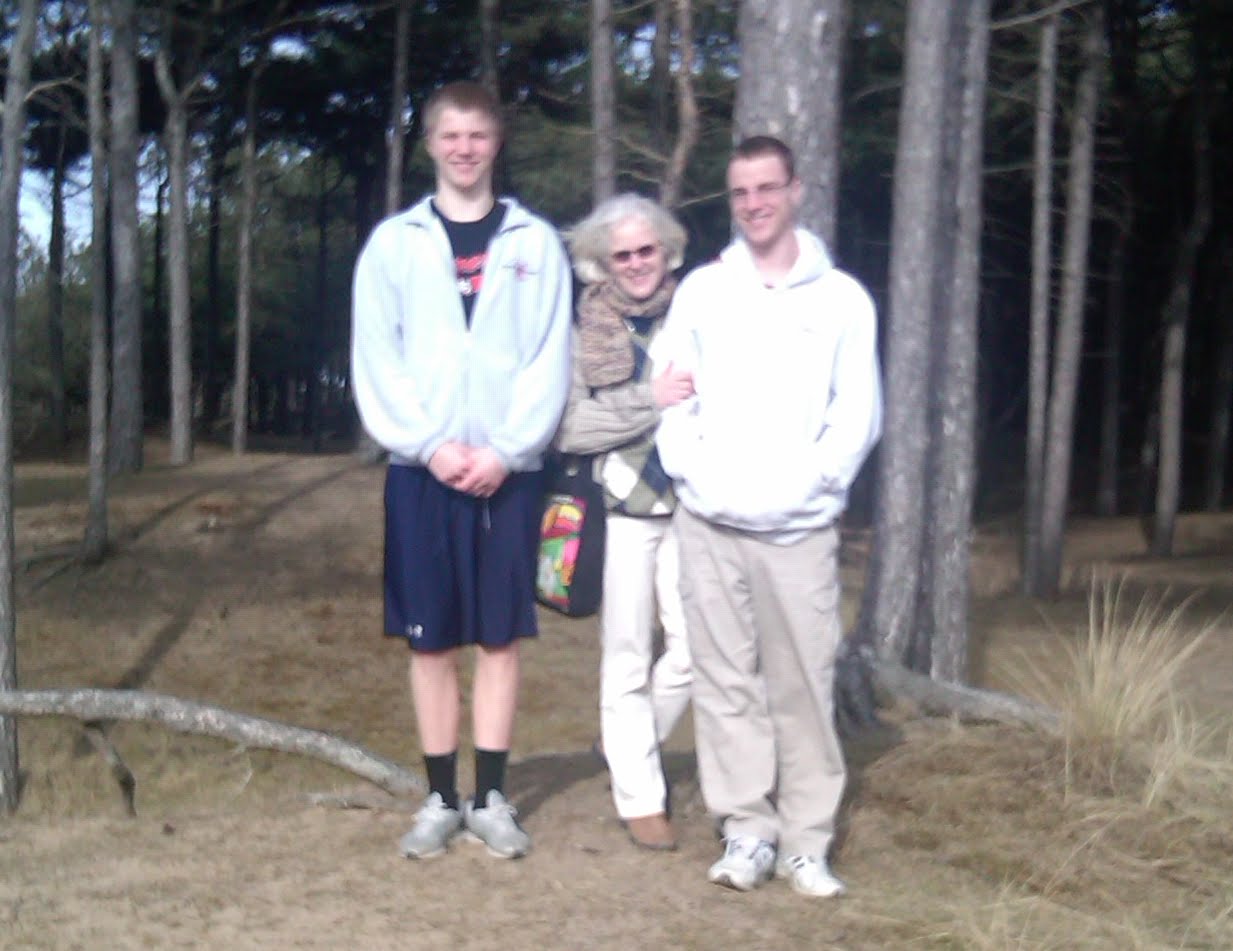
I can appreciate Lamott's anecdote about the evening when her son Sam hugged her good-night and they both suddenly realized how much taller than her he had grown: "Wow," he said, stepping back, "When did this happen? You're like a little gnome to me now."
(PLAN B, 150)
Speaking of which, in above photo:
My Older Son Ben, Me [Little Gnome], My Younger Son Sam
March 2010, Formby Pine Woods, Merseyside, England

OPERATING INSTRUCTIONS:
A JOURNAL OF MY SON'S FIRST YEAR (1993)

TRAVELING MERCIES: SOME THOUGHTS ON FAITH (1999)

I read these two Anne Lamott books about ten years ago, when my friend Etta gave them to me as a birthday present. Rather than one book about child-rearing and one book about faith, really both books are about both subjects. As I told Etta at the time, the religious parts are on the wacky side but Lamott's parenting insights are excellent, all about coping with the fragility of life and childhood passages (illness, growing pains, coming of age, etc.).

A couple of years later, I read BIRD BY BIRD: SOME INSTRUCTIONS ON WRITING AND LIFE (1994), and wrote to tell Etta what a delightful book it was, about writing and life, full of wit and creativity, positive energy and good advice:

"Don't be afraid of your material or your past. Be afraid of wasting any more time obsessing about how you look and how people see you. Be afraid of not getting your writing done. . . . Don't worry about appearing sentimental. Worry about being unavailable; worry about being absent or fraudulent. Risk being unliked. Tell the truth as you understand it" (226).

Etta wrote back all worried that I hadn't liked the first two Lamott books she had sent (Operating and Traveling). I had to remind her that my original assessment had been at least 50% positive. I wrote to her (thank goodness for saved mail): "Etta, go back in your mind to what I said when you sent them. I loved Lamott's wit from the very beginning. She seems like a wonderful parent, and her generous observations have allowed me to forgive myself for not being the perfect mother -- that 's saying a lot! Not many books have been able to do that! My one & only criticism was her religious mumbo jumbo, and you know that has always made me uneasy, since I was about age 9 or so! Still, everything else she says is so meaningful that I can work around the stumbling blocks. Now, do you believe me at last that the books were a wonderful present that have had a profound impact on my way of thinking and being in the world? I hope so!"

In fact, when I pulled out Operating Instructions that day (to re-read favorite passages after finishing Bird by Bird) guess what fell out -- the birthday card that Etta had enclosed back in 1999, telling me that Lamott's writing reminded her of my "funny voice." She had written on the card: "If you ever feel compelled to write, I hope you use your funny voice like this book does." What a wonderful compliment! I blushed at such high praise, and felt honored that she could see any resemblance between Lamott's tone & mine.

PLAN B: FURTHER THOUGHTS ON FAITH (2005)

GRACE (EVENTUALLY): THOUGHTS ON FAITH (2007)

In Plan B you'll find Lamott at her best! Last year, in my Fortnightly post, "Rocky Road" I told the story of how this book, like the first two, entered my life as a birthday present -- this time from my friend Cate. To this day, Cate's favorite is the essay about the rock in Mary's hand. I like the one called "Diamond Heart," which contains the "Little Gnome" incident and an opening ode to puttering: "I was puttering around the house, which is my main spiritual practice" (Plan B, 149). Hey, mine too! The exaltation of puttering! You've gotta love that!

Most recently is Grace Eventually, like the others a mixed bag but mostly terrific. Existential moment: "Why are we here? . . . "To live, love, help -- to decorate. To sweep our huts and find some food" (135). Another favorite line: "The lesson was on Letting Go: so I gritted my teeth winsomely" (31). Only Anne Lamott (and Roz Chast -- I can see it now) could grit her teeth winsomely. In fact, I can always count on these two for a laugh (also on my list: Bryson, Colbert, Sedaris, Vowell).

From my cynical perspective, these two books, same as with those above, contain some crazy portions that raised my skepticism. Lamott's narrative voice combines a progressive political stance with a near-fundamentalist religious outlook -- two views which, in my experience, rarely co-exist within one individual. Yet, she doesn't judge; and all of her books make me laugh and cry and feel compelled to read aloud to Gerry and think a lot about belief, faith, and forgiveness. I definitely admire her vision of what life on Earth is supposed to look like.

One thing you can say about Anne Lamott, she has the guts to expose her craziness to the world, and in a very reassuring way. More than any other writer I've ever encountered, she shows me how to forgive myself for being human, for being mean, for being wrong, for making bad choices and stupid mistakes. I need a writer like that in my life!

P.S. I tried Plan B as a book on tape, read by Anne herself. But strangely enough, I didn't feel the love, didn't hear the wryness, didn't laugh the way I do when hearing her voice in my head. The same thing happened when I saw her on The Colbert Report. She was earnest, but where was that "nice sick sense of humor" that she writes about in Bird by Bird (50)? Back home inside those books I guess. So, with these titles, even if they're available to download or as CDs, I have to recommend sticking with the written word.

P.P.S. Question / Suggestion for Anne: Why the same subtitle three times in a row? Time to branch out!

Sunday, March 28, 2010

HIGHLIGHTS FROM 2009

Last year's reading opened with one
coincidence and closed with another.


SYMBOLIC SEAGULLS! Back in January, I was surprised by the unlikely appearance of two symbolic seagulls. I started off the year with volume one of M. T. Anderson's historical fiction, The Astonishing Life of Octavian Nothing, Traitor to the Nation, quickly followed by Gladys Reunited: A Personal American Journey, a memoir by British / Danish writer Sandi Toksvig. As I wrote a few months ago on my Fortnightly Blog of Connection and Coincidence (see "Birds of Pray"), what's the odds that that I would encounter two one-legged seagulls in two weeks, in two books so widely differing from each other?

Anderson's book is about young Octavian, brought from Africa in the 1700s, and forced to participate in an elaborate educational experiment. As a young man, he strikes out on his own, chooses "Nothing" as his surname, and makes his way through a maze of contradictory American history.

Toksvig's book describes her travels across the United States, as she engages in a marathon reunion with the girls, now women, whom she knew from her school days on the East Coast. Her narrative ranges from amusing and insightful (regarding North American social customs and popular culture) to surprisingly unkind toward her former school chums, especially those who have made life choices and followed paths different than her own (as a Lesbian and a successful writer and entertainer).


FIRE ME! The year came to a close with two fiery titles: When You Are Engulfed in Flames by David Sedaris and Mother on Fire by Sandra Tsing Loh. How often does a title feature fire? I'm not sure, but I think I may have once again beat the odds with this thematic coincidence.

Not to be repetitive, but I have already mentioned When You Are Engulfed in Flames, on this Book List (see "Catching Up On Sedaris"). However, you can never really have too much Sedaris, can you? His trip to Japan yielded many humorous examples of "weird English," such as the one which, obviously, was to become the title of his book -- "When you are engulfed in flames" -- from a brochure on hotel safety; and this mysterioius one printed on a gift bag: "Only imflowing you don't flowing imflowing." (Please to translate!) He also recounts the trials and tribulations of being not just the worst student in his Japanese language class, but "clearly the worst" (283, 309). Poor David! On the serious side, here's one of his introspective observations that really stuck with me: "sometimes the sins you haven't committed are all you have to hold on to" (233). I'm going to keep thinking about that one.

Mother on Fire: A True Motherf%#$@ Story About Parenting! is an energetic, energizing book about parenting and picking the right grade school (public vs. private) for your kids. Okay, yes, I saw the negative press about Loh and her marriage, but I'm not going to think about that. I'm going to focus instead on how much I relished her depiction of the almost perfect, all-American childhood, and the driving force behind it, i.e., a Mom on Fire! Plus, I like the way that she weaves in Pride and Prejudice, Anna Karenina, Mary Poppins, and Charlotte's Web:

"Perhaps it is the wonder of periomenopause, but my days are suddenly shot through with luminous, almost hallucinogenic magic. All at once, I see the meaning of my whole year. . . . the wildest revelation of my unmedicated, premonopausal fever-dream: I suddenly saw what had been hitherto invisible to me, an astonishingly beautiful universe, a shimmering web made of millions of gossamer threads, tended, day by day hour by hour, patiently, by the stubborn and unsung force -- of women. Everywhere around me, in the the city, the whole time, there had been Charlottes, spinning their webs" (239).

Loh's metaphor captures the beauty of webs and being connected and taking care of each other. Charlotte must be the world's favorite spider, and what's more she is also a mother and a true friend. Certainly to me she has always seemed more human than arachnid. She's on our side. She loved Wilbur, and she saved his life. She looked to the future on behalf of her children.

Salutations!


Illustration by Garth Williams
from Charlotte's Web

Tuesday, February 16, 2010

The Colorful Cassons (& Conroys)

Click on Paint Chart to Enlarge
Enjoy Reading Humorous Captions!*

A few summers ago, when my nephew Daniel came to visit me In West Lafayette, we walked over to Chauncey Village so that he could have the fun of shopping at VON'S, the best bookstore for miles around. Daniel, a specialist in adolescent lit, checked out all the titles and settled on a book to leave behind for me to read after he returned home. He was sure that I would love it, and he was right!

That book, Saffy's Angel (2001) is the first in a series of five novels, and after just one, I was hooked! It was fun and fast (always a plus with me, the slowest reader under the sun), reminiscent of The Saturdays, Understood Betsy, and The Mixed Up Files of Mrs. Basil E. Frankweiler -- all rolled into one.

Written by British author, Hilary McKay, the Casson Books are a great teen reading series (let's say PG 13, as there is a substantial amount of adult conflict). The Casson parents are eccentric artists, who have named all their children after colors: the girls -- Cadmium, Saffron (that's Saffy), Rose, and their brother Indigo.

The novel opens and closes with a reference to the all - important paint chart on the wall of their chaotic kitchen: "Each little square had the name of the color underneath. To the Casson children those names were as familiar as nursery rhymes. Other families had lullabies, but the Cassons had fallen asleep to lists of colors" (1, Saffy's Angel).

In Saffy's Angel, each of the children is up to something. Saffy is searching for the meaning of her name and for the angel that is her inheritance, Caddy is learning to drive, and Indigo is learning to be brave. A few months ago, I wrote a Quotidian blog post about Indigo's quest for courage: "Indigo thought about it, and it seemed to him that he had been born afraid of almost everything. He made a list. He wrote down on a piece of paper all the things that frightened him most, and he set about to cure himself" (24, Saffy's Angel).

Each successive novel features one particular sibling, though we learn about all of them in every book: Indigo's Star (2003), Permanent Rose (2005), and Caddy Ever After (2006). Naturally, each child has a special talent, but it's Rose who seems to have inherited her parents' artistic tendencies:
"By now the morning was bright with heat. Rose, who saw the world in terms of pictures, thought that if she had wanted to paint it, she would need the sort of colors they were expected to use at school. Flat yellows and oranges, and hopeless, unshining greens. She squinted up to the sun as if to ask what it was thinking of to allow such unpleasantness. The sun glared back down at her like an overbearing adult who had finished with pandering to the likes of Rose." ~ from Permanent Rose (75)
As the youngest, Rose requires a bit more time to grow up. Thus, to the great delight of her readers, McKay has written one more novel on Rose's behalf: Forever Rose (2007). I can say for sure that Daniel and I would be happy if this series just went on and on and on . . .

Follow - Ups
Summer 2014: latest installment Caddy's World
Spring 2015: and now there's Rose's Blog


No doubt about it, McKay knows how to create a fun, lovable family, with plenty of sibling rivalry to go around, but also great affection. Before the Cassons, there were the Conroys, a family of four sisters -- Ruth, Naomi, Rachel, and Phoebe -- who call themselves The Exiles. In this trilogy -- The Exiles (1991), The Exiles at Home (1992), and The Exiles in Love (1996) -- McKay has recreated Little Women in present day England. Very clever and well done; every parallel is there!

A few favorite thoughts about thinking:
"Only people with no mental resources get bored."
~ from The Exiles in Love (122)

"Rachel's diary . . . In it every meal she had eaten that summer had been carefully recorded. Writing accounts of mere events, she had soon decided, was a waste of time and not at all necessary. For example, she could look at the previous Sunday's entry: 'Ordinary breakfast, roast chicken, peas, pots, runny trifle pudding, egg sandwiches, chocolate cake, ginger cookies,' and the whole day's happenings would immediately spring to mind and insert themselves neatly between the appropriate meals. Rachel thought that everyone's brain worked this way."
~ from The Exiles (148, 201)

Even better than Rachel's "meticulous record of . . . eating" (which I think just might work for me as a method of recollection!) is the girls' description of their grandmother's way of thinking: " . . . she doesn't forget things. She notices everything and it goes into her head and makes patterns. Or something. So the more she notices, the more she knows."
~ from The Exiles at Home (102)


*The humorously captioned color chart is a trade postcard,
advertising the BBC Good Homes Show 2002,
held at the National Exhibition Center
in Birmingham, England, 3 - 6 May 2002.

Sunday, January 10, 2010

FEASTS AND SEASONS

OUR CHRISTMAS CAKE 2009 CLICK HERE FOR RECIPE

The Frugal Gourmet Celebrates Christmas (1991) by Jeff Smith (1939 - 2004) is the best holiday cookbook I know of. Both my latkes and my mincemeat are from this source. One of my sisters gave me this book for Christmas back in 1996, and I gave a copy to one of my brothers a couple of Christmases after that.It's that good. Once you've read it, you'll want to give it as a present to someone else!

More than a collection of recipes, it is also a fascinating narrative of cultural history and seasonal tradition, ingeniously illustrated and creatively organized. Each chapter presents a dish for a different character from the traditional manger scene: angel hair pasta for the angels, green olive soup for the shepherds (I tried this recipe one year -- odd), lamb chops for the tax collector, Persian meatballs for the Magi, right down to milk and honey for the Baby Jesus.

Then there's The Frugal Gourmet Keeps the Feast: Past, Present, and Future (1995), a book about food as sacrament and celebration. Smith was an ordained minister as well as a chef, and the first half is a collection of articles about theology and feasting. The second half is organized into chapters such as "Old World Soups," "Salads from the Ancient World," and "Eggs on the Biblical Table." All things are ready! Come to the feast!

RED DINING ROOM, PHILADELPHIA, 2003

Which brings us to another favorite, The Feast of Christmas: Origins, Traditions, and Recipes (1992) by Paul Levy (b 1941). Filled with beautiful food photography, vintage illustrations, and lots of narrative, this book asks: "What is it that distinguishes the attitude of the feaster from that of the ordinary eater?" Answer: Sensory expectation, social pleasure, and intellectual reward. Levy says that "Instinctively we know the importance of feasting," but only rarely do we practice the art of eating reflectively: "Once a year [Christmas!] our dismal diet disappears, and . . . we are given a glimpse of what food can mean" (7).

In the same vein is The Supper of the Lamb: A Culinary Reflection (1967) by The Rev. Robert Farrar Capon (b 1925), an ordained Episcopal minister who combines theology, food, and digression. How so? "It is easier than you think" says Capon, "the road from temple to kitchen is quite plain. It lies through the subject of knives. . . . The oldest fingerprints in the world are those on tools: and of all tools, the knife remains supreme. . . . the one tool used by more people, more of the time, than any other. All the kitchens . . . are filled with knives. With your permission I shall" . . . digress! (53 - 54). You get the idea.

O CHRISTMAS TREE, O CHRISTMAS TREE!

Along with these books I just have to mention once again the goddess Laurie Colwin (1944 - 1992). How we miss her! What a gift she had for keeping the feast! Whether or not you like her fiction, you just have to read her two narrative cookbooks Home Cooking (1988) and More Home Cooking: A Writer Returns to the Kitchen (1993). The recipes are great, but even better is her sister - to - sister commentary. Totally engaging! Recommended by Jes. I have been touched and inspired by the honor Colwin ascribes to the custom and ceremony of food preparation:

"These two delicacies ["Spiced Beef" and "Country Christmas Cake"] have that profound, original, home-made taste that cannot be replicated, no matter what you spend. They make the person who made them feel ennobled. After all, it is holiday time. Aren't we meant to draw together and express our good feelings for one another? What could be better than to offer something so elementally, so wholesomely down-home and yet elegant? And both go a long way: You can feed a lot of loved ones with them. . . . If I did nothing else, I would still make this cake and spiced beef and fill my head with visions of candles and pine boughs. The sun goes down at four o'clock, the air is damp and chill, but in the pantry my cake is mellowing, and soon I will spice my beef as centuries of people have done before me" (More H C, 209 - 210).

CLICK HERE FOR MORE ON FEASTS & SEASONS:
JANUARY 14, 2010: "EMMANUEL, GOD WITH US"


On THE FORTNIGHTLY KITTI CARRIKER:
A FORTNIGHTLY LITERARY BLOG [every 14th & 28th]
OF CONNECTION & COINCIDENCE; CUSTOM & CEREMONY


CHRISTMAS 2001

Wednesday, December 9, 2009

HOLIDAY FAVORITES

Ben's House Without A Christmas Tree Art Project, 1995


Four short novels by Gail Rock
(screenplays by Eleanor Perry):


The House Without a Christmas Tree. I started loving this made-for-television movie back in 1972, watched it religiously for several seasons; and then it seemed to disappear. I was so happy when it reappeared in my life, first on VHS and now on DVD. What I always liked best were the transitions before each commercial when the final scene would freeze and then morph from realistic to a cut and paste bulletin board version of the same image: Dad's truck, the night kitchen, the Christmas Star. Does anyone else remember that? After the commercial break, the sequence would occur in reverse: the construction paper school building, Grandmother in the kitchen, and the Nativity Stage slowly becoming real as the action resumed. Even now, we wait for the moment of our favorite changes and try to guess which one is coming next. You'd think we'd have them memorized by now -- but maybe not if you're only watching once a year. Of course, that's part of the charm.The movies appeared first: The House Without a Christmas Tree (1972, winning an Emmy in 1973), followed by The Thanksgiving Treasure also called The Holiday Treasure (1973), The Easter Promise also called A Dream for Addie (1975), and Addie and the King of Hearts (1976). Then came the books by Gail Rock (in 1973, 1973, 1975 & 1975, respectively). I had not read any of them until a year or so ago, when I got the gift idea of giving copies of the book along with copies of the movie and felt I should read before sending.

While reading House Without a Christmas Tree, I could see the movie playing in my mind's eye and hear it in my mind's ear -- I guess if we have a "mind's eye," then we also have a "mind's ear," right? The voice-over narration that accompanies the movie and much of the dialogue comes across word for word as printed in the book. My usual pattern is to read the book first and think of the movie as a visual aid; but in this case, it's the opposite, the novel serving as script / reference work. Well, that works too.


Two short novels by Kate Douglas Wiggen:


The Birds' Christmas Carol
(1887) is another Christmas favorite from even earlier in my memory, the story of beautiful little Carol Bird, who was born on Christmas morning as the choir boys were singing "Carol joyfully . . . Carol merrily" and, sadly, dies on Christmas night ten years later, to the faint strains of "My ain countree": "A wee birdie to its nest . . . To his ain countree." How I loved hearing this book read aloud by Grandma or Mama, especially Chapter Four, when the next door neighbors, "the little Ruggleses" get ready to
attend the dinner party that Carol is hosting in their honor. Bath time, etiquette lessons, the feast, the presents -- it was all so much fun! And then came the sad ending.

Wiggen's best-known heroine, Rebecca of Sunnybrook Farm, was a nice girl, but she never won my heart the way Carol Bird did. There are antique copies to be had, floating around on the used book market, and also a lovely reissue, illustrated exactly as the original. I have one of each, a new one from amazon and an 1892 treasure -- a gift from my mother.

I only recently discovered another Christmas story by Kate Douglas Wiggen, The Romance of a Christmas Card (1916), containing a plot about breaking into the greeting card business (something I've always wanted to do myself) and a subplot about mothers and children and childbirth. Wiggen has a lovely name for Christmas Eve, calling it " . . . the Eve of Mary, when all women are blest" ( 74). She is also amazingly astute in her description of post-partum depression, when one character advises another not to be too critical of her sister - in - law's lack of interest in her newborn twins: "Eva's not right; she's not quite responsible. There are cases where motherhood, that should be a joy, brings nothing but mental torture and perversion of instinct. Try and remember that, if it helps you any" (37). Insights such as that more than make up for any sense of datedness.


Two Special 40th Anniversary Editions
by Lee Mendelson and Bill Melendez:


"It's The Great Pumpkin, Charlie Brown":
The Making of a Television Classic


"A Charlie Brown Christmas":
The Making of a Tradition


If you're a fan of the Charlie Brown shows, then you need these two beautifully designed books! Each one contains an illustrated script of the entire show, fond reminiscences of the incomparable Charles M. Schulz, photographs and personal histories of the child actors chosen at the time to perform the voices of the Peanuts Gang, and other original production materials and behind - the - scenes anecdotes. I look forward to flipping through these books every year -- yes, on the right hand corner of each page is a little flipbook animation sequence! These would both make great gifts, as some members of my family are about to find out!


A few additional titles from awhile back:

The Christmas Mystery by Jostein Gaarder. I have long been curious about all of his titles (e.g., Sophie's World) but this is the only one I've read so far. Gerry's mom placed it beside my bed when we went to England for Christmas 2002, so I read it to myself that year, and then the next year to Ben and Sam as a read-aloud for Advent 2003. The cover is brightly illustrated to resemble an Advent Calender, with miniature pictures of angels, castles, ships, sheep. Each chapter begins with a similar illustration, opening the door to another place and time. We followed along on a world map to track the fascinating progress of the characters, as each day they crossed another threshold, disappearing into world history. We learned so much on this intriguing journey and could hardly wait to see how the mystery would resolve itself on Christmas Eve

A Christmas Story by Jean Shepherd, the text behind the BB Gun Movie of the same name. The movie is nearly true to the text, with lots of local color. A kind of an American version of A Child's Christmas in Wales, featuring Northern Indiana between the World Wars.

Skipping Christmas by John Grisham. Ho hum bug. Nothing more than a lot of gift book hype. You can skip it . . . but don't skip Christmas!

Tuesday, November 17, 2009

CATCHING UP ON SEDARIS


David Sedaris is another author (like Bill Bryson) that I look forward to reading, book after book. The first one I read was Me Talk Pretty One Day, back in the summer of 2001. You know how some movies or books have such great and funny and apt lines that they just don't go away and you keep incorporating them into your life and conversation and laughing over and over? Well, that's Me Talk Pretty One Day! When I had this book open, I could not stop laughing - even while sitting all by myself on a public park bench. I may have looked a bit on the crazy side, but I couldn't help myself. He is that hilarious!

A couple of summers later, I was reading his book Naked while traveling, and the same thing happened again, yet another bout of suppressed (as best I could) snickers and snorts. Coincidentally, this is exactly the kind of thing that Sedaris loves to write about, i.e., what to do when you find yourself seated beside a nutcase on an airplane.

Holidays on Ice kept me entertained (more audible, embarrassing chuckling) while sitting in a huge holding pen in Philadelphia, waiting to see if I would be chosen for jury duty. Some of these Christmas essays don't strike me as Sedaris at his best, but "Dinah, the Christmas Whore" (also included in Naked) really captures his mother's compassionate nature. And in "SantaLand Diaries" (also included in Barrel Fever) Sedaris recounts his laughable stint as a department store elf named Crumpet. Laughable, but also grim. It is certainly not all HoHoHo in Elf Land. Sedaris reveals the dark side of seasonal employment and the less than charitable side of some parents who bring their kids to sit on Santa's lap.

If you're a fan of that silly movie Elf, then you know what "SantaLand Diaries" is all about. In fact, you'd swear that Sedaris had a hand in that film script. Watch Elf closely, and you'll notice that Amy Sedaris, beloved sister of David, has a part in the movie as an office secretary. (Speaking of Christmas movies, you may also recall that the two little brothers in A Christmas Story have a similarly bad experience when they visit the humorless department store Santa to ask about the BB gun.)

It is sad that David & Amy's mother didn't live to a ripe old age to see the success of her talented children. As portrayed in her son's essays, she seems an amazing woman. I admire the way she blows off all the teachers and school counselors who try to tell her there's something wrong with David when he is little and just starting school: "The kid's wound too tight, but he'll come out of it," she says, in "A Plague of Tics" (14, Naked). She trusted that everything would come out okay for him, and it did! The essays in which he describes the end of her life are heartbreaking, especially, "Ashes" (234 - 250, Naked).

Neither of his parents are anything like either of mine, nor are his five siblings much like my five; yet the family life he describes -- the discipline, the holidays, the values, the squabbling -- feels so familiar to me! Maybe it's his gift (one of many) to make everyone feel that way. In Dress Your Family in Corduroy and Denim, he takes a tender-hearted look at his various siblings, now adults. In When You Are Engulfed in Flames, he shares many funny moments of traveling with his partner Hugh, as well as many humorous examples of his attempt to learn Japanese, while living in Japan and giving up cigarettes.

His Japanese language lessons are reminiscent of his earlier French lessons, as described in the essay "Jesus Shaves" (177 - 180, Me Talk Pretty One Day). In a vocabulary exercise featuring French holidays, Sedaris learns that in France it is not the Easter Bunny who brings the chocolate eggs; it is the Easter Bell! This hilarious essay contains everything that I like most about Sedaris. He is so earnest yet so whimsical and unbelievably funny. So cynical yet so hopeful. Nothing slips past him. As he says of his French class:

"Why bother struggling with the grammar lessons of a six-year-old if each of us didn't believe that, against all reason, we might eventually improve? If I could hope to one day carry on a fluent conversation, it was a relatively short leap to believing that a rabbit might visit my home in the middle of the night, leaving behind a handful of chocolate kisses and a carton of menthol cigarettes. So why stop there? If I could believe in myself, why not give other improbabilities the benefit of the doubt? I told myself that despite her past behavior, my teacher was a kind and loving person who had only my best interests at heart. I accepted the idea that an omniscient God had cast me in his own image and that he watched over me and guided me from one place to the next. The Virgin Birth, the Resurrection, and countless miracles -- my heart expanded to encompass all the wonders and possibilities of the universe.

A bell, though . . . ." (180)


[You'll have to read the book yourself to see his final observation concerning this cultural oddity!]If you're into books on tape (CD, IPOD, whatever) it is especially fun to listen to Sedaris read his own works. He is very funny, of course, and so sincerely modest and unassuming; there's a touching sweetness in his tone that I wasn't really expecting.

For additional listening fun, try Stephen Colbert's I Am America (And So Can You!). Colbert, like Sedaris, has a built-in shit detector (see The Quotidian Kit, right hand column.) and he's not afraid to use it! You can plug these books in, do a few miles on the treadmill, and let everyone else at the gym wonder what the heck it is that you're chortling about!

Wednesday, October 21, 2009

Love Your Body

Here I am, sitting with the Nana Charlotte, in Hanover, Germany.
This Archetypal Everywoman is the creation of French artist
Niki de Saint Phalle (1930 - 2002)

Perfect Madness: Motherhood In An Age of Anxiety by Judith Warner: Last fall, in the months preceding the presidential election, I read a number of very good articles by Warner (before she went a little crazy) and was intrigued enough to buy and read her entire book in a couple of days. I think the subtitle just about says it all. It is easily the best book I've ever read concerning the politics of motherhood. No, I don't share every single one of her views, but for the most part, I just wish I'd written this book! It was so accurate about so many things in my life. She points out that unfortunately the early feminist movement distanced itself from traditional wife & motherhood to the point of not supporting women in those roles. Thus choosing kids & home life is now considered inferior to pursuing revenue - generating work.

Female Chauvinist Pigs: Women and the Rise of Raunch Culture by Ariel Levy. An excellent expose of all the mixed messages that girls and women are given today by the media and the popular culture, disturbing, enlightening, and sad. A good book for men and teenage boys to read, at least certain parts, to help them understand how hard it can be for women, especially young women, to make rational choices about their way of being in the world, in light of all the misogyny and greed and nastiness that we are bombarded with every passing moment. Levy analyzes the plague of distorted body image that continues to poison American culture and skew the way that girls and woman see themselves. Why is it that so much of a girl's coming of age is learning to dislike her sexuality and perceive her appearance as inadequate?

Her Blood Is Gold: Celebrating the Power of Menstruation by Lara Owen. This is a book I've been meaning to read ever since Sam was born and finally got around to it last year -- that's how long a book can stay in the "hopeful" stack beside my bed -- haha! But see, there really is hope, if you don't mind waiting for over a decade. Anyway it's also very meaningful menopause reading, so the delay doesn't matter all that much and is, in fact, rather timely. Here's what Owen says about PMS & feeling depressed:

"My breasts are tender and so is my heart. Everything hurts more -- I watch a movie on the television and weep, I cry myself to sleep, I worry about the world. I feel colder than normal, and vulnerable in a raw and aching seemingly never - ending way. I have felt this feeling so many times in my life -- and yet here I am, warm and dry, with food in my kitchen, clothes on my back, in a better situation for survival than most people on this planet. Yet nonetheless . . . I am weak and anxious . . . I find myself in more self - doubt at this time. Am I making a great big mess of my life" (140 - 41).

During these low, unhappy times, she tries to reason with herself and move on with her life. Her period comes, and she "goes easy on herself," knowing that this is a temporary hormonal depression that will go away when the hormones shift gears once again. Menopause can also be a huge hormonal shift that causes these same feelings, but the problem is that menopause lasts a lot longer than PMS or a menstrual period.

I was so excited about this book that I had to keep updating my family (all boys except for me, oh well) about it, chapter by chapter. During one of these conversations, my son said, "Mom how many times do you have to say menstrual cycle; can't you just say it? I just laughed and said, "No, in fact, that's the whole point of the book." Of all the things that do bother me in this life, saying menstrual is not one of them. Luckily my husband joined me in this little consciousness raising exercise. "Mom is right," he said,"those are just words to describe a fact of life."

In The Vagina Monologues, Eve Ensler makes the same point about the word vagina: "What are we saying about our bodies if we can't say vagina?" (150). One of the women interviewed in the book reports that she "said VAGINA at least a dozen times a day for two months" until she was able at last "to reclaim it as a word" (159).

Ensler points out that if our culture could normalize and fully accept female sexuality, then there would be so much less violence toward women. Likewise, in Her Blood is Gold Owen says: "Ignoring or despising menstruation is one of the ways that misogyny manifests itself" (159). She suggests that instead of being turned off by a woman's period, men should "bow to it from every cell, with deep feeling" (130). Over and over, she says, just imagine how different the world would be if this were so. How long oh Lord, oh Goddess, oh Nana?

Giant Goddess! Nana Sophie [and Kitti, 2006]

Sophie & Charlotte (above) are two of three "Nanas" created in 1974
for permanent outdoor display near the town hall in Hanover, Germany
by French artist Niki de Saint Phalle (1930 - 2002)