Saturday, October 31, 2020

"The Jeweled Books in the Shelves"

"Mystic literature -- take me away!" ~ Sir Igor
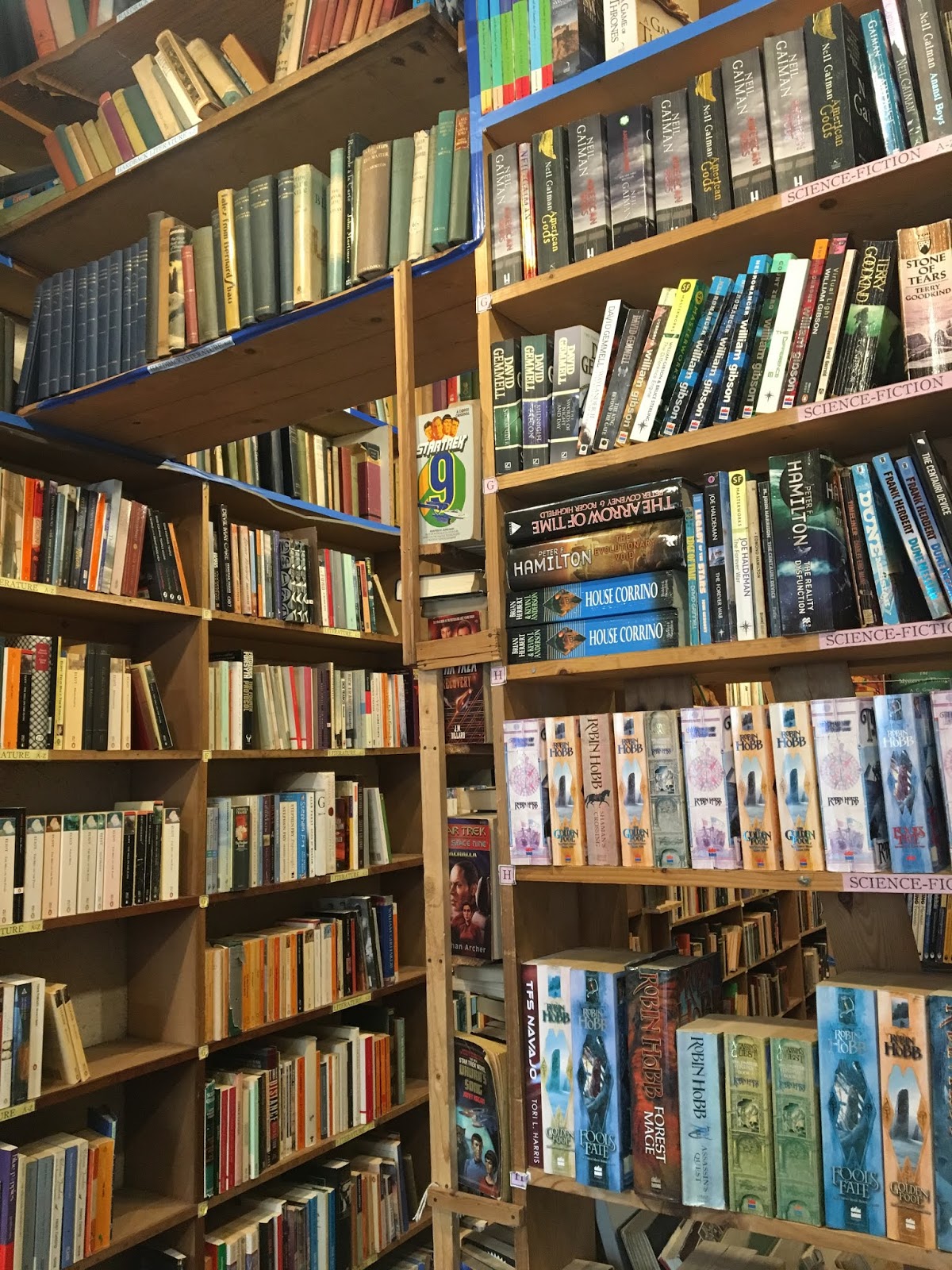
Our Mystical Library
The books, for example, with which my study walls were lined. Like the flowers, they glowed, when I looked at them, with brighter colors, a profounder significance. Red books, like rubies; emerald books; books bound in white jade; books of agate; of aquamarine, of yellow topaz; lapis lazuli books whose color was so intense, so intrinsically meaningful, that they seemed to be on the point of leaving the shelves to thrust themselves more insistently on my attention. . . .

I saw the books, but was not at all concerned with their positions in space. What I noticed, what impressed itself upon my mind was the fact that all of them glowed with living light and that in some the glory was more manifest than in others. In this context, position and the three dimensions were beside the point. Not, of course, that the category of space had been abolished.
Aldous Huxley
from The Doors of Perception (19 - 20, 34)

~~~~~~~~~~~~~~~~~~~

Wishing all readers a long introspective weekend!
Use that extra hour for reading!
Library Pumpkin
Missoula Montana Public Library

All Hallows ~ All Saints ~ All Souls
A Good Ending!

Wednesday, September 30, 2020

At the Library: It's Different in There!

I like the way this "Autumn Library"
resembles the Supreme Court!
Here are a couple of poems to read at the library . . .


Eating Poetry

Ink runs from the corners of my mouth.
There is no happiness like mine.
I have been eating poetry.

The librarian does not believe what she sees.
Her eyes are sad
and she walks with her hands in her dress.
The poems are gone.
The light is dim.
The dogs are on the basement stairs and coming up.

Their eyeballs roll,
their blond legs burn like brush.
The poor librarian begins to stamp her feet and weep.

She does not understand.
When I get on my knees and lick her hand,
she screams.

I am a new man.
I snarl at her and bark.
I romp with joy in the bookish dark.


by Mark Strand (1934 - 2014)

************************

Don’t Go Into the Library

The library is dangerous—
Don’t go in. If you do

You know what will happen.
It’s like a pet store or a bakery—

Every single time you’ll come out of there
Holding something in your arms.

Those novels with their big eyes.
And those no-nonsense, all muscle

Greyhounds and Dobermans,
All non-fiction and business,

Cuddly when they’re young,
But then the first page is turned.

The doughnut scent of it all, knowledge,
The aroma of coffee being made

In all those books, something for everyone,
The deli offerings of civilization itself.

The library is the book of books,
Its concrete and wood and glass covers

Keeping within them the very big,
Very long story of everything.

The library is dangerous, full
Of answers. If you go inside,

You may not come out
The same person who went in.


by Alberto Rios (b. 1952)

Thanks to Sheri Reda for sharing!

Happy Autumn Reading!
Wishing you some juicy poetry & some juicy peaches . . .

Monday, August 31, 2020

The Wind Flips the Pages

The Water Flips the Pages
~ click to see ~
Thanks to Sir Igor for sharing this
~ Water Feature for Readers ~
What was lost in winter
remains lost. But
once again the wind flips
the pages
of the book
like surf, delicately
backwards, and we start again
at the first chapter,
where just at the edge of sight
an ambiguous bee hangs
on the blossoms,
its ancient sting
almost forgotten.


by Linda Pastan
from the poem "At the Still Point"

Night after Night ~ Year after Year!
Especially this year!


P.S. Speaking of the wind . . .

The funny thing is,
I read reviews of these two books
saying that they would change my life:

1. When the Wind Blows

2. Shabanu: Daughter of the Wind
(6 years ago!)

. . . but they didn't.
Guess I'll just "whistle them down the wind."

I have loved this phrase,
ever since encountering it in a novel years ago,
but haven't had much occasion to use it:

"So, as for Jem Wilson, she could whistle him down the road."
from Mary Barton: A Tale of Manchester Life (1848)
the first novel by English author Elizabeth Gaskell (1810 - 1865)

Now seems the perfect time!


P.S.
Some nice quotes though . . .
Quotidian & Fortnightly

Friday, July 31, 2020

CATCHING UP ON ATKINSON

Charming, mysterious, irregular bookstore,
along the tourist path in Edinburgh; perfect for
browsing at leisure through the Kate Atkinson titles!
Armchair Books right next door to the
Afrin Barber, where Gerry got a shave

Scholarly, spell - binding, prize - winning,
can you ask for more than that?
The family sagas are filled with mystery,
the mysteries are filled with family drama.
Atkinson novels read to date:

~ 1995 ~ & ~ 1997 ~

In One Volume

Behind the Scenes at the Museum is a multi - generational novel, ranging from pre - WW I to the present, about all the women in a typical British family, containing lots of coincidences (in manner of Charles Dickens), centering around Bunty, who lost 2 of her 4 daughters in tragic accidents, narrated by one of her twin girls, starting in-utero.

Human Croquet is similar in scope and style, but a different family, with its own secrets, kept through the decades and slowly revealed to the reader, amidst the mysterious imagery of autumnal reverie, sleeping cats, and delicious babies.

[And: "How's my treasure? . . . He's edible, don't you think?" (p 78)
from the novel When Will There Be Good News?]

Next come the Scottish mysteries. If you don't already admire Kate Atkinson (b 1951) as one of the most literary authors on the shelf, then you've got to love her for creating Jackson Brodie (humble, lovable, cantankerous, heroic, damaged, striving) and Louise Monroe (independent, introspective, despondent, determined).

1. Case Histories
"She felt like someone who'd lost her way and ended up in the wrong generation. . . . She had read too much James and Wharton. No one in Edith Wharton's world really wanted to be there but Amelia would have got along fine inside an Edith Wharton novel. In fact, she could have happily lived inside any nineteenth - century novel. . . . she, in turn, wanted no one -- apart from men in nineteenth - century novels, which put a whole new spin on the idea of 'unattainable'" (130, 185).
2. One Good Turn
"Everything was connected.
Everything in the whole world
" (463).
(see this & more)

Near the end of One Good Turn,
Jackson recalls some lyrics from Cowboy Junkies:
"good news always sleeps till noon."
Bringing us to the next mystery in the series . . .

3. When Will There Be Good News?: All the major characters -- Jackson, Louise, Reggie, Joanna -- are readers themselves, carrying their own extensive frames of reference from which Atkinson allows them to make connections and share quotations. [Carnival ~ Carnage]

Numerous overlapping and leap - frogging memories tie the novels one to another: "'A coincidence is just an explanation waiting to happen,' Jackson Brodie had said to her once." When Louise makes this recollection in Good News (163, 319), I was delighted to flip back through Good Turn and reread the very conversation (343 - 44) to which Louise refers. Summarized here for you!

4. Started Early, Took My Dog
"Jackson's new pastime. Trains, coins, stamps, Cistercian abbeys . . . all part of the semi-autistic male impulse to collect -- a need for order or a desire to possess, or both. . . . the ruins had touched his soul in some inarticulate and melancholy place, the nearest thing to holiness for an atheistic Jackson. He missed God. But then who didn't? As far as Jackson was concerned, God slipped out of the building a long time ago and he wasn't coming back, but like any good architect, he had left his work behind as his legacy. North Yorkshire had been designed when God was in his pomp and each time that Jackson came here he was struck anew by the power that landscape and beauty had over him these days" (51).
More on photographs & lost youth
See poem by Emily Dickinson ~ in comments below
5. Big Sky

~ 2013 ~ & ~ 2015 ~

After the mysteries, Atkinson returns to her previous strength, another British family saga, spanning the world wars. These two novels are very good but sometimes almost too intriguing; and you can't expect the same sweetness as Behind the Scenes. Perhaps the nostalgic charm has been displaced by a graver, keener loss of innocence.

Both novels follow the impact of war upon each member of the Todd family, particularly Ursula in Life After Life and Teddy in A God in Ruins. Each novel is a companion to the other, though not necessarily a prequel or a sequel -- which would be unnecessary in any case, considering the ease with which these characters move through time. Not quite so easy for the reader, however, who must adjust to the timeless reality that past, present, alternative present, future -- all are one.

Also about WW2, but different characters: Transcription
Thanks to my sister - in - law Tina for highly and repeatedly recommending these books and to my friend Jonnie for jumping right in and reading everything by Atkinson at lightning speed; to my cousin - in - law Jonny for sharing his extra copy of One Good Turn and to Auntie Jan for the permanent loan of Started Early, Took My Dog.
P.S. Previous Catch - Ups

Bryson ~ Lamott ~ Sedaris

Tuesday, June 30, 2020

Freedom's Just Another Word

Free Speech by xkcd

Thanks to my son Sam for coming to visit for
Memorial Day Weekend and bringing along a
couple of books that everyone should read:

#1 The War on Normal People ~ published 2018
by Andrew Yang (b 1975)


Yang's central thesis is to promote the Freedom Dividend, which has received his mother's vote of confidence -- "If you think it's a good idea Andy, I'm sure it's a good idea" (endearing!) -- plus a thumbs up from my son Sam. And if Sam thinks it's a good idea, I'm sure it is! As Yang explains it:
"With the Freedom Dividend, money would be put in the hands of our citizens in a time of unprecedented economic dislocation. It would grow the consumer economy. It’s a stimulus of people. The vast majority of money would go directly into the economy each month, into paying bills, feeding children, visiting loved ones, youth sports, eating at local restaurants, piano lessons, extra tutoring help, car repairs, small businesses, housing improvements, prenatal vitamins, elder care, and so on. . . . most of the money would be spent locally and quickly" (168, 172).

"When I was a kid I just wanted to belong. As a smart person I was taught to leave others behind. We have to snap out of it and start remembering our own humanity. We're all the same people we were before we got sorted and socialized. We're all mothers, fathers, sisters, and brothers above all who want the same things for ourselves and our families. We're running out of time. In coming years it's going to be even harder to forge a sense of common identity across different walks of life. . . .

One could argue that it is essential for any democracy to do all it can to keep its population free of a mindset of scarcity in order to make better decisions. A culture of scarcity is a culture of negativity. People think about what can go wrong. They attack each other. Tribalism and divisiveness go way up. Reason starts to lose ground. Decision - making gets systematically worse. Acts of sustained optimism...all go down.
" (99, 108).

Similarly, from Sam Harris: "Speaking from personal experience, I think that losing the sense of free will has only improved my ethics -- by increasing my feelings of compassion and forgiveness, and diminishing my sense of entitlement to the fruits of my own good luck. . . . My hopes, fears, and neuroses seem less personal and indelible. There is no telling how much I might change in the future" (Free Will 45 - 46).

“You don't need free will
to determine that twice two is four.
That's not what I call free will
.”
~ Dostoevsky ~
Notes From Underground

***************

#2. Free Will ~ published 2012
by Sam Harris (b 1967)


Harris is sure that "Free will is an illusion. Our wills are simply not of our own making. . . . We do not have the freedom we think we have" (5).

I was prepared to resist this concept and felt unconvinced by a number of the dilemmas that Harris uses to indicate a lack of free will: to write a book or not, to exercise or not, to have coffee or tea, one cup or two, to maintain a healthy diet or not. E.g., "The soul that allows you to stay on your diet is just as mysterious as the one that tempts you to cherry pie for breakfast" (12). Okay, that made me laugh! But, really, do any of these things matter much?

Then a couple of his examples gave me pause:
A. "We are conscious of only a tiny fraction of the information that our brains process . . . utterly unaware of neurophysiological events . . . By merely glancing at your face or listening to your tone of voice, others are often more aware of your state of mind and motivations than you are" (7).

B. "From the perspective of your conscious awareness, you are no[t] responsible . . . for the fact that you were born into this world. . . . You did not pick your parents or the time and place of your birth. You didn't choose your gender or most of your life experiences. You had no control whatsoever over your genome . . . Where is the freedom in this?" (34 - 35, 41).

True! I had to admit -- on both counts! Thus, as I finished the book (really just a 75 - page essay that you can easily read and should reread in one setting) that's what I kept coming back to. Whenever I started to feel skeptical or defensive, I simply reminded myself that I had not chosen to be born, and suddenly Harris's insights, of which there are many, made a lot more sense. Here are a few of my favorites:

Sam Harris: "If the laws of nature do not strike most of us as incompatible with free will, that is because we have not imagined how human behavior would appear if all cause - and - effect were understood" (11).
Similar to
James Morrow:
"Science does have all the answers . . .
we [just] don't have all the science
"
(from the novel, Only Begotten Daughter, 90, 187).

[Nor do we have all the imagination,
but we may, at some point in the future!]

Sam Harris: "You are not controlling the storm, and you are not lost in it. You are the storm" (14).
Similar to
William Stafford
:
"COMFORT:
We think it is calm here,
or that the storm is the right size.
"

Sam Harris: "There is no question that our attribution of agency can be gravely in error. I am arguing that it always is" (25).

Similar to
Kurt Vonnegut, Jr.
:
"We just can't seem to help feeling so entitled to free will,
but what does that really mean?"

"You sound to me as though you don't believe in free will,"
said Billy Pilgrim.

"If I hadn’t spent so much time studying Earthlings,"
said the Tralfamadorian,
"I wouldn’t have any idea what was meant by 'free will.'
I've visited thirty-one inhabited planets in the universe,
and I have studied reports on one hundred more.
Only on Earth is there any talk of free will"

(from Slaughterhouse Five, Chap 5, p 86).

***************

Coronavirus tie - in: Yang's editors need to update his text for 2020, emphasizing that an emergency version of his Freedom Benefit (aka UBI) has indeed been distributed in the United States.

Harris, writing in 2012 about the use of punishment in our criminal justice system, acknowledges the power of pandemics: "If we could incarcerate earthquakes and hurricanes for their crimes, we would build prisons for them as well. We fight emerging epidemics -- and even the occasional wild animal -- without attributing free will to them. . . . Of course, if punishing bacteria and viruses would prevent the emergence of pandemic diseases, we would mete out justice to them as well" (56, 59).

Monday, May 25, 2020

The Story of a Book

'Tis the season for
sorting through reams of musty old family papers
and sharing all manner of amazing discoveries.
For my book blog, it had to be this essay,
written by my mother in 1941 (age 10, 5th grade)
and published in her school paper!

The Story of My Life
(A story of a book, by Mary Lindsey)

The first thing that I can remember was that I was being neatly printed in a printing press in New York City, New York. I was so pleased when I found myself enclosed in a pretty bright red cover. Soon I found myself nicely wrapped, placed in a box with a number of other books and traveling by train to a book-store in Kansas City, Missouri.

In Kansas City I was delivered to my destination. I was placed among the children's books on a shelf middle way to the front of the store. I was dusted every day, and handled by men, women, boys, and girls. And there I sat, fearing my leaves would yellow before I would be sold. Because I had so few pictures, no one cared much about me. Finally a school teacher who had promised some prizes to several of her pupils looked me over carefully. Decided I that was suitable for either boy or girls readers.

I really think the store-keeper was glad to dispose of me, and I was glad to get farther into the world. Again I was wrapped but this time I was tied with a bright colored cord. Then dropped in a shopping bag with the other prizes that had been purchased.

The little school-mom took me to her home and laid me on her study table. The days were quiet and lonesome and I had much time to think and wonder how I would be received in my new home. At last I was made ready to be presented to the little prize winner. After being placed in a pretty gift box with the reward card, I thought I looked nice enough to be appreciated by anyone.

I was carried off to school by the teacher who was very much pleased with me, for she knew I would carry a good lesson to the one who would receive me. At the close of the program I was given to a studious little girl who thanked her teacher kindly for me. I was sure that I would like her as soon as I saw her. She seemed so glad to receive me, and handled me very carefully. As soon as she reached home, I was taken from my box and she was delighted at my appearance. After looking over my contents, she began reading me at once. She screamed with delight after finding I was the book she had wanted.

She read and re-read me and loaned me many times to her little friends. I soon began to show my age by my leaves growing loose and my back broken. I hope I did a great deal of good during my life.

I was put in the bottom of the trunk of my little owner, who now is an old lady, but still treasures me. ~ Mary Beth Lindsey


************

Concluding note from the teacher:
"A-
A well written story.
It has excellent content."

************

One of my mother's
grade school reading books

Thursday, April 30, 2020

Books to Make You Laugh

Roz Chast can always make us laugh
. . . no matter what!
Thanks fellow fan Katie Field
for this addition to my humor library!

A month or so go, librarian and blogger Gale Charlotte sent out a query for books that will make us laugh. What do you recommend? I'll start: Eleanor Oliphant is Perfectly Fine and Amy Poehler's Yes, Please!"

At the time, I was re - reading Annie Choi's Happy Birthday or Whatever: Track Suits, Kim Chee, and Other Family Disasters (2007) in preparation for her follow - up collection: Shut Up, You're Welcome: Thoughts on Life, Death, and Other Inconveniences (2013). I can only read Choi's wry insightful essays with a constant smirk on my face, so I contributed these titles to Gale's running list of over 50 choices.

I knew Annie and her hilarious mother ("Mommy so confuse!) would have me chortling through quarantine, but things took a more ironic turn midway through Shut Up. Her essay "When Disaster Strikes" opens with a few typical fear dreams -- you know, the roller coaster comes to a precipitous halt, the car goes off the bridge -- but, the author confides, "None of these things have actually ever happened to me." She goes on to analyze her obsession with imaginary emergency situations:
"While meditating on disasters, I've come up with a lot of tough questions. Could I start a campfire without matches if I were lost in the forest? Could I build a shelter in an ice storm? Could I cut off my own foot if it got caught under something? The answer to those questions is no. I'm not very handy. I don't have a good grip on physics, and I tend to avoid sharp objects. It would take me five minutes to perish if I were stranded in the Australian outback. . . . I'm ill - prepared to help during a true emergency. I don't know CPR, I'm too squeamish to put a dislocated shoulder back into its socket, I don't know how to leap out of a moving vehicle, and I can't lift anything heavier than a gallon of milk. . . . I'm just not the kind of person who'd survive a catastrophe. . . .

"I think this is why I enjoy thinking about disasters. I live a very low - adrenaline and low - carb lifestyle. I vacuum regularly. I like salad. My life is pretty mundane. Of course, I am grateful that my life is blissfully uneventful and stable. I have food and clean water and access to health care . . . But these daydreams help me realize how little control I have over my life. I can get up in the morning, make my coffee exactly how I like it, and plan exactly where I'll for go for dinner. I know what book I want all the spots where I can buy it. I know where to get the best spanakopita in the city. But all that can change with a shift of the tectonic plates or a cyclone or a pandemic
." (141 - 42, emphasis added)
How ironic to be reading these words in April 2020 when, in fact, you cannot go for coffee or breakfast or dinner. When spanakopita is not to be had and the bookstores are shuttered against coronavirus. Indeed, Choi predicted the future: all that changes with a pandemic.

A little Jane Austen anyone?

P.S.
And how strange to watch movies these days,
peopled with individuals and crowded groups engaging
in pre - corona behavior: shaking hands, hugging, and
spitting all over their birthday cakes at office parties!
No, thanks!