Saturday, August 31, 2013

Sixteen Years Ago & Still So Sad


Missing Chapter from
Bridget Jones: The Edge of Reason
by Helen Fielding

*************************

Sunday 31 August [1997]

10.30 a.m. Is unbelievable. Like dream or sick newspaper April Fool. Is unbelievable. Diana dies is just not kind of thing she would do.

11.10 a.m. Am going to put on telly and they will say it has been a mistake and she is back then we will see her coming out of the Harbour Club with all the photographers asking her what it was like.

11.30 a.m. Cannot believe it. Is so scary when is obvious no one in authority knows what to do.

Noon. At least Tony Blair is in control. Seemed to say what everyone was thinking instead of repeating 'grief and shock' over and over again in manner of parrot.

1.15 p.m. Seems like the world has gone mad. Is no normality to come back to. . . .

1.45 p.m. . . . all agree that she was our national treasure and all feel very bad that everyone was so niggardly about her and she did not like being in England. Is like great big hand coming down from heaven saying, 'If you are going to squabble about her no one is going to have her.'

. . .

6 p.m. Cannot believe she is dead. Keep having to look at newspaper headline again to make self believe it. Really Princess Diana was patron saint of Singleton women because she started off like the archetypal fairy tale doing what we all thought we were supposed to do i.e. marry a handsome prince, and she was honest enough to say that life is not like that. Also if made you feel that if someone so beautiful and gorgeous could be treated like shit by stupid men and feel unloved and lonely then it wasn't because you were rubbish if it happened to you. Also she kept re - inventing herself and sorting out her problems. She was always just trying so hard like modern women. . . .

6.30 p.m. Just keep staring into space. Simply hadn't realized how much Princess Diana was part of consciousness. Is like Jude or Shazzer being there and full of life and giggly jokes and lip gloss then suddenly being something so grown - up and horror - filled and alien as dead.

6.45 p.m. Just saw on telly woman has been to garden centre and bought a tree and planted it for Princess Diana. Maybe could plant something in window box e.g. um, basil? Could get from Cullens.

7 p.m. Hmm. Basil does not seem right somehow.

7.05 p.m. Everyone is going to Buckingham Palace with floral tributes as if is long - standing tradition. Have people always done this? Is it something naff people do to try to get on television like camping all night outside sales or good, real thing? Hmm. Feel want to go though.

7.10 p.m. What is point of living in capital city if cannot join in great expressions of feeling? Does not seem very English thing to do but maybe everything has changed with the changing weather and Europe and Tony Blair and it is all right to express yourself. Maybe she has changed English stuffiness.

7.45 p.m. OK, am definitely going to go to Kensington Palace. Have not got any flowers, though. Will get some from petrol station.

7.40 p.m. Petrol station has sold out. Only things like Chocolate Orange and custard left. Nice but inappropriate.

7.45 p.m. Bet she would like them, though.

7.50 p.m. Have chose copy of Vogue, Cadbury's Milk Tray, one Instants, and packet of Silk Cut. Not perfect but everyone will have brought flowers and know she liked Vogue.

9.30 p.m. V. glad went. Felt a bit shy walking through Kensington in case people knew where I was going and that was on own, but then when think about it Princess Diana was often on own.

Inside park was v. dark and gentle with everyone just walking quietly in one direction. Was no histrionics like on news. The bottom of the wall was covered with flowers and candles in the darkness and people relighting the candles that had gone out and reading messages.

Hope that she knows now after all the times she worried about not being good enough, look what everybody felt about her. Really all this should give a message to women who are worried about how they look and being rubbish and expecting so much of themselves just not to worry so much. Felt a bit embarrassed about the Vogue and chocolate and Instants so hid under flowers and looked at the messages, which made you think that you do not have to be a spokesman or anything to be able to express things. The best one was copied from the Bible, I think, and it said in wobbly old lady's writing: 'When I was in trouble you cared about me, when I was in danger you tried to stop it, when I was sick you visited me, when people ran away you took my hand. Whatever you did for the poorest and the smallest people I felt as if you did it for me.'

Monday 1 September

. . . 'And now Princess Diana is dead,' said Shazzer solemnly.

The mood abruptly changed. We all fell silent, trying to absorb this violent, shocking and unthinkable thought.

pp 323 - 336
in the Picador Edition, 1999

*************************


Every year, at the end of August, I get out my British copy of Bridget Jones: The Edge of Reason and reread this poignant section, which is one of the dearest in memoriams to Diana, Princess of Wales, that I have ever read. I wept real tears when I read it the first time (in 1999). I went back and read this part again when I got to the end of the novel; then I went back and read the whole novel again; and the Diana part was just as good the third time. Even if you're not a Bridget fan, even if you don't read any other part of the book, in this brief section alone Fielding conveys the wave of emotion surrounding Diana's death. Overwhelmingly real and so much like we felt at the time. V. sad and true.

In subsequent printings of the novel, including those editions by Viking & Penguin that were marketed in the United States, this chapter and the next (spanning the days from Diana's fatal accident until shortly after the funeral, 31 August - 8 September, 1997) have been severely and awkwardly edited to leave out all mention of Diana. Why I cannot imagine! Nor can I find any satisfactory explanation for the omission on google or amazon. I've come across one reviewer who has recently questioned the removal of "a major plot twist"; and one interview with Helen Fielding, who, oddly, doesn't seem to mind having had her text tampered with. [Me? I'd be furious!]

As I read aloud every discrepancy to some fellow Bridget fans, one exclaimed, "Why would they do that? Diana was just as important in America as she was in England." But would that have been the reason? To somehow make the book more fun (by making it less serious, less factual) for American readers? Or was it to un - acknowledge this tragic moment in history, for the sake of British readers? I have yet to figure this one out!

Making the Pilgrimage in February 2000
Where Have All the Flowers Gone?


*******************************

Coming Soon! ~ Bridget Jones: Mad About the Boy

Wednesday, July 31, 2013

Girls of Summer

Two Girls Reading
by Robert Lewis Reid, 1862 – 1929
American Impressionist painter and muralist

"I was the youngest, shiest, most self-conscious adolescent
that -- I believe -- ever lived. In addition, I have to confess
that my adolescence lasted a phenomenally long time.
Dare I say I have outgrown that period even now?

"But if one eliminates adolescence from life and records,
how much is suppressed: youth, hope, dreams, impractical ideals,
falling in love with 'countless not impossible He's,'
gaiety that spurts up for no reason,
despair that is gone the next morning,
and a foretaste of the inevitable tragedies of life along with
one's early confused attempts to understand or meet them. . . .

"Besides, I have a certain respect
for the early efforts of this struggling adolescent,
who now seems so many lives removed from the self of today.
I can laugh at her and am often embarrassed by her,
but I do not want to betray her.
Let her speak for herself."


from the 1972 introduction to
Bring Me a Unicorn:
Diaries & Letters of Anne Morrow Lindbergh 1922 - 1928

by Anne Morrow Lindbergh, 1906 - 2001

I read Lindberg's early autobiography not long after it was written, during the fall of my Senior year in highschool, an intense time for any girl, bookish or otherwise. At the time, I had to think twice about her generous inclination to forgive her adolescent self. Already, by age seventeen, my tendency -- when it came to dealing with the embarrassing mistake - making me -- was toward suppression and betrayal. Did I really have to acknowledge the unbearable stupidity of that foolish girl? Lindbergh is right of course; you'd best come to terms with your past naivete. Author Joan Didion also urges against self - betrayal:
"I think we are well advised to keep on nodding terms with
the people we used to be whether we find them attractive company or not.
Otherwise they turn up unannounced and surprise us, come hammering
on the mind's door at 4 a.m. of a bad night and demand to know
who deserted them, who betrayed them, who is going to make amends."

from "On Keeping a Notebook,"
found in Slouching Toward Bethlehem

Earlier this summer I read Beverly Cleary's Fifteen (1956) and Maureen Daly's Seventeenth Summer (1942), forerunners in the genre of adolescent lit. I'm usually the first to say that it's never too late to pick up a book that you meant to read back when you were fifteen or sixteen, but perhaps I waited too late in life for these two. While both novels deal quite honestly with the confusing emotions listed by Lindbergh -- "youth, hope, dreams, impractical ideals, falling in love" -- I'm cannot say that they have stood the test of time. I cringed more than once. Still, I must concede that they have been and continue to be loved by many. So, heeding Lindbergh's advice, I suppose I can find Jane and Angie laughable or embarrassing if I want to, but it's not for me to betray them; they can speak for themselves!

To my great delight, I felt quite the opposite last month when at long last I opened A Tree Grows in Brooklyn (1943) by Betty Smith. As with Fifteen and Seventeenth Summer, I can't explain why I waited so long to read this classic that is often recommended for middle - schoolers, age ten and up. It seems like something I would have read when I was younger but somehow never did.Thankfully, however, I finally made up for lost time. I took it along to Las Vegas for airplane reading and, honestly, could not put it down, something that has not been happening often enough lately! I can say it no better than my niece - in - law Annie (much younger than I), who wrote: "I first read A Tree Grows in Brooklyn just this year. I was drawn in by the way she described her surroundings and the rise and fall of her hopes. I loved it."

Indeed, Francie's historically accurate and heartfelt narrative has lost no relevance whatsoever. As I was reading, I kept thinking how wonderful it would be to go to Brooklyn and take a walking tour of the street corners, schools, and neighborhoods described by Smith; but then I gradually realized that most of those spots don't even exist any more, although it was not all that long ago. I think that's part of what made me like the book so much -- the way Smith captures both the exterior and the interior of this vanishing time in American history.

Favorite summer vacation picture,
in case you missed it on my daily blog:

"As she read, at peace with the world and happy
as only a little girl could be with a fine book
and a little bowl of candy, and all alone in the house,
the leaf shadows shifted and the afternoon passed."


from A Tree Grows in Brooklyn
by Betty Smith

Should you care to devote the remainder of your summer to reading some great girl narratives, here are a few more recent titles that I've read this year. These novels honor the "struggling adolescent," whom Anne Morrow Lindbergh so eloquently urges us to respect. They feature girls who are filled with a "gaiety that spurts up for no reason," a "despair that is gone the next morning, and a foretaste of the inevitable tragedies of life along with one's early confused attempts to understand or meet them."

Annie John (1985) by Jamaica Kincaid

You just have to love Annie's exuberance for school: "It was the first day of the new term, Miss Nelson said . . . we were to spend the morning in contemplation and reflection and writing something she described as an 'autobiographical essay' . . . I knew quite well about 'autobiography' and 'essay,' but reflection and contemplation! A day at school spent in such a way!" (p 38).

As for the girls who don't catch the excitement as Annie does: ". . . what a dull bunch they were! They had no different ideas of how to be in the world; they certainly didn't think that the world was a strange place to be caught living in. . . . It was if I had grown a new skin over the old skin and the new skin had a completely different set of nerve endings. . . . We no longer lived on the same plane" (p 91 - 92).

[For more from Annie, see my post "Columbus Day"]

The Center of Everything (2004) by Laura Moriarity
Evelyn, a Kansas school girl, is a lot like Francie (in A Tree Grows in Brooklyn), growing up in poverty and putting her faith in education; questioning society and religion; coming to understand the facts of life as she sees friends, neighbors, and parents struggle through pregnancy, childbirth, child care, making a living, and making ends meet.

[You can read a few of Evelyn's insights in the end comments on my Fortnightly post: Lot's Wife, Who Gave Her Life For a Single Glance]

In Country (2005) by Bobbie Ann Mason
Samantha age 17

The Elegance of the Hedgehog (2008) by Muriel Barbery
Twelve - year - old Paloma seems a little too smart to be credible, as does her fifty - four - year - old co - narrator, the concierge Renee, whose overbearing snobbery -- and I suspect that of the author herself -- nearly ruins the narrative. Yet in some chapters, Paloma lapses into more believable age - appropriate diction; and I admire the concept of her notebook, which reminds me of my own blog intentions of searching for connections:

"I have set my goal to have the greatest number possible of profound thoughts, and to write them down in this notebook: even if nothing has any meaning, the mind, at least, can give it a shot, don't you think?"

and her conclusion:

"I have finally concluded, maybe that's what life is about: there's a lot of despair, but also the odd moment of beauty, where time is no longer the same. It's as if those strains of music created a sort of interlude in time, something suspended, an elsewhere that had come to us, an always within never.

Yes, that's it, an always within never.

. . . from now on, for you,
I'll be searching for those moments of always within never.

Beauty, in this world."
(pp 26, 325)


[More on my daily blog: Bouquet ~ Quotidian ~ Go]

Short Girls (2009) by Bich Nguyen
Not so tall sisters Van and Linny are somewhat of a disappointment after the endearing narrator of Stealing Buddha's Dinner.

The Marriage Plot (2012) by Jeffrey Eugenides
Twenty - two year old Madeline seems not quite as smart as she should be.

Young Girl Reading
by Berthe Morisot, 1841 - 95
Leading French Impressionist

Sunday, June 2, 2013

Fault In Our Stars


"the universe wants to be noticed"

"I had grand plans to be asleep tonight by two. But before I turned out the light I started reading The Fault in Our Stars. I just now finished. And I'm not sure if it's the bizarre combination of black coffee and red wine, or that I'm awake and the world's asleep, or that I've read 1000 pages of the most non-fiction ever the past two weeks, but this is the best book I've ever read. The recommendation letter written for John Nash read simply, 'this man is a genius.' That's the kind of review I give this book. I'll be shocked if it's not read a hundred years from now."


a few words of early morning praise
for the awesome & multi - talented John Green
from my awesome & multi - talented son Ben McCartney

************************

A couple of months ago, on this blog (scroll down or click), I took a brief look at Green's main character, cancer survivor ("All salvation is temporary" 59) Hazel Grace Lancaster, who comes of age while also coming to terms with an array "Cancer Perks" and the "Side Effects of Dying," the Good Days and the Bad Days, the dignity and the indignities, the nostalgia and the cynicism, even the absurdity.

As someone who has worked with young cancer patients, John Green, without any hint of didacticism or prescribed order, portrays his characters cycling in and out of anger, denial, bargaining, depression, and acceptance: "There are no bad guys. . . . Even cancer isn't a bad guy really: Cancer just wants to be alive" (246).

As Green's starry title suggests,
his engagement with the topic of cancer is cosmic:

p 13: "There will come a time when all of us are dead. All of us. There will come a time when there are no human beings remaining to remember that anyone ever existed or that our species ever did anything. There will be no one left to remember Aristotle or Cleopatra, let alone you. Everything that we did and built and wrote and thought and discovered will be forgotten and all of this will have been for naught. Maybe that time is coming soon and maybe it is millions of years away, but even if we survive the collapse of our sun, we will not survive forever. There was time before organisms experienced consciousness, and there will be time after. And if the inevitability of human oblivion worries you, I encourage you to ignore it. God knows that’s what everyone else does."

p 194: " . . . the definition of humanness is the opportunity to marvel at the majest of creation . . . "

p 202: "The tales of our exploits will survive as long as the human voice itself . . . And even after that, when the robots recall the human absurdities of sacrifice and compassion, they will remember us. They will robot - laugh at our courageous folly . . . But something in their iron robot hearts will yearn to have lived and died as we did: on the hero's errand."

p 223: “I believe the universe wants to be noticed. I think the universe is improbably biased toward consciousness, that it rewards intelligence in part because the universe enjoys its elegance being observed. And who am I, living in the middle of history, to tell the universe that it -- or my observation of it -- is temporary?"

p 294: "I was thinking about the universe wanting to be noticed, and how I had to notice it as best I could. I felt that I owed a debt to the universe that only my attention could repay, and also that I owed a debt to everybody who didn't get to be a person anymore and everyone who hadn't gotten to be a person yet."

p 233: "Some infinities are bigger than other infinities" (see also 260).

p 266: "We live in a universe devoted to the creation, and eradication, of awareness. Augustus Waters did not die after a lengthy battle with cancer. He died after lengthy battle with human consciousness, a victim -- as you will be -- of the universe’s need to make and unmake all that is possible.”

p 276: "Omnis cellula e cellula "All cells come from cells. Every cell is born of a previous cell, which was born of a previous cell. Life comes from life. Life begets life begets life begets life begets life.”

p 308: "Who am I to say that these things might not be forever? Who is Peter Van Houten to assert as fact the conjecture that our labor is temporary? All I know of heaven and all I know of death is in this park: an elegant universe in ceaseless motion, teeming with ruined ruins and screaming children."

p 312: " . . . the real heroes are the people NOTICING things, paying attention."

***************************

Ben and I also had some fun tracking down the following literary allusions:

1. Shakespeare
First of all, for his title, Green provides a subtle inversion of Shakespeare's dictum --
“The fault, dear Brutus, is not in our stars,
But in ourselves, that we are the underlings.”

Julius Caesar (I, ii, 140-141)

suggesting not that we are free of responsibility, but that the stars themselves may not be without fault. After all, we're not in charge of everything.

2. Emily Dickinson
A central figure in the novel is Peter Van Houten, author of Hazel's favorite book An Imperial Affliction. Like Green himself, the fictional Van Houten choses his title from a pre - existing work, a poem by Emily Dickinson:

A Certain Slant of Light


There’s a certain Slant of light,
Winter Afternoons —
That oppresses, like the Heft
Of Cathedral Tunes —

Heavenly Hurt, it gives us —
We can find no scar,
But internal difference,
Where the Meanings, are —

None may teach it — Any —
’Tis the Seal Despair —
An imperial affliction
Sent us of the Air —

When it comes, the Landscape listens —
Shadows — hold their breath —
When it goes, ’tis like the Distance
On the look of Death —


Emily Dickinson, 1830 - 86
found in The Complete Poems

Reading Dickinson's poem, throws a couple of other passages into sharp relief:

Early in the novel, the spring air is "just on the cold side of perfect, the late-afternoon light heavenly in its hurtfulness" (18).

And later at the cemetery, the mourners stand "beneath the clear blue sky with its certain slant of light" (274).

3. T. S. Eliot
On the way to Amsterdam Hazel recites a few lines from "The Love Song of J. Alfred Prufrock":

Let us go, through certain half-deserted streets,
The muttering retreats
Of restless nights in one-night cheap hotels
And sawdust restaurants with oyster-shells:
Streets that follow like a tedious argument
Of insidious intent
To lead you to an overwhelming question….
Oh, do not ask, “What is it?”
Let us go and make our visit. . . .

We have lingered in the chambers of the sea
By sea-girls wreathed with seaweed red and brown
Till human voices wake us, and we drown.

[Click to hear Eliot himself recite]

In the Anne Frank House, Augustus remembers the reference and promises Hazel that "The tales of our exploits will survive as long as the human voice itself" (153, 164, 202).

4. William Carlos Williams
One of the most touching allusions is Hazel's re-write of the straightforward and striking poem, "The Red Wheel Barrow" (246 - 47).

Here is Williams' original:

so much depends
upon
a red wheel
barrow

glazed with rain
water

beside the white
chickens

and here is Hazel's rendition:

so much depends
upon
the transparent
G - tube

erupting from the gut
of the blue - lipped boy

so much depends
upon
this observer
of the universe


4. Robert Frost
Frost's brief poem "Nothing Gold Can Stay" makes a brief appearance when Hazel despairs for the future: "It seemed to me that I had already seen everything pure and good in the world, and I was beginning to suspect that even if death didn't get in the way, the kind of love that Augustus and I share could never last. So dawn goes down to day, the poet wrote Nothing gold can stay" (278).

Here's the whole poem, short, sweet, sad:

Nothing Gold Can Stay
Nature's first green is gold,
Her hardest hue to hold.
Her early leaf's a flower;
But only so an hour.
Then leaf subsides to leaf.
So Eden sank to grief,
So dawn goes down to day.
Nothing gold can stay.

Nature's first green: see the Wabash through the leaves?

There are plenty of other intertextual references, including allusions to The Great Gatsby (191) and V for Vendetta (17, 29 - 30). For more, check out The Fault in Our Stars Metatext site, which seems to have found them all.

P.S.
HAPPY 23rd BIRTHDAY BENEDICT!

Friday, May 31, 2013

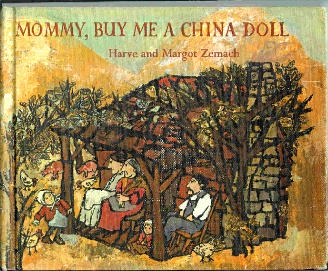
Songs Our Grandmothers Sang


My friend Meg wrote:

"Kitti, my heart leapt when I saw this picture. Mommy, Buy Me a China Doll was my very favorite picture book (along with Rain Makes Applesauce)--it was the first book I could 'read' (because I memorized it). I also loved the eyes of the mother and daughter. Just last week, Elaine and I were parodying the text as she tried to convince me to get her a bigger bed."


What a great memory for Meg -- and even better that she has passed it on to her daughter Elaine! I don't know how I missed out on knowing this story as a child, but luckily it keeps coming into my life through my relatives!

Earlier this month when we were in England, Gerry's Auntie Jan showed me a copy of this book that she had discovered at a used book sale. When she asked if I knew the tune, I hummed a few bars as best I could and told her that I hadn't known it as child, but my cousins Maggie and Scott taught it to me at our family reunion in 1998! Like my friend Meg, my cousin Maggie has passed the song on to her children. She recalled nostalgically, "I think Grandma [Adeline Carriker] sang it to Mom [that would be my dad's only sister, Frances] when she was a child. Now all my grandsons know it as well!"

The book (rare now but available on amazon) contains many verses but no music. Luckily, Ben was able to download the music and leave a copy with Auntie Jan so that she can now learn the old Ozark melody and sing it to her British grandkids!

Another childhood song that my Grandma Rovilla Lindsey sang to me is "Babes in the Woods." It must have been a favorite of hers, for at some point (I'm guessing in the 1950s or 60s) she took time to write down all the verses:


If there's one thing I love to save
-- and I have only a very few samples of it for saving --
it is my Grandma Lindsey's beautiful elegant handwriting.
In addition to the above page of lyrics,
I am lucky enough to have this Easter Booklet
that she designed for her Sunday School Students


In Marilynne Robinson's novel Home, there is a reference to "Babes in the Wood" along with an interesting analysis of its effect on children. Glory Boughton, now thirty - eight, thinks back to what she was told as a child, "Glory, you take things too much to heart":

"That was what they always said about her. . . . Glory took everything to heart. She wished they had told her how to do otherwise, what else she should have done.

"She wept easily. This did not mean that she felt things more deeply than other did. It certainly did not mean that she was fragile or sentimental . . . When she was four . . . she had sobbed over Heidi and Bambi and the Babes in the Woods. Which they read to her dozens of times. As if there were any other point to those stories after all but to elicit childish grief"
(14 - 15).

Childish grief. Childish worry. I think I know exactly how Glory felt. Though, I did not have a picture book of "Babes in the Woods," the images evoked by my grandmother's singing were vivid and sorrowful. The deserted children, covered over with strawberry leaves, were merged in my storybook universe with Hansel and Gretel, searching in vain for the bread crumbs, and Little Red Riding Hood, alone and worried in the forest. The poor little things! And as Robinson mentions in this same passage, somehow "Now I Lay Me Down to Sleep" was mixed in there too. (But not Robin Hood; that came later with the Christmas pantomime.)

There are a lot of other things to like about Home, but that's enough for now.

P.S. On the topic of China Dolls,
I have never been known to have a way with houseplants
but the China Doll Plant has always been one of my favorites:

Radermachera sinica
.

Saturday, April 13, 2013

Losing Strength, Not Style


I Love You ~ painting by Elena Desserich

Notes Left Behind
by Brooke and Keith Desserich
Brooke and Keith Desserich's personal journal entries -- about their six - year - old daughter Elena -- describe the last 256 days of Elena's life, starting with the tragic discovery of an inoperable tumor in her brain. Their loving anecdotes capture the despair and joy of each remaining day and preserve the precious personality of Elena, creating a memoir to be read in the future by little sister Gracie.
To learn more: The Cure Starts Now ( www.thecurestartsnow.org )

The Fault In Our Stars
by John Green
John Green's novel -- about the fictional seventeen - year - old Hazel Grace Lancaster, who has been living with thyroid cancer since the age of thirteen -- is based on his experience as a student chaplain in a children's hospital, helping children with life-threatening illnesses. Through Hazel and her friend Gus, Green opens our eyes to the tension of teen - age angst, compounded by the hope and uncertainty of living with cancer.
To learn more: This Star Won't Go Out ( www.tswgo.org )

Each of these sad sweet books is about an intelligent, creative, admirable girl engaged in a heartbreaking struggle against cancer. Though quite different in style and genre, the two stories explore similar themes: the sorrow of diagnosis at such a young age; the unfairness of interrupted youth; the reorganization of the family around new needs and priorities; the courage and energy of a bright young patient determined to seize the day no matter what the odds against her.

Both books brought to mind these sad lyrics from the musical Evita:

Oh what I'd give for a hundred years
But the physical interferes
Every day more, O my Creator
What is the good of the strongest heart
In a body that's falling apart?
A serious flaw, I hope You know that . . .

Your little body's slowly breaking down
You're losing speed, you're losing strength, not style
That goes on flourishing forever
But your eyes, your smile
Do not have the sparkle of your fantastic past
If you climb one more mountain it could be your last

I'm not that ill, bad moments come but they go
Some days are fine, some a little bit harder
But that doesn't mean we should give up our dream
Have you ever seen me defeated?
Don't you forget what I've been through and yet
I'm still standing

Eva, you are dying

So what happens now?
Where am I going to?

Don't ask anymore . . . "
**************************
In Memoriam
Marilyn, 7 March 1957 - 27 November 1993
Celine, 27 August 1942 - 24 April 1997
Dagmar, 13 April 1959 - 9 March 2011

Sunday, March 31, 2013

Transfixed

Yet I believe beyond believing
that life can spring from death,
that growth can flower from our grieving,
that we can catch our breath
and turn transfixed by faith.

~ William Gay ~


Sun Shining Through Lace Curtains Onto the Hardwood Floor
(photo taken 15 September 2011)

~ Some books I like to reread each year around Easter ~

Fifth Business
Robertson Davies

A wise aging priest discusses the need for a role model: "My own idea is that when [Christ] comes again it will be to continue his ministry as an old man. I am an old man and my life has been spent as a soldier of Christ, and I tell you that the older I grow the less Christ's teaching says to me. I am sometimes very conscious that I am following the path of a leader who died when He was less than half as old as I am now. I see and feel things He never saw or felt. I know things He seems never to have known. Everybody wants a Christ for himself and those who think like him. Very well, am I at fault for wanting a Christ who will show me how to be an old man?* All Christ's teaching is put forward with the dogmatism, the certainty, and the strength of youth: I need something that takes account of the accretion of experience, the sense of paradox and ambiguity that comes with years!" (164.)

* Or how to be a woman of any age!

The Secret Life of Bees
Sue Monk Kidd
[Also mentioned in 2003]

So similar to what Davies says about the need for an old Christ: "I wish you could've seen the Daughters of Mary the first time they laid eyes on [the Black Madonna]. You know why? Because when they looked at her, it occurred to them for the first time in their lives that what's divine can come in dark skin. You see, everybody needs a God who looks like them" (141).

For years now, I've been saying that Jesus needed a twin sister; and Kidd has incorporated this own personal heresy of mine into her novel: "I could read her thought: If Jesus' mother is black, how come we only know about the white Mary? This would be like women finding out Jesus had had a twin sister who'd gotten half God's genes but none of the glory" (53).

The Last Temptation of Christ
Nikos Kazantzakis
[See previous posts: 2007 & "Let Them All In"]

His somewhat unconventional Jesus insists that he is "son of man, I tell you, not son of God. . . I shall stand up and proclaim the truth!"

The Apostle Paul replies in anger: "True or false -- what do I care! It 's enough if the world is saved. . . . What is 'truth'? What is 'falsehood'? Whatever gives us wings, whatever produces great works and great souls and lifts us . . . above the earth -- that is true. Whatever clips off our wings -- that is false. . . . I create the truth, create it out of obstinacy and longing and faith." (477)

In an excellent closing note, P. A. Bien, writes that Kazantzakis "was not primarily interested in reinterpreting Christ or in disagreeing with, or reforming, the Church. He wanted rather, to lift Christ out of the Church altogether . . . The measure with which the reader of this book feels (perhaps for the first time) the full poignancy of the Passion will be the measure of the author's success."

While I feel no doubt of this novel's success, it is actually another novel which, in my opinion, renders the Passion most poignantly, and that is . . .

The Master and Margarita
Mikhail Bulgakov
[See companion post: "Illusion of Control"
and Nadia Bolz-Weber on "Forgiveness"]

Bulgakov treats not only the Passion of Christ, but also

~ the Passion of the Master, whose novel about Pontius Pilate is rejected by the critics and lands him in the mental asylum but is later read by both Jesus and Pilate, himself;

~ and the Passion of Margarita, whose quest for happiness leads her to Satan's ball and the final realization that "the world is built on" forgiveness, complete forgiveness;

~ and the Passion of Pontius Pilate, who commands the prisoner Yeshua to "swear by your life since it is hanging by a thread."

Yeshua responds calmly: "You do not think, do you, Hegemon, that you hung it there? . . . If you do, you are very much mistaken."

Pilate: "I can cut that thread."

Yeshua: "You are mistaken about that too . . . Don't you agree that that thread can only be cut by the one who hung it?" (19).

Pilate then asks: " . . . the kingdom of truth will come?"

"It will, Hegemon," replied Yeshua with conviction.

"It will never come! Pilate shouted in such a terrible voice that Yeshua recoiled. (23).

Bulgakov's doubting Pilate is utterly conflicted, whereas his mephistophelean Woland is a devil of great confidence. Like Paul, above, in Last Temptation, Woland teaches by "obstinacy, longing, and faith." He whispers to the doubting poet Berlioz: "Keep in mind that Jesus did exist."

"You know, Professor . . . we respect your great knowledge, but we happen to have a different point of view regarding that issue."

Woland: "No points of view are necessary . . . He simply existed, and that's all there is to it."

Berlioz: "But surely some proof is required."

Woland: "No, no proof is required. . . . But as we part, I implore you, at least believe that the devil exists! I ask no more than that. Keep in mind that for this we have the seventh proof . . ." (12, 34).

***********************

" . . .there is nothing but mystery in the world,
how it hides behind the fabric of our poor, browbeat days,
shining brightly, and we don't even know it"

~ The Secret Life of Bees (63) ~


P.S.
Not forgetting The Gospel According to
Another Roadside Attraction
Tom Robbins
Featured previously on Kitti's List:
Now I know that I read Even Cowgirls Get the Blues a couple of times in the 70s, and Still Life With Woodpecker a couple of times in the 80s. So why not Another Roadside Attraction? Luckily, my eldest brother sent me a copy for Christmas in 2006. If, like me, you missed it in the 70s, it's not too late! The funky restaurant and wacky animal acts were fun, and I appreciated all of Amanda's nature / life philosophies; but what I really loved (and maybe this is true for everyone who reads the book) was the last third of the novel when the criminal monastery subplot takes over and becomes the plot!

It was kind of like The Da Vinci Code meets The Last Temptation of Christ which, by the way is another one of my favorite novels. Both Roadside and Last Temptation (by Nikos Kazantzakis) force the reader to question what matters most in Christianity -- is it the death and resurrection; is it to love your neighbor as yourself, is it that the kingdom is within? One thing for sure -- it is NOT what it has become over the centuries. However, if the secret is still hidden somewhere amidst all the distortions and meanness and abuses of power, these novelists come closer to finding and revealing it (to me anyway) than anything I have ever happened across in any church.
And previously on the Quotidian Kit
Equinox Earth & Sky
Delacroix et Delacroix
Even Cowgirls

Saturday, February 2, 2013

Book Haven

Happy 131st Birthday to James Joyce
and Happy One Year Anniversary to The Book Haven
Book Haven ~ F Street ~ Salida, Colorado

I've never been to Salida, but should I ever visit, I know where I'm heading first -- straight to Lisa Marvel's Book Haven on F Street!

My friend Laura wrote to me a year ago to tell me all about it: "We, and about sixty of Lisa's Salida friends, moved all of the books to the new location in about two hours in mid - January, then spent the next 10 days re - arranging, re - alphabetizing, and safely shelving them all. The Grand - Re - Opening on February 2nd was great fun. Lisa and I spent about eight hours preparing hors d'oeuvres for the even, and Joachim and I gave them fun names:

Cannery Row Wannabees (herring in wine sauce)
Grapes of Wrath (skewered fruit)
Pride and Prejudice (sweet and sour meatballs)
Pigs in Heaven (little smokies nestled in crescent rolls)
Call of the Wild (greens and veggies)
Tortilla Flat (chips & salsa)
Joy Luck Club (wraps / mini eggrolls)
Health Food for Heidi, etc.

"Following food and fellowship, thirty of us participate in a "Rapid Fire Salute to the Written Word" -- 30 one - minute readings. Kent Haruf convinced me to read the cose of Molly Bloom's Soliloquy, since it was James Joyce's birthday, so we ended with a big celebratory 'yes I said yes I will Yes!' "

favorite page from

~ favorite photo exhibit ~

The Family of Man

I am looking forward to hearing
Shellie K. Johnson sing
"The Wonderful Widow of Eighteen Springs"

to be performed on 24 February 2013
by The Tippecanoe Chamber Music Society
text from Finnegans Wake by James Joyce
music by John Cage

The Wonderful Widow of Eighteen Springs
"night by silentsailing night. . .
Isobel. . .
wildwoods' eyes and primarose hair,
quietly,
all the woods so wild, in mauves of
moss and daphnedews,
how all so still she lay neath of the
whitethorn, child of tree,
like some losthappy leaf,
like blowing flower stilled,
as fain would she anon,
for soon again 'twil be,
win me, woo me, wed me,
ah weary me!
deeply,
Now evencalm lay sleeping; night
Isobel
Sister Isobel
Saintette Isobel
madame Isa
Veuve La belle"


The Piano at Book Haven