Friday, December 12, 2014

All I Want for Christmas
is a Book about Christmas!

Make Your Own Book


On my Fortnightly Blog ~ A Dream of Christmas

On my Book Blog ~ Christmas: Past, Present, Future

Seventeen Magazine ~ Santa Lucia

Christmas Version
[and Halloween]
of my favorite tin cat signs

Thursday, November 27, 2014

Happy Thanksgiving

Always grateful for a good book,
a sunny corner, and a couple of close friends!

Three Girls Reading, 1907
by American Impressionist
Edmund C. Tarbell, 1862 - 1938

**************

Notes on the Art of Poetry
by Dylan Thomas
I could never have dreamt that there were such goings-on
in the world between the covers of books,
such sandstorms and ice blasts of words,
such staggering peace, such enormous laughter,
such and so many blinding bright lights,
splashing all over the pages
in a million bits and pieces
all of which were words, words, words,
and each of which were alive forever
in its own delight and glory and oddity and light.
**************

Also, take a look at
"12 Beautiful Poems for Book Lovers"
by Alison Nastasi

Friday, October 31, 2014

Books for a Scary Night

Thanks to my facebook friend Bonnie Gushard
for sharing this October ~ y vintage image
from The Graphics Fairy


Read Quickly:
The Circle
Gone Girl

Got Started:
Americanah
A Mother's Work
Someone Knows My Name
Super Sad True Love Story
Where Wicked Starts

**************
Thinking ahead to Christmas:
"It's the most wonderful time of the year . . .

There'll be scary ghost stories
And tales of the glories of
Christmases long, long ago . . .
"
music & lyrics by Edward Pola and George Wyle

***************

. . . and this eerie yet charming passage
from A Child's Christmas in Wales
Bring out the tall tales now that we told by the fire as the gaslight bubbled like a diver. Ghosts whooed like owls in the long nights when I dared not look over my shoulder; animals lurked in the cubbyhole under the stairs where the gas meter ticked. And I remember that we went singing carols once, when there wasn't the shaving of a moon to light the flying streets. At the end of a long road was a drive that led to a large house, and we stumbled up the darkness of the drive that night, each one of us afraid, each one holding a stone in his hand in case, and all of us too brave to say a word. The wind through the trees made noises as of old and unpleasant and maybe webfooted men wheezing in caves. We reached the black bulk of the house. . . .

One, two, three, and we began to sing, our voices high and seemingly distant in the snow-felted darkness round the house that was occupied by nobody we knew. We stood close together, near the dark door.

"Good King Wencelas looked out
On the Feast of Stephen . . . "

And then a small, dry voice, like the voice of someone who has not spoken for a long time, joined our singing: a small, dry, eggshell voice from the other side of the door: a small, dry voice through the keyhole. And when we stopped running we were outside our house; the front room was lovely; balloons floated under the hot-water-bottle-gulping gas; everything was good again and shone over the town.
"Perhaps it was a ghost."

~ Dylan Thomas ~

Tuesday, September 30, 2014

A Book Inside Me

I opened a book and in I strode.
Now nobody can find me.
I've left my chair, my house, my road,
My town and my world behind me.
I'm wearing the cloak, I've slipped on the ring,
I've swallowed the magic potion.
I've fought with a dragon, dined with a king
And dived in a bottomless ocean.
I opened a book and made some friends.
I shared their tears and laughter
And followed their road with its bumps and bends
To the happily ever after.
I finished my book and out I came.
The cloak can no longer hide me.
My chair and my house are just the same,
But I have a book inside me.


by Julia Donaldson
in her book Crazy Mayonnaisy Mum: Poems

******************

Thanks to my grade school friend Joan
for introducing me to this fanciful poem!
We were in the same reading group together back in first
grade at Eugene Field Elementary, Neosho, Missouri.

And to my friend Paula for the Grammarly Card!

*******************

A couple of titles I enjoyed this month:
American Wife
The Friendly Persuasion

Thursday, August 14, 2014

Stories Worth Telling

Not all sandals come with their own postcard!*
Just one more reason to love my Tevas!

"Life. It's a funny thing.

You know, the moments we live for are so short. . . .
But if you think about it, it's in these rare moments
that you feel, that you really feel alive.
That is where great stories are born,
and it's these stories that make us tick.
So, what story will you tell? . . .

Your story? It could be anything.
It's out there waiting to be lived,
and there isn't a different you who can live it.
The stories that you choose to live, that is your decision.
That is what defines you.
So are you happy with your story? You should be."

~ Live Better Stories ~ by Teva ~

**************

Anne Lamott, in her recent (August 12) tribute to Robin Williams, urges us to "Live stories worth telling!"

She quotes from Frederick Buechner --
"It is absolutely crucial, therefore, to keep in constant touch with what is going on in your own life's story and to pay close attention to what is going on in the stories of others' lives. If God is present anywhere, it is in those stories that God is present. If God is not present in those stories, then they are scarcely worth telling "
These lines from Lamott and Buechner brought to mind something that I read earlier this summer in Terry Galloway's memoir Mean Little deaf Queer. Like Buechner, performance artist Galloway puts her finger on what it is that validates our existence: "the presence of something still unspoken" (emphasis added).

from Part III: Emerging: "Why Should I Matter"

"As a child who suffered mightily from existential doubt, and took enormous pleasure in it, by the way, I grew up thinking that an overwhelming loss of faith in one's existence was an everyday
occurrence. . . .

"If I don't matter, neither does that poor southern man. Nor does his son who was my father. Neither does the young Texan named Edna who died of typhoid nor the lush little beauty Edna for whom she was named. Nor does the fragile baby Robert who died in his crib or the two identical Eves who loved and held him. Nor do those two beautiful boys, both named Donald, both so thin when they died the needles went right through them.

"If they don't matter then neither does anyone else whose name I've evoked in this small book I've written, including Shakespeare, Mother Teresa, June Allyson, and FDR. And while I may have trouble believing in the meaningfulness of my own life, I have a little less trouble believing in the meaningfulness of theirs. In every sentence, every word of stories told I feel the presence of something still unspoken or as yet unheard, and I feel it as an emptiness akin to hope. There are so many more of us out here who don't know how to tell our own stories or to make our own small triumphs compelling or simply convince others that we have souls as complex (or perhaps more so) as any movie star, politico, or prince of the realm. If we don't or won't or simply can't tell our own stories, does that mean we matter less or not at all?"
(201, 219 - 220, emphasis added)

from the Epilogue

"That morning, the little bit more I'd been given to hear no longer felt like delayed and bitter restitution, but like the gift and promise that it was. Lying abed surrounded by that cozy domesticity of sound -- the shower, the cat, the book falling off the bed onto the floor, my own deep, grunting sigh -- it seemed churlish not to admit that mine was a happy life, when I could stand it." (228)

**************

~ Funny Story ~ From Donna ~


See also:
Goodbye Sandal Weather & Everyone Loves Stories

*Len writes: Reading your post without my glasses, I read "Not all scandals come with their own postcard!" Hmmmm. . . .

Thursday, July 31, 2014

Words of Wisdom from Wild Swans

"A place a cat tries to hide in is a lucky place."

~~ Dr. Xia, quoted in Wild Swans, 110 ~~


Beaumont in the Wrapping Paper Drawer

Pine in the Cereal & Table Cloth Cabinet

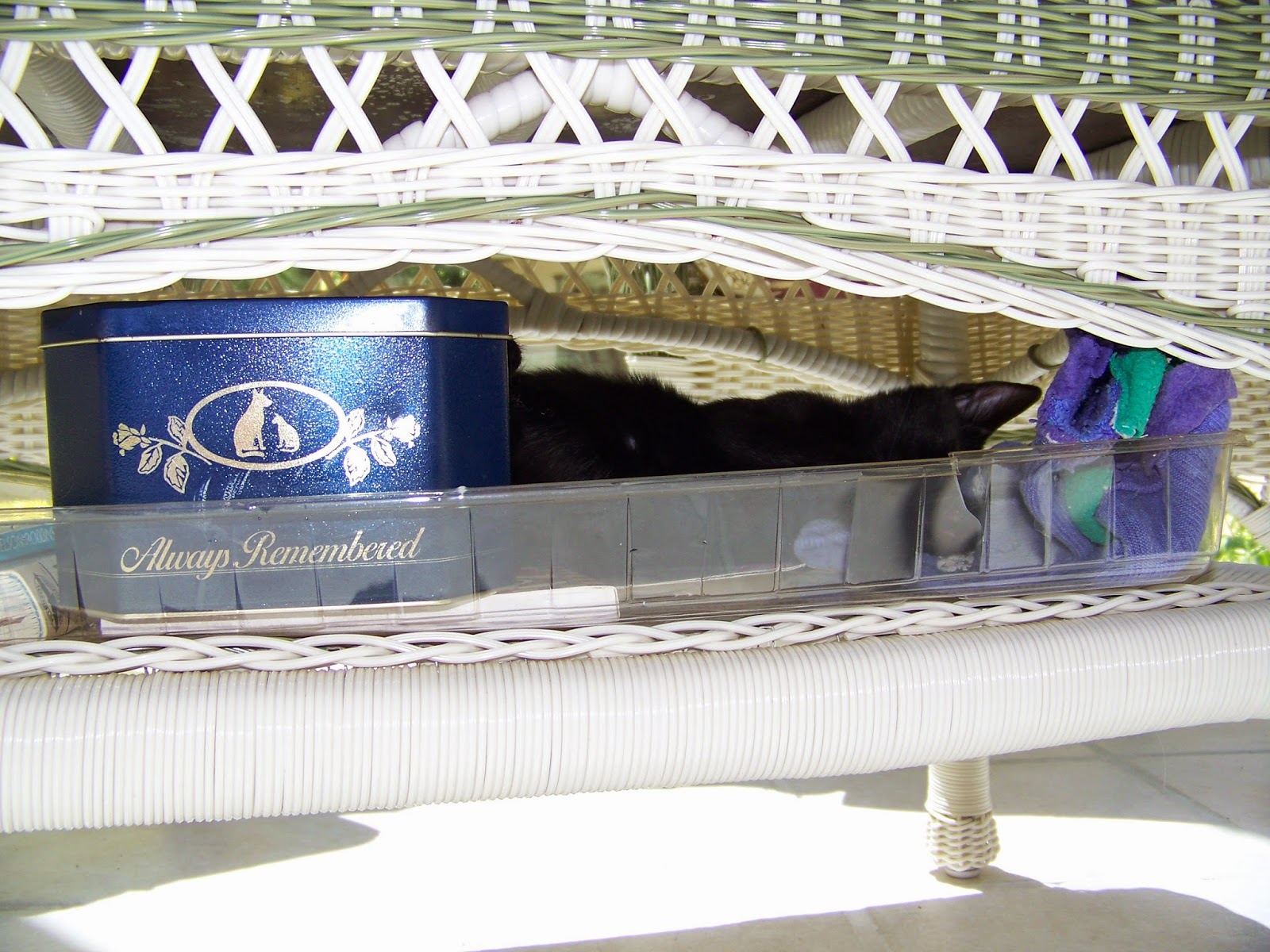
Fuqua, Napping Next to Josef's Ashes

A secret napping spot of our youngest cat, Fuqua (3 years old next month), is in the sunroom on the little underneath shelf of the wicker coffee table, wrapped around the can containing the ashes of our dear old Josef cat (who died in 2007 at age 19). As my sister Peggy said: "I find there are very few coincidences in this universe. Sweet little Fuqua is probably channeling equally sweet little Josef."

Even though Fuqua never met Josef, he seems to sense that there is some kind of special connection on that shelf! Some of Josef's toys are there, and you can also see Josef's favorite purple socks with green cuffs, which he loved dragging around the house or bringing up and leaving beside my bed as a present. They actually had little kittens printed on them as part of the original design! Once again, it's as if he knew that those socks were meant for cats! Cosmic!

*********************

This post, long in the making, contains a selection of my favorite passages from Wild Swans: Three Daughters of China by Jung Chang, who grew up in the 1960s under the Maoist Regime. I highlighted so many paragraphs when reading this intense memoir, but have tried to focus on the most informative descriptions of what life was like for the author, her mother, and her grandmother -- the three wild swans of the title:

76: When hiding their Japanese friend from the Russians in 1945: "In case anybody asked, they would say she was my mother's cousin. The Chinese have so many cousins no one can keep track of them."

81 - 83: For a short time back in 1946, Chang's mother dated a young man named Mr. Liu, "who was about nineteen [and] seemed to be a man of the world; he was wearing a dark - green suit with a handkerchief sticking out of his breast pocket, which was tremendously sophisticated and dashing for a provincial town like Jinzhou. He was enrolled in a university in Peking, where he was reading Russian language and literature. My mother was very impressed with him . . . ."

But after a few months, despite his "urbanity . . . my mother felt he was shallow. She noticed that he never went to Peking, but lounged around at home enjoying the life of a dilettante. One day she discovered that he had not even the The Dream of the Red Chamber, the famous eighteenth - century Chinese classic, with which every literature Chinese was familiar. When she showed how disappointed she felt, young Liu said airily that the Chinese classics were not his forte, and that what the actually liked most was foreign literature. To try to reassert his superiority, he added: 'Now have you read Madame Bovary? That's my all - time favorite. I consider it the greats of Maupassant's works.'

"My mother had read Madame Bovary -- and knew it was by Flaubert, not Maupassant. This vain sally put her off Liu in a big way . . .

"My grandmother . . . said, 'Who ever heard of a girl rejecting a man because he got the name of some foreign writer wrong?'"

99: " . . . the Chinese tradition made it virtually impossible to say no to a relation. The obligation to one's family and relatives always took precedence over one's own moral judgment."

114 - 15: "From the moment the Communist forces arrived [in 1948], my mother had been longing to throw herself into working for the revolution. She felt herself to be very much a part of the Communist cause. After some days of waiting impatiently, she was approached by a Party representative who gave her an appoint to see the man in charge of youth work in Jinzhou, a Comrade Wang Yu."

"My mother set off to see Comrade Wang one morning on a mild autumn day, the best time of year in Jinzhou. The summer heat had gone and the air had begun to grow cooler, but it was still warm enough to wear summer clothes. the wind and dust which plague the town for much of the year were deliciously absent."

125: "She was both soft - spoken and persuasive, and also, something rare in China, precise. This was an extremely important quality for him, as he hated the traditional florid, irresponsible, and vague way of talking. . . . She was also attract by his conversation. He struck her as learned and knowledgeable -- definitely not the sort of man who would mix up Flaubert and Maupassant."

133 - 39: "My mother did not get on with some of her bosses in the Women's Federation. They were older, and conservative, peasant women who had slogged for years with the guerrillas, and they resented pretty, educated city girls like my mother who immediately attracted the Communist men. My mother had applied to join the Party, but they said that she was unworthy.

"Every time she went home she found herself being criticized. She was accused of being 'too attached to her family,' which was condemned as a 'bourgeois habit,' and had to see less and less of her own mother. . . .

"Just eighteen, recently married, and full of hope for a new life, my mother felt miserably confused and isolated. She had always trusted her own strong sense of right and wrong, but this now seemed to be in conflict with the views of her 'cause' and, of ten the judgment of her husband, whom she loved. She began to doubt herself for the first time. . . .

"From the very beginning of their marriage, there was a fundamental difference between my parents. My father's devotion to communism was absolute: he felt he had to speak the same language in private, even to his wife, that he did in public. My mother was much more flexible; her commitment was tempered by both reason and emotion. She gave a space to the private; my father did not. . . .

"My mother's joy at Liberation had turned to an anxious melancholy. Under the Kuomintang she had been able to discharge her tension in action -- and it had been easy to feel she was doing the right thing, which gave her courage. Now she just felt in the wrong all the time. When she tried to talk it over with my father he would tell her that becoming a Communist was an agonizing process. That was the way it had to be."

171 - 72: "In the Youth League my mother was working with people her own age. They were better educated, more carefree, and more ready to see the humorous side of things that the old, self - righteous peasant - turned - Party - official women she had been working with before.

". . . my mother was treated with more respect . . . As she grew to be more confident and to rely less on my father, she felt less disappointed with him. Besides, she was getting used to his attitudes; she had stopped expecting him always to put her first, and was much more at peace with the world."

221 - 22: "This absurd situation [transferring 100 million laborers from agricultural work into steel production in 1958] reflected not only Mao's ignorance of how an economy worked, but also an almost metaphysical disregard for reality, which might have been interesting in a poet, but in a political leaders with absolute power was quite another matter."

246: "As a child, my idea of the West was that it was a miasma of poverty and misery, like that of the homeless "Little Match Girl' in the Hans Christian Andersen story. When I was in the boarding nursery and did not want to finish my food, the teacher would say: 'Think of all the starving children in the capitalist world!' In school, when they were trying to make us work harder, the teachers often said: 'You are lucky to have a school to go to and books to read. In the capitalist countries children have to work to support their hungry families.' Often when adults wanted us to accept something they would say that people in the West wanted it, but could not get it, and therefore we should appreciate our good fortune. I came to think this way automatically. When I saw a girl in my class wearing a new kind of pink translucent raincoat I had never seen, I thought how nice it would be to swap my commonplace old wax-paper umbrella for one. But I immediately castigated myself for this 'bourgeois' tendency, and wrote in my diary: 'Think of all the children in the capitalist world -- they can't even think of owning an umbrella!' "

247: "My image of a foreigner was more or less the official stereotype: a man with red, unkempt hair, strange - colored eyes, very, very long nose stumbling about drunk, pouring Coca_Cola into his mouth from a bottle . . . Foreigners said 'hello' all the time, with an odd intonation. I did not know what 'hello' meant; I thought it was a swear word. When boys played 'guerrilla warfare,' which was their version of cowboys and Indians, the enemy side would have thorns glued onto their noses and say 'hello' all the time."

AND SO MANY MORE
. . . that I will continue to add when time allows . . .

Monday, June 30, 2014

Books My Mom Suggested

Eating Sweet Potato Fries with my Mom
at the American Diner in West Philadelphia, 1994


************************
One of Gerry McCartney's favorite jokes:

Two guys are sky - diving and their parachutes fail to open.
One says: "It's at times like these that I wish I'd listened to my mother."
The other one asks, "Why? What did she say?"
The first one answers: "I don't know; I never listened!"


Haha!

But seriously, I did listen when my mother recommended the following, though I must confess that so far I'm only about half - way through the list. You'll notice a strong emphasis on one of Mom's specialities, American History; so if you're in need of a beach book for the upcoming Fourth of July Weekend, you need look no further:

Having Our Say: The Delany Sisters' First 100 Years
by Sarah L. Delany and A. Elizabeth Delany

The twin narratives of two amazing African - American sisters -- Sadie (September 19, 1889 – January 25, 1999) and Bessie (September 3, 1891 – September 25, 1995) who forged successful, professional careers despite the discrimination they faced in post - slavery America. With fortitude, education, humor, and strong family ties, they let nothing stand in their way and lived to tell all!

The Egg and I
by Betty MacDonald

A highly entertaining collection of essays on the real - life trials and tribulations of chicken farming in the Great American Northwest.

My favorite lines on the joys of life in the country:
Jerry: "I think this is an idea spot to do penance in,
but a hell of a place to live."

Jerry's wife: "But Jerry, this moonlight, the mountains,
the quiet and the food! It's like something you dream about."

Jerry: "Uh - huh, but we'd rather have a peanut butter sandwich
in Grand Central Station, wouldn't we Betty?"
(p 190)

I was reminded of another favorite quotation,
this one from the French painter Edouard Manet ((1832–1883):
"The Countryside only has its charms
for those not obliged to live there."

No Survivors
by Will Henry

Old Jules
The Battle of Little Big Horn
Crazy Horse: The Strange Man of the Oglalas
all by Mari Sandoz

Valley of Decision
by Marcia Davenport

"Reading . . . began to fill more and more of her time. . . . Now she realized in a few extraordinary hours that she need no longer spend her empty leisure time grinding her problems over and over in her head. She could sit on the straight - backed chair in her cramped room, with a book between her hands, and literally step off the planet of her everyday life into intoxicating space" (111).

"It smells good here," she said.
It did. It had the indefinable smell of a perfectly - kept, well - loved American home; and the smell found nowhere else on earth. A smell of cleanliness and polish and Ivory soap and potted plants and baking bread -- the sweet warm smell of simplicity and abundance. . . . everything in the room felt kind and gentle and safe
" (407).

Not As a Stranger
by Morton Thompson

Dress Gray
Full Dress Gray
both by Lucian K. Truscott