Wednesday, May 31, 2023

Life Stories

Classy Gift from a Classy Friend
an intriguing mystery in verse,
complete with whimsical illustrations
and this stylish cover design!
Thanks to my friend Megan --
a good sport, a good writer, an intense reader,
and a guest blogger -- for the above clever diversion
and for following serious suggestions:

Megan: I am delving into autobiographies and biographies right now. Listening to them when I'm out walking daily is a great way to enjoy them. I was doing podcasts before that and decided to try some audiobooks:
First I tried Einstein's but found it too technical! Haha!

Warren Buffett's 800 pager was great in my opinion.

Melinda Gates: The Moment of Lift: How Empowering Women Changes the World was excellent and I highly recommend.

Now I'm on The Code Breaker: Jennifer Doudna, Gene Editing, and the Future of the Human Race by Walter Isaacson (Re CRISPR).
Megan: One of my favorite thrift stores has softcover books for 25 cents & hardcover for a dollar. I'm thankful that there seems to be a biography reader in the neighborhood!
I have Mark Twain's autobiography sitting on my nightstand -- several tomes! I'm sure they'll be really entertaining though.

Just finished Johnny Cash's short biography. Tina Turner's is sitting here as well, coincidentally since she had just passed away this week. My neighbor was throwing those out so I grabbed them, even though musicians are not a typical choice for me.

I read Audition: A Memoir by Barbara Walters earlier in the year, before she died. That was super interesting since I knew all the famous players that she was interviewing and had stories of! Couldn't believe she died a short time later and that she was 93! What a life she had, a groundbreaker for women in journalism and in the world!

I've also noticed that there seems to be a Larry McMurtry reader in the neighborhood too. I read one of his novels a long time ago for a book club and found him to be a beautiful writer; but these are cowboy stories, not biographies, so I'm passing on McMurtry for the moment.
My friend Beata
recommends this one:

One more bio / autobio
for summer reading:

Thanks to our friends Michele & Stephen,
and to Gerry for sharing this one with me:
Favorite passage:
"I enjoyed the rhythms [of the flight drills],
the poetry, the meditative chant of it all.
And I found deeper meanings in the exercise.
I'd often think: It's the whole game, isn't it?
Getting people to see the world as you see it?
And say it all back to you?
" (127)

Interesting comparison of Harry's book
to Bridget Jones' Diary

I find this connection especially appropriate
because no one wrote more sensitively about
the death of Diana than Helen Fielding did in
the sequel: Bridget Jones: The Edge of Reason

Sunday, April 30, 2023

Way Back Books

The Girl Needs a Book!
Do You Remember When

You can pretty much count on it that someone, somewhere is always looking back nostalgically. According to our wisest poets, nearly anything at any time can bring on a backward - glancing case of "Nostalgia." You can even feel nostalgia for nostalgia: "Man. When I was a kid, nostalgia was a lot better than that." Thus concludes a reader last month in the comments following "Nostalgia economics is totally wrong," a pertinent essay by journalist Matthew Yglesias that turned up in my mailbox last month.

Around the same time, more nostalgia arrived in the form of "Grandpa," a memoir from my friend Gene Ziegler, complete with this helpful etymology:

Nostalgia,
from the Greek nostos (meaning homecoming)
and algos (meaning pain).

Gene's thesis: maybe there's a way to "remember the homecoming part and block out any pain." For the sake of his grandchildren and great - grands, he captures what it was like growing up in Allentown, PA, in the 1940s, back when a happy home included one bathroom for all, an icebox -- not a refrigerator, a radio -- not a television, a front porch -- not an air-conditioner, a clothes line -- not a dryer, a party line -- not a cellphone, but even so, one of the only phones on the block, so nothing to sneeze at! Looking back, Gene concludes:
These may seem like hard times by today’s standards, but they didn’t seem so at the time. I never thought of us as poor, never went hungry, never felt deprived of things I wanted or needed. I never felt threatened or unloved. Life was just simpler then. I’d have my trolly car back in a heartbeat.
I, too, could remember all those things; and what I wouldn't give for a trolley line! I also have Gene to thank for sharing the above Weekly Reader cover of yesteryear, which took me straight back to elementary school, homecoming pain and all. How could I have forgotten about that! The Weekly Reader made us feel so grown up and important. How exciting when it was delivered (every Friday?) to our classroom.

One year we even got to “subscribe” and save each issue in a special binder, so at the end of second grade, we had “the year in review.” I saved mine for ages, but sadly ditched it somewhere along the way, probably in one of my college moves. That Weekly Reader collection is definitely on the list of things I've thrown away and later wished to have back again, along with my junior high art portfolio. What was I thinking? No doubt, the Weekly Readers live on, somewhere online. But the artwork? Only in my mind.

"Never such innocence again . . ."

*************

Of all the reading I have been doing lately, here are three titles -- one memoir and two historical novels -- filled with nostalgia for an earlier, happier time:

1. Way back -- when Billy Crystal was a kid:

700 Sundays
by Billy Crystal (b 1948)
84: "They [his parents] met at Macy's in 1935. They both worked there. Dad was in the legal department and my mom was in notions. She has this little notions counter where she sold stray thoughts, concepts and ideas." (84)

48: Billy describes the iconic moment in his childhood when none other than the legendary Billie Holiday (who was friends with his father) took him to see Shane at the movie theater. As the movie draws to a close and Shane rides off into the sunset, "Miss Billie whispered in my ear, 'He ain't never coming back.'"

56: "Heroes don't have to be public figures of any kind. Heroes are right in your family. There's amazing stories in all of our families, you just have to ask, 'And then what happened?'"

69 - 71: "May 30, 1956. Dad takes us to our first game at Yankee Stadium. . . . Someone took my program into the clubhouse, and it came out with several autographs on it, most notably Mickey Mantle's."

78 - 79: ". . . Remember that program Mantle signed in 1956? Well in 1977 . . . Mickey was a guest on the Dinah Shore show [along with Billy Crystal], and I brought the program, and he signed it again, 21 years later. We became good friends.

"In 1991 . . . an original seat from Yankee Stadium . . . was given to me. . . . Mickey signed the seat for me. It reads, 'Billy, wish you were still sitting here, and I was still playing.' When Mickey died, I thought my childhood had finally come to an end."

2. Way back --

Before We Were Yours (2017)
by Lisa Wingate (b 1965)
Unlocking the cottage after a long absence:
139: "Bitter and sweet. Familiar and strange. The tastes of life."

When she loses sight of her little sister:
157: "The big boys don't answer when I ask where she is.
They just shrug and go on playing a game of conkers with the buckeyes
they pick up by the back fence.


Wondering why she doesn't
come to the beach more often:

114 - 115: "The answer tastes bitter, so I don't chew on it very long. Our schedules are always filled with other things. That's why.

"Who chooses the schedules we keep? We do, I guess.

"Although, so often it seems as if there isn't any choice."

3. Way back -- on "a March day that was like June" (88)

Mothering Sunday (novel: 2016 & movie: 2021)
by Graham Swift (b 1949)
3: "Once upon a time, before the boys were killed and when there were more horses than cars, before the male servants disappeared and they made do . . . with just a cook and a maid"

37: "All of her life she would try to see it, to bring back this Mothering Sunday, even as it receded and even as its very reason for existing became a historical oddity, the custom of another age."

117 - 18: "It was Mothering Sunday [March, 30] 1924. A different thing from the nonsense they call Mother's Day now. And she had no mother, you see. She was raised in an orphanage, then put into service. Another phrase you don't hear often these days."

The day she was born:
123: "It was hard to think now of a time when half the world was 'in service.' She was born in 1901 . . . and she would grow up to become a maid, which anyone might have predicted. But to become a writer -- no one could have predicted that."

The day she first saw herself as herself,
physically and intellectually:

87: "She had never before had the luxury of so many mirrors. She had never before had the means to view her whole unclad self. All she had in her maid's room was a little square of a mirror, no bigger than one of the hall tiles.

"This is Jane Fairchild! This is me
!"

The day her boss offered
her a secondhand typewriter:

135: "And that, you might say, was when she really became a writer. The third time. As well as at birth. As well as one fine day in March, when she was a maid."

122: "This was the great truth of of life, that fact and fiction were always merging, interchanging. And if you were a maid you weren't given [your birthday] off. And being a maid was a little like being an orphan, since you lived in someone else's house, you didn't have a home of your own to go to.

"Except on Mothering Sunday. When you did get the day off, to go home to your family. Which would always put her at a bit of a loss."
*************

In a similar vein: A "kind of monument to loss," the following poem by Philip Larkin captures "all that accumulated loss and grief" (124) that comes to the surface in Swift's Mothering Sunday.

MCMXIV

Those long uneven lines
Standing as patiently
As if they were stretched outside
The Oval or Villa Park,
The crowns of hats, the sun
On moustached archaic faces
Grinning as if it were all
An August Bank Holiday lark;

And the shut shops, the bleached
Established names on the sunblinds,
The farthings and sovereigns,
And dark-clothed children at play
Called after kings and queens,
The tin advertisements
For cocoa and twist, and the pubs
Wide open all day;

And the countryside not caring
The place-names all hazed over
With flowering grasses, and fields
Shadowing Domesday lines
Under wheat's restless silence;
The differently-dressed servants
With tiny rooms in huge houses,
The dust behind limousines;

Never such innocence,
Never before or since,
As changed itself to past
Without a word—the men
Leaving the gardens tidy,
The thousands of marriages
Lasting a little while longer:
Never such innocence again.


Philip Larkin (1922 - 1985)

Friday, March 31, 2023

Like Absinthe

The Garden of Eden
Woman with the Basket (1927)
by Juan Gris (1887 - 1927)

After failing to enjoy Garden of Eden as much as she thought she would, a friend of mine wrote to air her grievances and ask for advice about Hemingway:
"The best thing about this book is its cover! I was taken by the great art. And I adore baskets. But like baskets -- with naturally occurring holes -- this book has some miscues. It has some lapses for sure -- no wonder -- Hemingway had worked on it on and off for feefteen years (that’s purposely done)! That’s right! I have a right to be angry because women don’t behave as he portrays! And during those same 15 years, surprisingly, he also wrote and published The old Man and the Sea. I’m already sick of the absinthe and martinis coming from every other page -- brace yourself; drinks on you! So much more annoyed than I would be out on the sea with the old man."
My honest advice: I think it’s safe to say that you have given this book a fair chance, and you should now feel free to put it down without finishing! In fact, you are free to move on to another author completely and leave Hemingway behind. You gave it a try — that’s more than most!

I agree that it’s a lovely painting on the cover! I must confess that I have never read this novel, and per your review, I won’t be bumping it up to the top of my reading list!

It’s funny you should say that about absinthe because my favorite line in all of the Hemingway that I have read (I certainly cannot claim to have read the complete works) is from the short story "Hills Like White Elephants," in which the girl wants to try an absinthe flavored drink called “Anis Del Toro.”

When the drinks come, her boyfriend asks how it tastes.

"It tastes like licorice," the girl said and put the glass down.

“That's the way with everything."

“Yes," said the girl. "Everything tastes of licorice. Especially all the things you've waited so long for, like absinthe."

The boy is trying to pressure the girl into terminating her pregnancy, and those lines totally capture the sadness of their relationship (and accurately sum up my feelings about black licorice).

Another sad one is "In Another Country," about soldiers getting experimental rehab for lost limbs. The story concludes with another unforgettable one - liner from Hemingway: “I am utterly unable to resign myself.” That breaks my heart every time.

You can pull these stories up for free on line if you want to read them (click titles above). They are very short, but also very sad. Still, I would recommend them, and you might like them more than “Garden of Eden.”

The sadness of Hemingway's wounded vet reminds me of this line from Cicero (106 - 43 BC), concerning the death of his adult daughter, who died shortly after childbirth: " . . . he read everything that the Greek philosophers had written about overcoming grief, ‘but my sorrow defeats all consolation.’ ”

Another sad one:
"A Clean, Well - Lighted Place"

The Van Gogh paintings capture the tone:
Café Terrace at Night, 1888
by Vincent Van Gogh (1853 - 1890)

Exterior vs Interior

Saturday, February 25, 2023

Cassandra, Gemma, Tamara

What I want for Christmas (only 10 short months away):
a film version of Cassandra Darke
so I can add it to my long list of Scrooge favorites.

TO DO LIST for a fun start to the New Year: First, go ahead and read Cassandra Darke while it's still wintry outside. It won't take long, and it will inspire you "to keep Christmas in your heart all the year."

Next, take a look at these books and movies, in which Posy Simmonds -- cartoonist, illustrator, and writer extraordinaire -- re-enlivens Emma Bovary and Bathsheba Everdene. In her clever and crafty retelling of each story, Simmonds shifts their 19th century troubles into conflicts more pertinent and accessible -- and entertaining! -- to a 21st century audience.

Project #1
read Madame Bovary by Gustave Flaubert (1856)
watch the film -- so many good versions, pick one or more
read Gemma Bovery the graphic novel by Posy Simmonds (1999)
watch the film (2014)

Project #2
read Far From the Madding Crowd by Thomas Hardy (1874)
watch the film --so many good versions, pick one or more
read Tamara Drewe the graphic novel by Posy Simmonds (2005)
watch the film (2010)

Extra Credit Project
No Posy Simmonds tie - in for this one,
but still a most enjoyable sequence:
read Emma by Jane Austen (1815)
watch one of the many good versions of the film
watch Clueless (1995)

*************************

I do have one quibble about the email that the juvenile delinquents send from Tamara Drewe's laptop. The subsequent action depends entirely on all three recipients knowing that all three of them have received the message. But look at the drawing: Andy has been bcc'd -- meaning that he would NOT know about the other two and the other two would not know about him. How could clever Posy Simmonds make such a crucial mistake -- and her editors let her down like this? My guess is that Simmonds thought the drawing would have a cute symmetrical look with one guy's name on each line of the email header, without stopping to think that it wouldn't make sense that way.

In the movie, it doesn't matter, because we hear the event described in conversation; but in the book, seeing the "bcc" totally botches the meaning. Has anyone else noticed? I can't find any reference to it as a "blooper," not even in this otherwise thorough review of the book:
"Jody opens up Tamara’s email and – drunk – addresses an email to Ben, Nick and Andy, subject: ‘Love’, text: ‘I want to give you the biggest shagging of your life’. And before petrified Casey can stop her, Jody presses send. Because she cc-ed the others, all three can see the message was sent to the other two as well as themselves."
No! Incorrect! This description does NOT reflect what the drawing indicates. I'd feel better if the reviewer [Simon at astrofella] had read the text carefully enough to detect the error, as I did. Instead, it seems that he and perhaps most readers simply make a mental correction and move right along -- or maybe don't notice it at all.

In addition to overlooking the "bcc" mistake, Simon refers to Tamara as being on the phone to her mother, which can't be right because her mother is dead! I'm curious to read his long reivews of Gemma Bovery and Cassandra Darke, but I shall proceed wary of unreliable narration and less than careful attention to detail!

*************************

On the topic of carelessness, language blogger Brandon Robshaw [here's a good one] was recently calling out the error of referring to suffragist Emmeline Pankhurst as "Emily."

My thoughts in response: "Brandon, like you, I am a watchdog for sexism; but in this case, I might attribute the error to sheer carelessness.

"Emmeline Pankhurst was real, and deserves to be called by her name. Yet, even in fiction, such carelessness is frustrating. I recently read an otherwise well – written novel that confuses “Cc” and “Bcc” as methods of sending an email, although the plot twist depends on who has seen which email. Apparently neither author nor editor nor proofreader (nor numerous tolerant readers) understand or care that a “Bcc” message would not reveal every other recipient. Careless!

"Searching for some commentary on this rather important mistake and its impact on the subplot, I read a serious review that glosses glibly over the “Bcc” error; and — insult to injury –goes on to refer to a deceased character as alive and speaking on the telephone. Careless, careless!

"As careful readers, I think we may underestimate the very high tolerance for carelessness."

Brandon: "Agreed: carelessness is infuriating to the careful."

Sunday, January 1, 2023

Little Match Girl

~ Reminds me of Philly ~
Thanks Nikki!
Painting by Richard Savoie

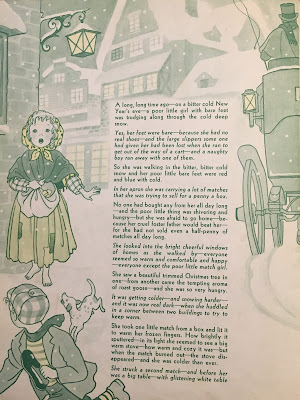
Last month, my sisters and I were reminiscing about various Christmas books from our childhood. One title that came to mind was The Little Match Girl by Hans Christian Andersen. This sweet, sad story has been illustrated, beautifully, many times over the centuries, but naturally, our holiday nostalgia tends toward the version we grew up with.

My younger sister, Diane, said to me,

"As a child,
I don't remember feeling happy when reading it.
Yet I was drawn to it."

She was curious to see once again the illustrations
imprinted in our collective memory:
Just as we remember!
The story appears in this anthology;
but, sadly, no artist's name is given.

For additional commentary
on the topic of children out in the cold,

take a look at this excellent blogpost
on "The Little Match Girl,"
Wordsworth, Dickens, and more:
Memories of Snow in Literature

Sunday, December 25, 2022

Little Golden Christmas

So many Little Golden Treasures,
re-discovered while sorting through
old Christmas storybooks from childhood:
See the inscriptions?
My sister Peggy's Little Golden
Christmas book from the 1950s,
and
her son Jerrod's Little Golden
Christmas book from the 1970s!

We all loved this one!
But did we know that it was illustrated
by the legendary Richard Scarry?
I don't think so!

I assumed that his popularity began when
our kids were small, not “back in the day”
when my siblings and I were little tykes!
~ Copyright 1950 ~
The page I remember best:
The apple in the snow!

Speaking of legendary,
when it comes to nostalgic illustrators,
no one compares to Eloise Wilkin:

If you no longer have every little
book from childhood, never fear!
This fun anthology is filled with favorite pages,
some long forgotten, some long - remembered!
The selections range from 1946 - 2011,
generations of Golden Christmas Memories!

Wednesday, November 30, 2022

New Blue Library

An Evening at Home, 1888
Sir Edward John Poynter (1836 - 1919)

Thanks to my friend and Patron of the Arts, Sir Igor
for choosing this beautiful blue library painting,
now on display in our new library, also painted blue!
See the painting on the shelf, just above
A Christmas Carol Pop-Up Book,
likewise a gift from Uncle Igor!
Just like the painting, the adjoining dining room
features an arched doorway and a gold ribbon mirror.
So, truly, this painting is perfect for this house!
Our Favorite Spot!
The library is lined with blue shelves,
upon which I have managed to alphabetize all the
fiction from Louisa May Alcott to Banana Yoshimoto.
With the non-fiction, I always have more trouble
sticking to the alphabet. In the end most of it
has made its way to various sub - categories
and groupings that may or may not make sense
to anyone else but me. But who's counting?
Also our favorite room for watching TV.
We went to the Habitat Re-Store,
found a 2nd - hand baby changing table;
and Gerry refinished it as a matching TV stand.
Configured differently than our previous
~ Magical ~ McCartney Addition ~
but an equally loveable space, in a different way.
Instead of a side porch - turned - nook, we have a
shelf - lined library - den - TV room - study - family room.
Or, as they say in England: The Snug
On the shelves . . .
A Note to my friend Kathie
[who sent me the Botero Set]

Can you see what's on the shelf just above the Botero? Books by Leonard Orr and his daughter Leah Orr. The dark blue Yeats and Postmodernism contains an essay by you and one by me; the orange one next to it, an essay by Joe Buttigieg! I bought Louisa May Alcott and Charlotte Bronte because the author refers to Celine Carrigan's work on the role of the governess in fiction. Right next to that is Victoria Amador's definitive bio of Olivia de Havilland: Lady Triumphant, Jan Donley's novel The Side Door, Terry Galloway's memoir Mean Little Deaf Queer, The Good Psychologist by Noam Shpancer, Lost Girls by Laurie Fox, and more!
P.S.
Reading in a Cozy Room