Showing posts sorted by relevance for query Atkinson. Sort by date Show all posts

Friday, July 31, 2020

CATCHING UP ON ATKINSON

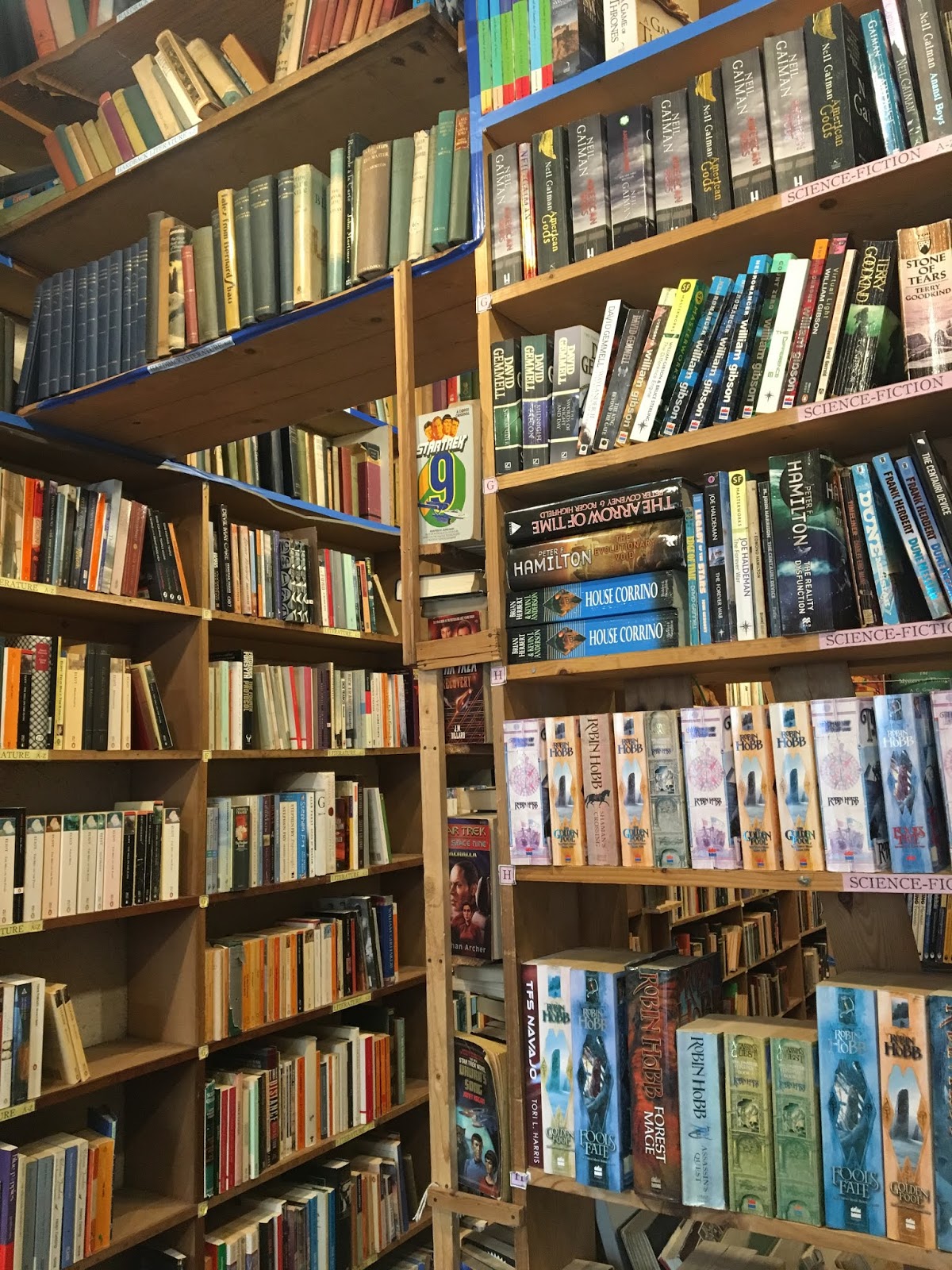
Charming, mysterious, irregular bookstore,
along the tourist path in Edinburgh; perfect for
browsing at leisure through the Kate Atkinson titles!
Armchair Books right next door to the
Afrin Barber, where Gerry got a shave

Scholarly, spell - binding, prize - winning,
can you ask for more than that?
The family sagas are filled with mystery,
the mysteries are filled with family drama.
Atkinson novels read to date:

~ 1995 ~ & ~ 1997 ~

In One Volume

Behind the Scenes at the Museum is a multi - generational novel, ranging from pre - WW I to the present, about all the women in a typical British family, containing lots of coincidences (in manner of Charles Dickens), centering around Bunty, who lost 2 of her 4 daughters in tragic accidents, narrated by one of her twin girls, starting in-utero.

Human Croquet is similar in scope and style, but a different family, with its own secrets, kept through the decades and slowly revealed to the reader, amidst the mysterious imagery of autumnal reverie, sleeping cats, and delicious babies.

[And: "How's my treasure? . . . He's edible, don't you think?" (p 78)
from the novel When Will There Be Good News?]

Next come the Scottish mysteries. If you don't already admire Kate Atkinson (b 1951) as one of the most literary authors on the shelf, then you've got to love her for creating Jackson Brodie (humble, lovable, cantankerous, heroic, damaged, striving) and Louise Monroe (independent, introspective, despondent, determined).

1. Case Histories
"She felt like someone who'd lost her way and ended up in the wrong generation. . . . She had read too much James and Wharton. No one in Edith Wharton's world really wanted to be there but Amelia would have got along fine inside an Edith Wharton novel. In fact, she could have happily lived inside any nineteenth - century novel. . . . she, in turn, wanted no one -- apart from men in nineteenth - century novels, which put a whole new spin on the idea of 'unattainable'" (130, 185).
2. One Good Turn
"Everything was connected.
Everything in the whole world
" (463).
(see this & more)

Near the end of One Good Turn,
Jackson recalls some lyrics from Cowboy Junkies:
"good news always sleeps till noon."
Bringing us to the next mystery in the series . . .

3. When Will There Be Good News?: All the major characters -- Jackson, Louise, Reggie, Joanna -- are readers themselves, carrying their own extensive frames of reference from which Atkinson allows them to make connections and share quotations. [Carnival ~ Carnage]

Numerous overlapping and leap - frogging memories tie the novels one to another: "'A coincidence is just an explanation waiting to happen,' Jackson Brodie had said to her once." When Louise makes this recollection in Good News (163, 319), I was delighted to flip back through Good Turn and reread the very conversation (343 - 44) to which Louise refers. Summarized here for you!

4. Started Early, Took My Dog
"Jackson's new pastime. Trains, coins, stamps, Cistercian abbeys . . . all part of the semi-autistic male impulse to collect -- a need for order or a desire to possess, or both. . . . the ruins had touched his soul in some inarticulate and melancholy place, the nearest thing to holiness for an atheistic Jackson. He missed God. But then who didn't? As far as Jackson was concerned, God slipped out of the building a long time ago and he wasn't coming back, but like any good architect, he had left his work behind as his legacy. North Yorkshire had been designed when God was in his pomp and each time that Jackson came here he was struck anew by the power that landscape and beauty had over him these days" (51).
More on photographs & lost youth
See poem by Emily Dickinson ~ in comments below
5. Big Sky

~ 2013 ~ & ~ 2015 ~

After the mysteries, Atkinson returns to her previous strength, another British family saga, spanning the world wars. These two novels are very good but sometimes almost too intriguing; and you can't expect the same sweetness as Behind the Scenes. Perhaps the nostalgic charm has been displaced by a graver, keener loss of innocence.

Both novels follow the impact of war upon each member of the Todd family, particularly Ursula in Life After Life and Teddy in A God in Ruins. Each novel is a companion to the other, though not necessarily a prequel or a sequel -- which would be unnecessary in any case, considering the ease with which these characters move through time. Not quite so easy for the reader, however, who must adjust to the timeless reality that past, present, alternative present, future -- all are one.

Also about WW2, but different characters: Transcription
Thanks to my sister - in - law Tina for highly and repeatedly recommending these books and to my friend Jonnie for jumping right in and reading everything by Atkinson at lightning speed; to my cousin - in - law Jonny for sharing his extra copy of One Good Turn and to Auntie Jan for the permanent loan of Started Early, Took My Dog.
P.S. Previous Catch - Ups

Bryson ~ Lamott ~ Sedaris

Wednesday, February 17, 2021

Carnival

Mardi Gras . . . Ash Wednesday . . .
"The farewell to flesh.
I dressed in feathers. Pointed beak and glitter.
How we danced, through lights and confetti.
The good-bye to the body.

Not forever, but for now
." (66)

~ Carole Maso ~ from AVA ~

[More on The Quotidian Kit]

Mardi Gras ~ Cat Mask ~ Previous Post
"'CARNAGE!,' the headline screamed above a full - color picture of a train carriage that was almost broken in two. Carnage from the Latin caro, carnis, meaning 'flesh,' Same root as carnival. 'The taking away of the flesh.' You couldn't really get two more different words than carnival and carnage. Everywhere -- well, perhaps not everywhere, not in Bangladesh, for example, but certainly in an awful lot of places -- they had some kind of carnival before Lent, but in Britain all you got were pancakes. (171)

"When he woke up, they told him about the train crash again. A nurse showed him the front page of a newspaper. 'CARNAGE!' it said. He couldn't remember what the word meant. Nothing to do with cars, he supposed. . . . It was mere luck that he was alive when others weren't, a momentary lapse in concentration from the Fates that had led to him surviving and not someone else. (182, 310)

"Reggie wanted to say that it was nothing to do with her, but it would have sounded churlish given the circumstances -- carnage, et cetera. (187)

" . . . a wedding ring that strangled your finger . . . Strangled, estranged . . . the words were very similar." (322)

~ Kate Atkinson ~
from When Will There Be Good News?
****************************

P.S.
2023
The Kiss (1870)
Auguste Toulmouche (1829 – 1890)

See also Raoul & Marguerite

Wednesday, December 31, 2025

The Midnight Blogpost

The Moon on New Year's Eve

If you're looking for something to read
when the clock strikes twelve, how about this novel
concerning the quirks and tweaks and funny tricks of time:

The Midnight Library by Matt Haig

At least 4 friends (Gene, Katy, Kerry, Laura), all on separate occasions, recommended this novel; plus, it was a clue on Jeopardy! so I knew it was going to be a good one. I admit that I was not consistently enamoured of Nora and the multiverse, but I was perpetually enthralled by the manner in which it brought to mind so many other things that I deeply love, such as
1. This poem by Ernest Sandeen

My Two Lives

The life I could have lived,
that other, better one,
is also mine. Who else
can claim it?
Each morning, stooping down,
I know that I am not worthy
to tie my own shoelaces.


Ernest Sandeen, 1908 - 1997
Notre Dame Professor and Poet

2. This poem by H. D.

Never More Will the Wind
Never more will the wind
cherish you again,
never more will the rain.
Never more
shall we find you bright
in the snow and the wind.
The snow is melted,
the snow is gone,
and you are flown:
Like a bird out of our hand,
like a light out of our heart,
you are gone.


by H.D. (aka Hilda Doolittle, 1886 – 1961)

3. The dreamy (also nightmarish) poetic novel:
Einstein's Dreams by Alan Lightman

4. The dreamy (also nightmarish) historical novel:
Life After Life by Kate Atkinson

5. The Mirror of Erised -- Desire reversed -- in the Harry Potter novels -- where Harry glimpses a chance for the desire of his heart: communication beyond the grave.

6. A few movies come immediately to mind:
Coherence, Sliding Doors, It's a Wonderful Life
-- and doubtless there are many, many more.

7. Who couldn't use a do-over, right?
In each of these narratives, the characters are able to visualize a world in which they make better choices, maximize their options, achieve better outcomes; and try, try, try again for a more palatable existence.

And that's what The Midnight Library is all about:
"Every life contains many millions of decisions. Some big, some small. But every time one decision is taken over another, the outcomes differ. An irreversible variation occurs, which in turn leads to further variations. These books are portals to all the lives you coud be living. . . . You have as many lives as you have possibilities. There are lives where you make different choices. And those choices lead to different outcomes. If you had done just one thing differently, you would have a different life story. And they all exist in the Midnight Library. They are all as real as this life.” (p. 31)
One of my favorite features is "The Book of Regrets." Although Nora is only 35 years old, her "Book of Regrets" is already so heavy that she can barely pick it up (p. 34). However, it gets lighter and lighter as she realizes that no matter what alternative life she may have chosen, it would not have been perfect (pp. 155, 266). In fact, those other lives may not have worked out well at all, so she can relinquish her regret -- based only upon imagination and lack of knowledge -- for not having chosen them. Similar to the Parable of the Cross is her discovery "that the place you wanted to escape to is the exact place you escaped from. That the prison wasn't the place, but the perspective.” (284)

Nora also learns some hard realities:

1. " . . . death is the opposite of possibility." (p. 69)

2. " . . . you can choose choices but not outcomes." (p. 83)

3. " [her] father . . . had been a difficult man. . . .
Nora had felt that simply to be in his presence
was to commit some kind of invisible crime
." (p. 87)

4. “'You’re overthinking it.’
‘I have anxiety.
I have no other type of thinking available
.'” (p. 109)

5. "'You might need to stop worrying
about other people's approval . . .
you don't need a permission slip to be your
--'" (p. 193)

6."Nora wanted to live in a world
where no cruelty existed, but the only worlds she had
available to her were worlds with humans in them
." (p. 197)

7."'It seems impossible to live with hurting people.'
'Well, in fairness, dying hurts people too.'"

At the core of the novel (truly, the exact half - way point!), Matt Haig presents his core message, in a short chapter entitled "Expectation":
“Nora had always had a problem accepting herself. From as far back as she could remember, she'd had the sense that she wasn't enough. Her parents who both had their own insecurities, had encouraged that idea.

She imagined, now, what it would be like to accept herself completely. Every mistake she had ever made. Every mark on her body. Every dream she had ever made. Every mark on her body. Every dream she hadn't reached or pain she had felt. Every lust or longing she had suppressed.

She imagined accepting it all. The way she accepted nature. The way she accepted a glacier or a puffin or the breach of a whale.

She imagined seeing herself as just another brilliant freak of nature. Just another sentient animal, trying her best.
And in doing so, she imagined what it was like to be free.
"
(p. 143)
The Full Moon After Yule

Are the library and librarian for real, or just a whirlwind vision, a frantic exploration of the dusty shelves before the clock strikes midnight?
"There is a chance that just before you die you'll get a chance to live again. You can have things you didn't have before. You can choose the life you want. . . . this whole library is part of you. Do you understand? You don't exist because of the library; the library exists because of you." It turns out that all Nora needs is "the book of her future . . . in this one that future was unwritten." The book of regrets can be left behind: "That is the last book you need. That will be ash by now. That will have been the first book to burn." (pp. 225, 265, 270 266)
The novel concludes optimistically:
She had to try harder. She had to want the life she always thought she didn’t. Because just as this library was a part of her, so too were all the other lives. She might not have felt everything she had felt in those lives, but she had the capability. She might have missed those particular opportunities that led her to become an Olympic swimmer, or a traveller, or a vineyard owner, or a rock star, or a planet-saving glaciologist, or a Cambridge graduate, or a mother, or the million other things, but she was still in some way all those people. They were all her. She could have been all those amazing things, and that wasn’t depressing, as she had once thought. Not at all. It was inspiring. Because now she saw the kinds of things she could do when she put herself to work. And that, actually, the life she had been living had its own logic to it. . . . What sometimes feels like a trap is actually just a trick of the mind. She didn’t need a vineyard or a Californian sunset to be happy. She didn’t even need a large house and the perfect family. She just needed potential. And she was nothing if not potential. She wondered why she had never seen it before.” (p 269)

Related reading for 2026:
The Personal Librarian (suggested by Igor)
by Marie Benedict and Victoria Christopher Murray.

Maybe after that, I'll look for something else
with the word Library or Librarian in the title!

Or perhaps the word Book
as in The Last Bookaneer by Matthew Pearl
recommended by Gene;

or the personification of text
as in Inkheart by Cornelia Funke,
from Katie

See previous book blogs:
January 2025: bookstore = cathedral
"If you are in a cathedral,
you are quiet because you are in a cathedral,
not because other people are there.
It's the same with a library
." (185)

Chernobyl:
"He seemed like he would be able
to sit in a field near Chernobyl and
marvel at the the beautiful scenery
." (204)
April 2016 & May 2016

& The Quotidian Kit:
Children in the Leaves & Straw

Some other lives for me:
stick with childhood swimming and piano
end bad relationships sooner
stay single longer
major in accounting
go to art school
accept offer to model for art class
go to Hallmark or Ideals

Sunday, December 30, 2012

Another Year Over

Time to winterize your croquet set!

Memorable Passages from Books Read in 2012

A Couple of Novels by Kate Atkinson

1. Human Croquet

109: "Eliza picked Isobel up from the counter and started nibbling her ear. Why, Vinny wondered, was Eliza always trying to eat bits of her children? What a tasty little morsel, Eliza murmured in Isobel's ear while Vinny patted butter aggressively, imagining it was Eliza's head. If Eliza wasn't careful, Vinny thought, she'd look around one day and discover that she'd eaten them all up."

131: "The sadness of autumn is in the air, the smell of woodsmoke and earth and things long-forgotten. Over our heads the first skein of geese (the souls of the dead) scissor through the air, heading for their winter home, north of Boscrambe Woods, the creaking noise they make engenders a fit of melancholy in both of us. The Dog lifts its head, watching them make their black wingprints across the sky and gives a sad little whine. 'Here comes winter,' Audrey says."

135: "Why do cats sleep so much? Perhaps they've been trusted with some major cosmic task, an essential law of physics -- such as: if there are less than five million cats sleeping at any one time the world will stop spinning. So that when you look at them and think, what a lazy, good - for - nothing animal, they are, in fact, working very, very hard."

2. Behind the Scenes at the Museum: I actually read this one back in 2002 and again in 2006, and have been meaning to read Human Croquet ever since. Finally, mission accomplished!


A Couple of Titles by Ann - Marie MacDonald

1. Fall on Your Knees

86: " . . . the mysterious population of that far - off place called the Old Country. A place better than any on earth, but a place you are nonetheless lucky to have escaped."

106: "On Christmas Day 1914, the British and the Germans had laid down their arms, climbed out of their trenches, and walked into No Man's Land. They met halfway between the lines, and exchanged gifts. Not so strange, considering that never before had so many nice men with families and decent job volunteered to face each other under arms across distances as brief and static as twenty yards. Such chocolate. Such bully beef. The truce was completely spontaneous and not repeated in anything like those numbers again -- somehow people can still get into the Christmas spirit when they've only been mowing each other down with ordinary bullets, but the festivity goes right out of the season once they've gassed each other."

174: "She still has all her dolls from when she was little. . . . there is Maurice, the organ - grinder's monkey; there is Scarlet Fever, the girl baby with the porcelain head; there is Diphtheria Rose . . . there are the twin sailors, Typhoid and TB Ahoy, and the little boy doll, Small Pox. There used to be a lovely lady doll in a ball gown, Cholera La France, but she got lost somewhere. In the pride of place is the flamenco dancer with her crimson dress and castanets. Spanish Influenza."

216: "When you're about to die and the priest comes and gives you extreme unction, he takes a set of clean underwear out of your drawer and blesses them. Then he puts them on you. Or if it's an emergency and there's no priest, anyone can bless the clean underwear. That's where Fruit of the Loom underwear comes from, it comes from the Hail Mary when you say, 'Blessed is the fruit of thy loom, Jesus.'"

239: "It's simple really: just don't move, and you won't do anything you'll regret later."

481: Actually, you smell like the sea. . . . it smell[s] . . . Like rocks. Like an empty house with all the windows blowing open. Like thinking, like tears. Like November."

2. Goodnight Desdemona (Good Morning Juliet)

7: "In neither play do the supposedly fate - ordained deaths of the flawed heroes and heroines, seem quite inevitable. . . . In both plays, the tragic characters, particularly Romeo and Othello, have abundant opportunity to save themselves. The fact that they do not save themselves, tends to characterize them as the unwitting victims of a disastrous practical joke. Insofar as these plays may be said to be fatalistic at all, any grains of authentic tragedy must be seen to reside in the heroines, Desdemona and Juliet."

The main character, Constance, is a sad Shakespearean academic whose theory is that Othello & Romeo Juliet would be comedies instead of tragedies except that both plays lack the character of the Wise Fool, whose role is to provide the characters with the information they need to avert tragic consequences. Constance then magically falls into the action of each of the plays and becomes the Wise Fool. She meets Desdemona and Juliet, introduces them to each other, and saves them from death. Voila - comedy! Very clever!

Years ago, I wrote something similar (though certainly not as clever) about the tragic heroine Anne Frankford in "A Woman Killed With Kindness" by Thomas Heywood (contemporary to Shakespeare). My complaint was that Anne is merely a character -- not a woman -- killed with kindness because Heywood leaves her woefully undeveloped and motive-less, using her only to serve the contrary and misogynistic point of his play. Who am I to criticize the master? Well, I am heartened to see that MacDonald also feels less than satisfied with the time - honored heroines. I applaud and recommend her most delightful re-write!

Similarly, in Reading Lolita in Tehran, Azar Nafisi writes of the tyrannical novelist "who shapes his characters according to his own ideology or desires and never allows them the space to become themselves" (249).

Similar also in Stoner by John Williams: Edith is cast as a bad wife and mother because the author feels that the story calls for such a damaged character. Stoner is a martyr to Edith's unkindness, but what motivates Edith? If she is "enigmatic," it is not as a character trait but as a lack of character devolpment.


A Couple of Heartfelt Memoirs

1. So Briefly An Eagle
by Don Carriker

A sad and beautiful tribute written by my Uncle Don (my dad's youngest brother) about their older brother Uncle Rudy who died in France in WW II.

2. Mourning and Dancing: A Memoir of Grief and Recovery
by Sally Downham Miller

Very sad. A local hero, gone too soon. This book was recommended to me in 2010 by a local friend who died unexpectedly in 2011. Strange. As if she knew.


A Couple of Funny Family Tales

1. Bossypants
by Tina Fey

The early coming - of - age chapters were the most fun, all about growing up right outside of Philadelphia in neighborhoods that I recognized from my West Philly years. The show - biz chapters, less fun. Maybe you had to be there. By the end, I wasn't calling my friends to say "buy and read!" the way I had been at the beginning!

2. Happy Birthday or Whatever:
Track Suits, Kim Chee, and Other Family Disasters

by Annie Choi

I enjoyed the adventures -- food, fashion, travel, education -- of this odd but smart, lovable family and am looking forward to reading her upcoming Shut Up, You're Welcome: Thoughts on Life, Death, and Other Inconveniences


A Couple of History Books

1. Unfamiliar Fishes
by Sarah Vowell

Before starting in on Hawaii, Vowell reminisces about majoring in French: "Affection for the French Enlightenment kind of comes with the diploma, along with a map of the Paris subway and a foolproof recipe for Proust's madeleines. One of my first homework assignments at college was to read Voltaire's Candide. I loved the book, but I especially loved discussing the book in class. I had spent my high school years trying to hide just how pretentious I was. So imagine my teenage glee at sitting in a fluorescent - lit room arguing about what Voltaire meant by 'we must cultivate our garden.' It occurs to me now that the novel is actually about an optimistic young person's disillusionment, but that irony was lost on me."

After reading Unfamiliar Fishes . . .

. . . you might want to take an hour to reread Candide, just for old time's sake, and as a reminder to count our blessings and cultivate our gardens and contemplate the best of all possible worlds. In the following storypeople story, Brian Andreas captures perfectly Candide's Dilemma:

Partial Enlightenment
The problem with knowing everything's
going exactly as it needs to is that
when you're not having that much fun
it doesn't even do any good to complain.

. . . and you'll wish that all of your history classes had been taught by Sarah Vowell . . . or Bill Bryson . . .

2. At Home: A Short History of Private Life
by Bill Bryson


A Couple of Conspiracy Theories -- or Not

1. Diana: Death of a Goddess
by David Cohen

Well, what can I say. Every now and then, I just have to read a Diana book. Talk about gone too soon. I passed this one on to my British father - in - law.

2. Killing Kennedy: The End of Camelot
by Bill O'Reilly

Very level - headed. No in - your - face agenda. One of my Christmas presents from Sam, which I read in conjunction with our visit to Dallas and New Year's Eve tour of the Book Depository and the Grassy Knoll. Next, I'll have to read O'Reilly's Killing Lincoln . . . but will it be better than Sarah Vowell's Assassination Vacation?
Wednesday, January 25, 2017

Three Christmases: Barbara G. Walker

Felt Skate, Cowboy Boot, Cowgirl

December's post, Three Christmases,
featured memories from Harry Leslie Smith & Ruth Wolff.
Now for number three:

3. In The Skeptical Feminist: Discovering the Virgin, Mother, and Crone, Barbara G. Walker (b. 1930, Philadelphia) describes the "typical middle - class American Christmases" of her youth:

40 - 42: "I used to be mystified by the slogan, 'Put Christ back in Christmas.' As far as I was concerned, Christ had never been in Christmas very much except as its mispronounced first syllable. At best he was only the infant portion of the formal mother - child symbol, representing the foundation of human -- not divine -- love.

"Had I been aware of the old pagan name of the Yuletide festival, matrum noctem or Night of the Mother, and the meaning of its ancient pre - Christian madonna and child idols, I would have understood more about my own special feeling for Christmas.

"My family treated Christmas as an intrinsically secular holiday celebrating the best in human feelings of kinship, love, joy, kindness, and appreciation of blood bonds without any reference to the Christian myth except for an appearance at church services. Our celebrations had their own rituals, meaningful for us, and a generally Dickensian - English, old - fashioned Christmas atmosphere of indiscriminate goodwill. My mother was the Fezziwig who made it work.

"My mother was the youngest of three sisters, all of whom raised their families within reachable distance of each other in different suburbs of the same city. Consequently aunts, uncles, and cousins were inevitably involved on Christmas Day. Christmas Eve, however, belonged to our household alone.

"Of course the festival began long before that: as soon as we began drawing up lists and keeping secrets, when mysterious packages were hidden away on high closet shelves and when rolls of bright wrapping paper and ribbon appeared. About a week before Christmas my mother and I had a wrapping session. Sitting amid a litter of paper string, tape, tags, cards, and assorted decorations, we happily toiled together for hours over the gifts, remaking prosaic boxes and other objects into things of satisfying, if ephemeral, beauty.

Court Jester and Blue Angels

"The end result was magic: perfectly ordinary things transmuted into shining, dreamlike talismans. . . . There can be no doubt that the gift - giving custom was and is the major source of children's happy memories of Christmas, the custom that fixes it in their minds for life as a benevolent, enjoyable time. Nonetheless, our traditions included much more than gifts.

"The real excitement began on Christmas Eve, the matrum noctem of our pagan ancestors, who revered the mystery of birth above the character of the one born. I would wake on the morning of December 24th with the pleasantly squiggly inner feeling that this would be one of the best days of the year: a day of fun, irradiated by anticipation of the morrow.

"The first project was setting up the tree . . . For a few years when I was very small, I believed that Santa Claus trimmed the tree in the night because it appeared like magic on Christmas morning: a whole fairy - tale world of light and color where an ordinary end table had stood the day before. My parents soon dispensed with Santa Claus, however, and enlisted my aid in building this particular fairy - tale world."

Geisha, Nutcracker, Court Jester
[I would love to simply type up this chapter in its entirety because Walker so beautifully and thoroughly describes the perfect Christmas! I'm sorry to leave out a single detail, though I should probably move along a bit more quickly and gloss over the next few pages, in which Walker describes so many lovely activities and customs, but one in particular that was entirely new for me this year: " . . . lighting the bayberry candles in the bathtub where they could safely burn unwatched all night!]
45- 46: "On the whole ours were typical middle - class American Christmases: not unique, not sacred, not particularly religious. They could easily be criticized as commercial, and overindulgent. My mother used to say, 'Christmas is for the children.' Children were hardly expected to comprehend the improbable doctrine of a woman impregnated by a god without sexual intercourse or to recognize in the resulting infant a future man whose death would be ordered by that same god to induce himself to accept human beings into heaven. Perhaps such doctrines would have strained even the uncritically receptive childish imagination.

For example, as parodied
by Rowan Atkinson and friends
in Blackadder's Christmas Carol:
"So, shall I begin the Christmas story?

"Absolutely, as long as it’s not that terribly depressing one about the chap who gets born on Christmas Day, shoots his mouth off about everything under the sun, and then comes a cropper with a couple of rum coves on top of a hill in Johnny Arab land.

"You mean Jesus, Sir…

"Yes, that’s the fellow. Keep him out of it — he always spoils the X-mas atmos."
Now, getting back to Walker:

"My cousins and I were not burdened by any such incredulities. At Christmas we simply and openly reveled in our childish acquisitiveness and sensual enjoyments, through which, somehow, the festival was transmuted into beautiful memories and tender sentiments, which we carried forward in time to our own children.

Glow - in - the - dark Stoplight ~ A Childhood Favorite

"I suspect that even people who think they put Christ in Christmas treat it, in practice, as a celebration of family feeling, bodily indulgence, and a catering to children's shallow joy. At Christmas most people pity the poor and lonely because they lack material goods and human relationships, not because they lack the salvation supposedly engineered by the Christ child, which was said to belong to all. In this we demonstrate an awareness that Christ is not going to make anyone happy in honor of the season. This responsibility must fall on human shoulders."

47 - 48: "But perhaps the very fact that Christmas has gone secular and commercial is directly related to the practical reality of its more recent implications. . . . Children really are delighted by their gifts. Grown - ups really do enjoy watching their pleasure. The decorations really are pleasant to contemplate. The family feasts really are fun. The warmth of friends and relatives reaching out to one another really exists. Though a Christ child may be taken as mere myth or symbol, children are certainly real and motherhood certainly is, psychologically and physiologically, the fountainhead of love: a fact that stands in need of much wider recognition in a patriarchal and alienated society. . . . Perhaps, after all, Christmas is not about gods or miraculous births or world - saving infants threatening evil kings. Perhaps it is only about people."

Gold Filagree Coffee Pot & Tea Pot